
Close Menu
    Facebook X (Twitter) Instagram
    SciTechDaily
    • Biology
    • Chemistry
    • Earth
    • Health
    • Physics
    • Science
    • Space
    • Technology
    Facebook X (Twitter) Pinterest YouTube RSS
    SciTechDaily
    Home»Space»“A Successful Failure” – NASA Commemorates 50th Anniversary of Apollo 13
    Space

    “A Successful Failure” – NASA Commemorates 50th Anniversary of Apollo 13

    By NASAApril 7, 2020No Comments3 Mins Read
    Facebook Twitter Pinterest Telegram LinkedIn WhatsApp Email Reddit
    Share
    Facebook Twitter LinkedIn Pinterest Telegram Email Reddit
    Apollo 13 Crewmembers
    S70-35614 (17 April 1970) — The crewmembers of the Apollo 13 mission, step aboard the USS Iwo Jima, prime recovery ship for the mission, following splashdown and recovery operations in the South Pacific Ocean. Exiting the helicopter which made the pick-up some four miles from the Iwo Jima are (from left) astronauts Fred W. Haise Jr., lunar module pilot; James A. Lovell Jr., commander; and John L. Swigert Jr., command module pilot. The crippled Apollo 13 spacecraft splashed down at 12:07:44 p.m. (CST), April 17, 1970. Credit: NASA

    As NASA marks the 50th anniversary of the Apollo 13 mission – which has become known as “a successful failure” that saw the safe return of its crew in spite of a catastrophic explosion – the agency is sharing a variety of resources, recognizing the triumph of the mission control team and the astronauts, and looking at how those lessons learned can be applied to its lunar Artemis program.

    “Our goal 50 years ago was to save our valiant crew after sending them around the Moon and return them safely to Earth,” said NASA Administrator Jim Bridenstine. “Our goal now is to return to the Moon to stay, in a sustainable way. We are working hard to ensure that we don’t need to respond to this kind of emergency in Artemis, but to be ready to respond to any problems we don’t anticipate.”
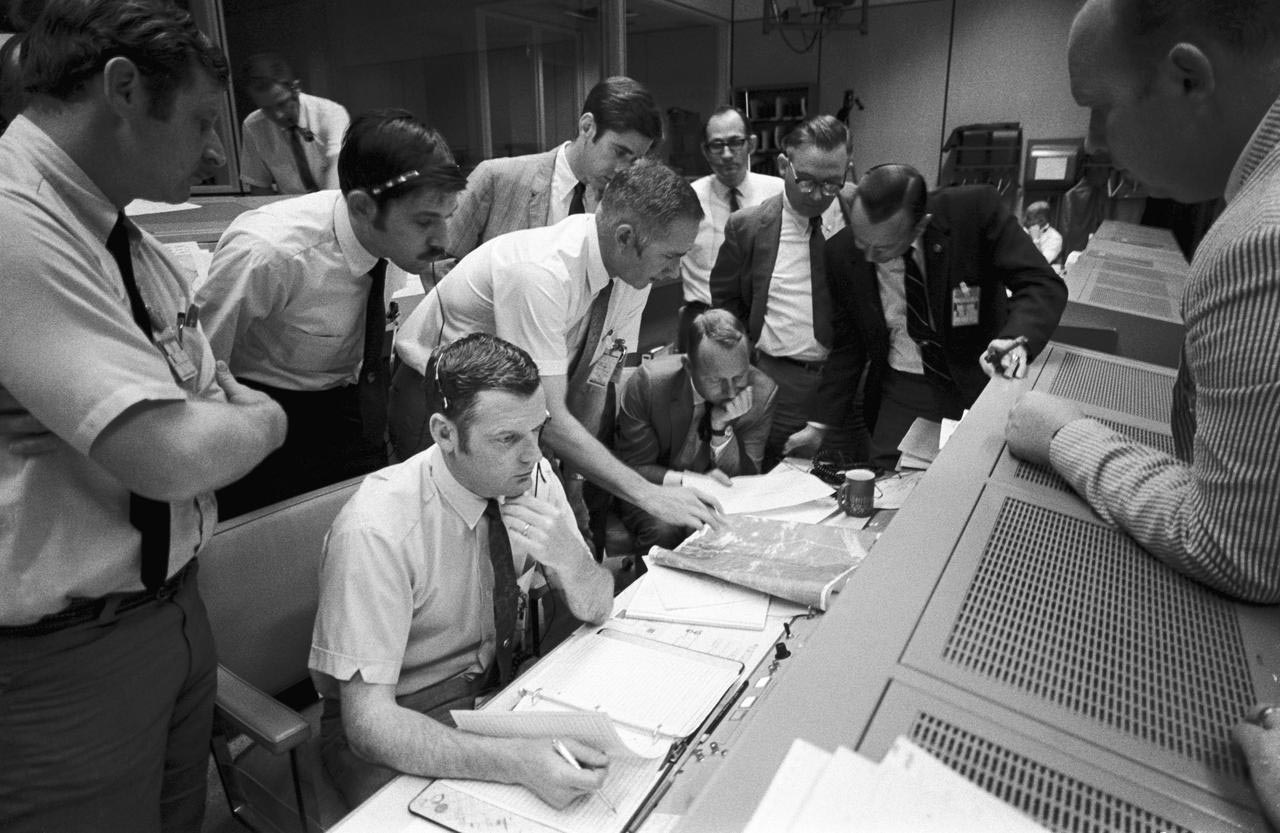
    Flight Controllers Apollo 13
    A group of flight controllers gathers around the console of Glenn S. Lunney (seated, nearest camera), Shift 4 flight director, in the Mission Operations Control Room (MOCR) of Mission Control Center (MCC), located in Building 30 at the Manned Spacecraft Center (MSC). Their attention is drawn to a weather map of the proposed landing site in the South Pacific Ocean. Among those looking on is Dr. Christopher C. Kraft, deputy director, MSC, standing in black suit, on right. When this photograph was taken, the Apollo 13 lunar landing mission had been canceled, and the problem-plagued Apollo 13 crew members were in trans-Earth trajectory attempting to bring their crippled spacecraft back home. Credit: NASA

    The crew of Apollo 13 consisted of Commander James (Jim) Lovell Jr., Command Module Pilot John Swigert Jr. and Lunar Module Pilot Fred Haise Jr. Their Saturn V rocket launched at 2:13 p.m. EST on April 11, 1970, from Launch Pad 39A at NASA’s Kennedy Space Center in Florida. The command module was named Odyssey, and the lunar module was named Aquarius.

    While en route to the Moon on April 13, an oxygen tank in the Apollo service module ruptured. The lunar landing and moonwalks, which would have been executed by Lovell and Haise, were aborted as a dedicated team of flight controllers and engineering experts in the Apollo Mission Control Center devoted their efforts to developing a plan to shelter the crew in the lunar module as a “lifeboat” and retain sufficient resources to bring the spacecraft and its crew back home safely. Splashdown occurred in the Pacific Ocean at 1:07 p.m. April 17, after a flight that lasted five days, 22 hours and 54 minutes.

    Never miss a breakthrough: Join the SciTechDaily newsletter.
    Follow us on Google and Google News.

    NASA
    Share. Facebook Twitter Pinterest LinkedIn Email Reddit

    Related Articles

    NASA’s Artemis II Cleared for Moon Flight As Orion Prepares for Critical Engine Burn

    NASA Artemis II Crew Scrambles To Fix Unexpected Toilet Failure in Space

    Liftoff! NASA’s Artemis II Launch Sends Astronauts Around the Moon for First Time in 50 Years

    Scientists Propose a Radical New Method To Find Alien Life

    NASA’s Psyche Could Reveal the Secret Inside This Metal World

    Mars Was Once Warm and Wet. NASA’s ESCAPADE Is About to Learn What Went Wrong

    NASA’s Curiosity Rover Discovers Spiderweb Ridges on Mars That Hint at Ancient Water

    NASA’s DART Impact Actually Changed an Asteroid System’s Orbit Around the Sun

    “At First, We Thought Something Was Wrong” – NASA DART Mission Reveals a Cosmic Snowball Fight

    Leave A Reply Cancel Reply

    • Facebook
    • Twitter
    • Pinterest
    • YouTube

    Don't Miss a Discovery

    Subscribe for the Latest in Science & Tech!

    Trending News

    Massive Study Warns Marijuana Use in Teens Is Linked to Serious Mental Illness

    Scientists Discover a Completely Unexpected Way T Cells Kill Cancer

    Scientists Just Found the Solar System’s Original “Planet Factory”

    Study Warns Widely Used Food Preservatives Linked to High Blood Pressure and Heart Disease

    New Treatment Could Reverse Osteoarthritis Within Weeks

    Physicists Have Measured “Negative Time” in Bizarre Quantum Experiment

    The Deadly Tapeworm Spreading Across America Has Reached the Pacific Northwest

    Could Low Vitamin D Be Making Your Pain Worse?

    Follow SciTechDaily
    • Facebook
    • Twitter
    • YouTube
    • Pinterest
    • Newsletter
    • RSS
    SciTech News
    • Biology News
    • Chemistry News
    • Earth News
    • Health News
    • Physics News
    • Science News
    • Space News
    • Technology News
    Recent Posts
    • Scientists Discover Mysterious Creature Living in the Great Salt Lake – and It Exists Nowhere Else on Earth
    • It’s Alive? Surprising Discovery Changes What We Know About Fog
    • Simple Family Routines May Be the Secret to a Smoother Start at School
    • Brain Study Overturns Long-Held Beliefs About How Humans Learn Speech
    • Ancient Goose Fossil Challenges Long-Held Theories About New Zealand Birds
    Copyright © 1998 - 2026 SciTechDaily. All Rights Reserved.
    • Science News
    • About
    • Contact
    • Editorial Board
    • Privacy Policy
    • Terms of Use

    Type above and press Enter to search. Press Esc to cancel.