
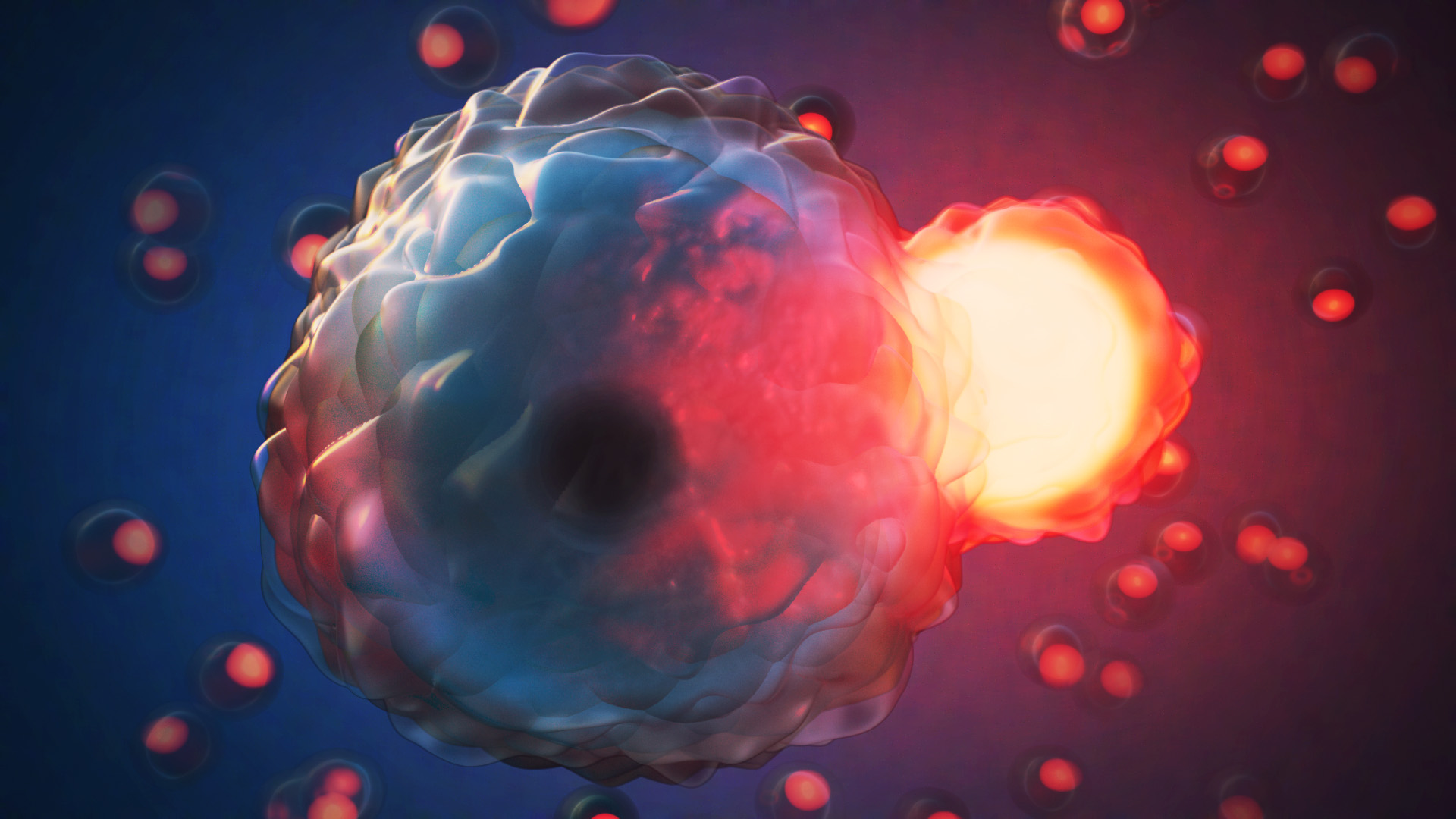
New research reveals that cell-in-cell phenomena, where one cell consumes another, are common across all life forms and important for normal biological functions, not just associated with cancer.
In a recent review paper, Carlo Maley and his team at Arizona State University explore the cell-in-cell phenomena where one cell engulfs and sometimes consumes another. The study shows that cases of this behavior, including cell cannibalism, are widespread across the tree of life.
The findings challenge the common perception that cell-in-cell events are largely restricted to cancer cells. Rather, these events appear to be common across diverse organisms, from single-celled amoeba to complex multicellular animals.
The widespread occurrence of such interactions in non-cancer cells suggests that these events are not inherently “selfish” or “cancerous” behaviors. Rather, the researchers propose that cell-in-cell phenomena may play crucial roles in normal development, homeostasis, and stress response across a wide range of organisms.
The study argues that targeting cell-in-cell events as an approach to treating cancer should be abandoned, as these phenomena are not unique to malignancy.
By demonstrating that occurrences span a wide array of life forms and are deeply rooted in our genetic makeup, the research invites us to reconsider fundamental concepts of cellular cooperation, competition, and the intricate nature of multicellularity. The study opens new avenues for research in evolutionary biology, oncology, and regenerative medicine.
The new research, published in the Nature journal Scientific Reports, is the first to systematically investigate cell-in-cell phenomena across the tree of life. The group’s findings could help redefine the understanding of cellular behavior and its implications for multicellularity, cancer, and the evolutionary journey of life itself.
“We first got into this work because we learned that cells don’t just compete for resources — they actively kill and eat each other,” Maley says. “That’s a fascinating aspect of the ecology of cancer cells. But further exploration revealed that these phenomena happen in normal cells, and sometimes neither cell dies, resulting in an entirely new type of hybrid cell.”
Maley is a researcher with the Biodesign Center for Biocomputing, Security and Society; professor in the School of Life Sciences at ASU; and director of the Arizona Cancer Evolution Center.
The study was conducted in collaboration with first author Stefania E. Kapsetaki, formerly with ASU and now a researcher at Tufts University, and Luis Cisneros, formerly with ASU and currently a researcher at Mayo Clinic.
From Selfish to Cooperative Cell Interactions
Cell-in-cell events have long been observed but remain poorly understood, especially outside the context of immune responses or cancer. The earliest genes responsible for cell-in-cell behavior date back over 2 billion years, suggesting the phenomena play an important, though yet-to-be-determined, role in living organisms. Understanding the diverse functions of cell-in-cell events, both in normal physiology and disease, is important for developing more effective cancer therapies.
The review delves into the occurrence, genetic underpinnings, and evolutionary history of cell-in-cell phenomena, shedding light on a behavior once thought to be an anomaly. The researchers reviewed more than 500 articles to catalog the various forms of cell-in-cell phenomena observed across the tree of life.
The study describes 16 different taxonomic groups in which cell-in-cell behavior is found to occur. The cell-in-cell events were classified into six distinct categories based on the degree of relatedness between the host and prey cells, as well as the outcome of the interaction (whether one or both cells survived).
A wide spectrum of cell-in-cell behaviors are highlighted in the study, ranging from completely selfish acts, where one cell kills and consumes another, to more cooperative interactions, where both cells remain alive. For example, the researchers found evidence of “heterospecific killing,” where a cell engulfs and kills a cell of a different species, across a wide range of unicellular, facultatively multicellular, and obligate multicellular organisms. In contrast, “conspecific killing,” where a cell consumes another cell of the same species, was less common, observed in only three of the seven major taxonomic groups examined.
Obligate multicellular organisms are those that must exist in a multicellular form throughout their life cycle. They cannot survive or function as single cells. Examples include most animals and plants. Facultative multicellular organisms are organisms that can exist either as single cells or in a multicellular form depending on environmental conditions. For example, certain types of algae may live as single cells in some conditions but form multicellular colonies in others.
The team also documented cases of cell-in-cell phenomena where both the host and prey cells remained alive after the interaction, suggesting these events may serve important biological functions beyond just killing competitors.
“Our categorization of cell-in-cell phenomena across the tree of life is important for better understanding the evolution and mechanism of these phenomena,” Kapsetaki says. “Why and how exactly do they happen? This is a question that requires further investigation across millions of living organisms, including organisms where cell-in-cell phenomena may not yet have been searched for.”
Ancient Genes
In addition to cataloging the diverse cell-in-cell behaviors, the researchers also investigated the evolutionary origins of the genes involved in these processes. Surprisingly, they found that many of the key cell-in-cell genes emerged long before the evolution of obligate multicellularity.
“When we look at genes associated with known cell-in-cell mechanisms in species that diverged from the human lineage a very long time ago, it turns out that the human orthologs (genes that evolved from a common ancestral gene) are typically associated with normal functions of multicellularity, like immune surveillance,” Cisneros says.
In total, 38 genes associated with cell-in-cell phenomena were identified, and 14 of these originated over 2.2 billion years ago, predating the common ancestor of some facultatively multicellular organisms. This suggests that the molecular machinery for cell cannibalism evolved before the major transitions to complex multicellularity.
The ancient cell-in-cell genes identified in the study are involved in a variety of cellular processes, including cell-cell adhesion, phagocytosis (engulfment), intracellular killing of pathogens, and regulation of energy metabolism. This diversity of functions indicates that cell-in-cell events likely served important roles even in single-celled and simple multicellular organisms well before the emergence of complex multicellular life.
Reference: “Cell-in-cell phenomena across the tree of life” by Stefania E. Kapsetaki, Luis H. Cisneros and Carlo C. Maley, 29 March 2024, Scientific Reports.
DOI: 10.1038/s41598-024-57528-7
Never miss a breakthrough: Join the SciTechDaily newsletter.
Follow us on Google and Google News.