
Close Menu
    Facebook X (Twitter) Instagram
    SciTechDaily
    • Biology
    • Chemistry
    • Earth
    • Health
    • Physics
    • Science
    • Space
    • Technology
    Facebook X (Twitter) Pinterest YouTube RSS
    SciTechDaily
    Home»Space»Adaptive Optics Improve Measurements of the Properties of Stars
    Space

    Adaptive Optics Improve Measurements of the Properties of Stars

    By National Optical Astronomy ObservatoryMay 2, 20131 Comment4 Mins Read
    Facebook Twitter Pinterest Telegram LinkedIn WhatsApp Email Reddit
    Share
    Facebook Twitter LinkedIn Pinterest Telegram Email Reddit
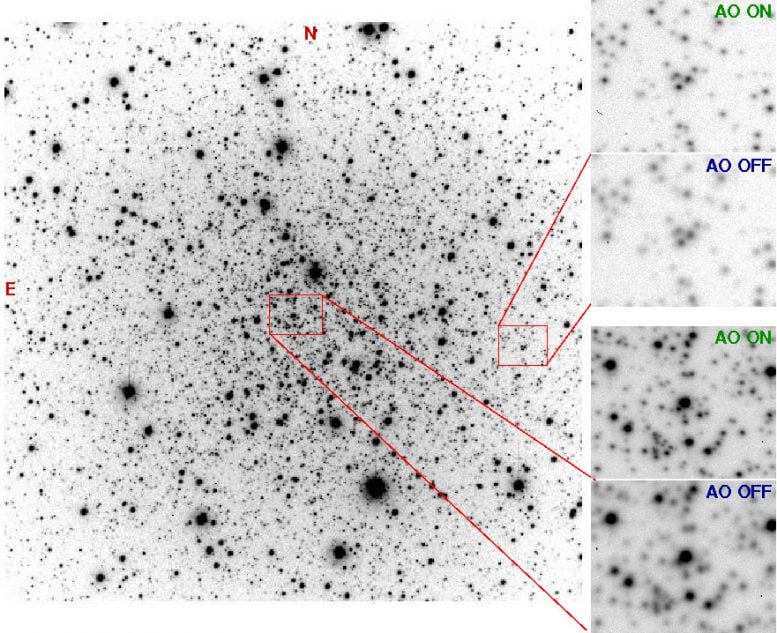
    Astronomers Observed Globular Cluster NGC 6496 Using a New Instrument Dubbed SAM
    The image is about 3 arc minutes across. The enlarged sections of the cluster show the image with SOAR adaptive optics (AO) on and off. Credit: NOAO/AURA/NSF

    Using a new instrument dubbed SAM, astronomers demonstrated the significant difference that sharp stellar images can make in our understanding of the properties of stars, allowing astronomers to make more precise measures of the colors of the stars and better measurements of distance, age, and metallicity of globular clusters.

    Astronomers at the Southern Observatory for Astrophysical Research (SOAR) and the Cerro Tololo Inter-American Observatory (CTIO) have demonstrated the significant difference that sharp stellar images can make in our understanding of the properties of stars. They have observed the globular cluster NGC 6496 using a new instrument dubbed SAM, for SOAR Adaptive Module, which creates an artificial laser guide star. SAM, built by CTIO/NOAO-S, is mounted on the SOAR 4.1-meter (13.5-foot) telescope.

    From the surface of the earth, stars twinkle as their image wobbles around due to the effects of the Earth’s atmosphere, rather like observing a penny on the bottom of a swimming pool. By removing this wobble, using an adaptive optics system that utilizes a laser guide star, the stellar images are sharpened, and fainter stars appear. The accompanying figure shows this globular cluster, and the difference between the image of NGC 6496 with the artificial laser-produced guide star turned on and off. Turning on the artificial guide star allows the effect of the atmosphere to be determined so that the adaptive optical system can sharpen the image.

    The resulting stellar images allow astronomers to make more precise measures of the colors of the stars, and for a globular cluster, this translates into a better measurement of distance, age, and what astronomers call metallicity: how much the stars are enriched with elements that are heavier than hydrogen and helium. This, in turn, allows for a better understanding of the stellar evolution of the stars in these dense clusters.

    There are only about 150 known globular clusters in the Milky Way, important because they represent some of the oldest objects in the Galaxy. Because NGC 6496 is on the other side of the Galactic center, it is seen through a thick layer of dust. The position of this globular cluster has made it difficult to determine its basic properties. For example, previous measurements of its distance do not agree well with each other.
    Astronomers Use Adaptive Optics to View Globular Cluster
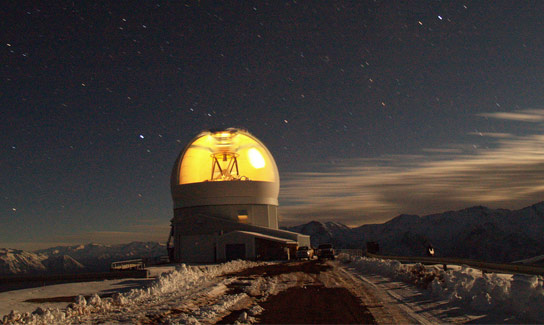
    Time exposure of SOAR telescope observing at Cerro Pachon in Chile. Credit: Daniel Maturana/NOAO/AURA/NSF

    Luciano Fraga, Andrea Kunder, and Andrei Tokovinin (in a paper accepted for publication by the Astronomical Journal) used the capabilities of SAM to sharpen star images to peer deep into this crowded cluster, obtaining more accurate results than done previously from the ground. The authors find a distance of 32,600 light-years, an age of 10.5 billion years, and a value for metallicity that is much higher than in most globular clusters. To do this, they measured over 7000 stars in the cluster. Then they plotted the colors and brightness of each star, resulting in a diagram referred to as a color-magnitude diagram. This diagram immediately tells astronomers a great deal about the evolutionary phase of the stars in the cluster.

    SAM works in the visible spectral region and can cover a field of 3 arc minutes, about one-tenth the size of the full moon. It compensates for the lower atmospheric turbulence by using an artificial guide star created by a powerful ultraviolet laser. While this technique, called adaptive optics, has been used on other telescopes before, SAM covers a wider field of view and shorter wavelengths.

    Reference: “SOAR Adaptive Optics Observations of the Globular Cluster NGC 6496” by Luciano Fraga, Andrea Kunder and Andrei Tokovinin, 13 May 2013, The Astronomical Journal.
    DOI: 10.1088/0004-6256/145/6/165

    Never miss a breakthrough: Join the SciTechDaily newsletter.
    Follow us on Google and Google News.

    Astronomy European Southern Observatory National Optical Astronomy Observatory
    Share. Facebook Twitter Pinterest LinkedIn Email Reddit

    Related Articles

    Supermassive Black Holes on a Collision Course: Closest Pair of Supermassive Black Holes to Earth Ever Discovered

    Black Hole Discovered Lurking in Star Cluster Outside Our Galaxy

    Discovery in a Galaxy Over 12 Billion Light-Years Away – Reveals How Element Found in Our Bones Is Forged in the Universe

    Strange 160 Mile-Long “Dog-Bone” Asteroid Kleopatra Captured in Detailed Images

    Astronomers Find Small Rocky Planet – Just Half the Mass of Venus

    First Clear Detection of a Moon-Forming Disc Around a Planet Outside Our Solar System

    Mystery Solved: Astronomers Unravel the Puzzle of Betelgeuse’s “Great Dimming”

    Stunning Galactic Fireworks: New ESO Images Reveal Spectacular Features of Nearby Galaxies

    Astronomers Were Puzzled by “Great Dimming” of Betelgeuse – Now the Mystery Is Solved

    1 Comment

    1. Game on May 2, 2013 7:58 am

      Thanks for this article.I love astronomy

      Reply
    Leave A Reply Cancel Reply

    • Facebook
    • Twitter
    • Pinterest
    • YouTube

    Don't Miss a Discovery

    Subscribe for the Latest in Science & Tech!

    Trending News

    Scientists May Have Found the Key to Jupiter and Saturn’s Moon Mystery

    Scientists Uncover Brain Changes That Link Pain to Depression

    Saunas May Do More Than Raise Body Temperature – They Activate Your Immune System

    Exercise in a Pill? Metformin Shows Surprising Effects in Cancer Patients

    Hidden Oceans of Magma Could Be Protecting Alien Life

    New Study Challenges Alzheimer’s Theories: It’s Not Just About Plaques

    Artificial Sweeteners May Harm Future Generations, Study Suggests

    Splashdown! NASA Artemis II Returns From Record-Breaking Moon Mission

    Follow SciTechDaily
    • Facebook
    • Twitter
    • YouTube
    • Pinterest
    • Newsletter
    • RSS
    SciTech News
    • Biology News
    • Chemistry News
    • Earth News
    • Health News
    • Physics News
    • Science News
    • Space News
    • Technology News
    Recent Posts
    • Scientists Discover Game-Changing New Way To Treat High Cholesterol
    • Breakthrough Drug Delays Rheumatoid Arthritis for Years After Treatment Ends
    • This Small Change to Your Exercise Routine Could Be the Secret to Living Longer
    • Physicists Discover a Strange New Kind of One-Dimensional Particle
    • Scientists Discover Unexpected Climate Benefit Hidden in Forest Soils
    Copyright © 1998 - 2026 SciTechDaily. All Rights Reserved.
    • Science News
    • About
    • Contact
    • Editorial Board
    • Privacy Policy
    • Terms of Use

    Type above and press Enter to search. Press Esc to cancel.