
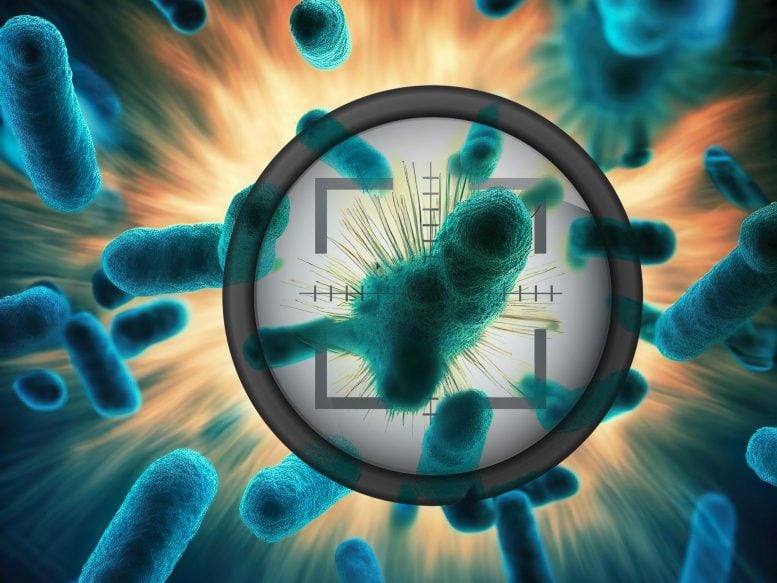
The machine-learning algorithm identified a compound that kills Acinetobacter baumannii, a bacterium that lurks in many hospital settings.
Using an artificial intelligence algorithm, researchers at MIT and McMaster University have identified a new antibiotic that can kill a type of bacteria that is responsible for many drug-resistant infections.
If developed for use in patients, the drug could help to combat Acinetobacter baumannii, a species of bacteria that is often found in hospitals and can lead to pneumonia, meningitis, and other serious infections. The microbe is also a leading cause of infections in wounded soldiers in Iraq and Afghanistan.
“Acinetobacter can survive on hospital doorknobs and equipment for long periods of time, and it can take up antibiotic resistance genes from its environment. It’s really common now to find A. baumannii isolates that are resistant to nearly every antibiotic,” says Jonathan Stokes, a former MIT postdoc who is now an assistant professor of biochemistry and biomedical sciences at McMaster University.
Acinetobacter baumannii is a species of bacteria commonly found in the environment, such as soil and water, but it can also inhabit human skin and healthcare environments. It’s known for its ability to survive on artificial surfaces for extended periods, making hospitals a common site for infection. It primarily affects people with compromised immune systems, causing a range of illnesses including pneumonia, blood infections, and meningitis. A. baumannii is particularly concerning because of its resistance to many antibiotics, leading to its classification as a “superbug.” As a result, infections can be challenging to treat, posing a significant threat to healthcare settings.
The researchers identified the new drug from a library of nearly 7,000 potential drug compounds using a machine-learning model that they trained to evaluate whether a chemical compound will inhibit the growth of A. baumannii.
“This finding further supports the premise that AI can significantly accelerate and expand our search for novel antibiotics,” says James Collins, the Termeer Professor of Medical Engineering and Science in MIT’s Institute for Medical Engineering and Science (IMES) and Department of Biological Engineering. “I’m excited that this work shows that we can use AI to help combat problematic pathogens such as A. baumannii.”
Collins and Stokes are the senior authors of the new study, which was published on May 25 in the journal Nature Chemical Biology. The paper’s lead authors are McMaster University graduate students Gary Liu and Denise Catacutan and recent McMaster graduate Khushi Rathod.
Drug Discovery
Over the past several decades, many pathogenic bacteria have become increasingly resistant to existing antibiotics, while very few new antibiotics have been developed.
Several years ago, Collins, Stokes, and MIT Professor Regina Barzilay (who is also an author on the new study), set out to combat this growing problem by using machine learning, a type of artificial intelligence that can learn to recognize patterns in vast amounts of data. Collins and Barzilay, who co-direct MIT’s Abdul Latif Jameel Clinic for Machine Learning in Health, hoped this approach could be used to identify new antibiotics whose chemical structures are different from any existing drugs.
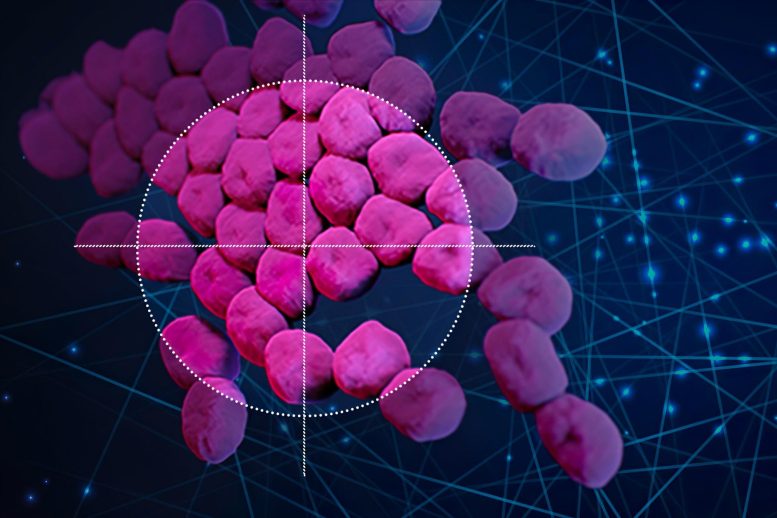
In their initial demonstration, the researchers trained a machine-learning algorithm to identify chemical structures that could inhibit growth of E. coli. In a screen of more than 100 million compounds, that algorithm yielded a molecule that the researchers called halicin, after the fictional artificial intelligence system from “2001: A Space Odyssey.” This molecule, they showed, could kill not only E. coli but several other bacterial species that are resistant to treatment.
“After that paper, when we showed that these machine-learning approaches can work well for complex antibiotic discovery tasks, we turned our attention to what I perceive to be public enemy No. 1 for multidrug-resistant bacterial infections, which is Acinetobacter,” Stokes says.
To obtain training data for their computational model, the researchers first exposed A. baumannii grown in a lab dish to about 7,500 different chemical compounds to see which ones could inhibit growth of the microbe. Then they fed the structure of each molecule into the model. They also told the model whether each structure could inhibit bacterial growth or not. This allowed the algorithm to learn chemical features associated with growth inhibition.
Once the model was trained, the researchers used it to analyze a set of 6,680 compounds it had not seen before, which came from the Drug Repurposing Hub at the Broad Institute. This analysis, which took less than two hours, yielded a few hundred top hits. Of these, the researchers chose 240 to test experimentally in the lab, focusing on compounds with structures that were different from those of existing antibiotics or molecules from the training data.
Those tests yielded nine antibiotics, including one that was very potent. This compound, which was originally explored as a potential diabetes drug, turned out to be extremely effective at killing A. baumannii but had no effect on other species of bacteria including Pseudomonas aeruginosa, Staphylococcus aureus, and carbapenem-resistant Enterobacteriaceae.
This “narrow spectrum” killing ability is a desirable feature for antibiotics because it minimizes the risk of bacteria rapidly spreading resistance against the drug. Another advantage is that the drug would likely spare the beneficial bacteria that live in the human gut and help to suppress opportunistic infections such as Clostridium difficile.
“Antibiotics often have to be administered systemically, and the last thing you want to do is cause significant dysbiosis and open up these already sick patients to secondary infections,” Stokes says.
A Novel Mechanism
In studies in mice, the researchers showed that the drug, which they named abaucin, could treat wound infections caused by A. baumannii. They also showed, in lab tests, that it works against a variety of drug-resistant A. baumannii strains isolated from human patients.
Further experiments revealed that the drug kills cells by interfering with a process known as lipoprotein trafficking, which cells use to transport proteins from the interior of the cell to the cell envelope. Specifically, the drug appears to inhibit LolE, a protein involved in this process.
All Gram-negative bacteria express this enzyme, so the researchers were surprised to find that abaucin is so selective in targeting A. baumannii. They hypothesize that slight differences in how A. baumannii performs this task might account for the drug’s selectivity.
“We haven’t finalized the experimental data acquisition yet, but we think it’s because A. baumannii does lipoprotein trafficking a little bit differently than other Gram-negative species. We believe that’s why we’re getting this narrow spectrum activity,” Stokes says.
Stokes’ lab is now working with other researchers at McMaster to optimize the medicinal properties of the compound, in hopes of developing it for eventual use in patients.
The researchers also plan to use their modeling approach to identify potential antibiotics for other types of drug-resistant infections, including those caused by Staphylococcus aureus and Pseudomonas aeruginosa.
Reference: “Deep learning-guided discovery of an antibiotic targeting Acinetobacter baumannii” by Gary Liu, Denise B. Catacutan, Khushi Rathod, Kyle Swanson, Wengong Jin, Jody C. Mohammed, Anush Chiappino-Pepe, Saad A. Syed, Meghan Fragis, Kenneth Rachwalski, Jakob Magolan, Michael G. Surette, Brian K. Coombes, Tommi Jaakkola, Regina Barzilay, James J. Collins and Jonathan M. Stokes, 25 May 2023, Nature Chemical Biology.
DOI: 10.1038/s41589-023-01349-8
The research was funded by the David Braley Center for Antibiotic Discovery, the Weston Family Foundation, the Audacious Project, the C3.ai Digital Transformation Institute, the Abdul Latif Jameel Clinic for Machine Learning in Health, the DTRA Discovery of Medical Countermeasures Against New and Emerging Threats program, the DARPA Accelerated Molecular Discovery program, the Canadian Institutes of Health Research, Genome Canada, the Faculty of Health Sciences of McMaster University, the Boris Family, a Marshall Scholarship, and the Department of Energy Biological and Environmental Research program.
Never miss a breakthrough: Join the SciTechDaily newsletter.
Follow us on Google and Google News.