
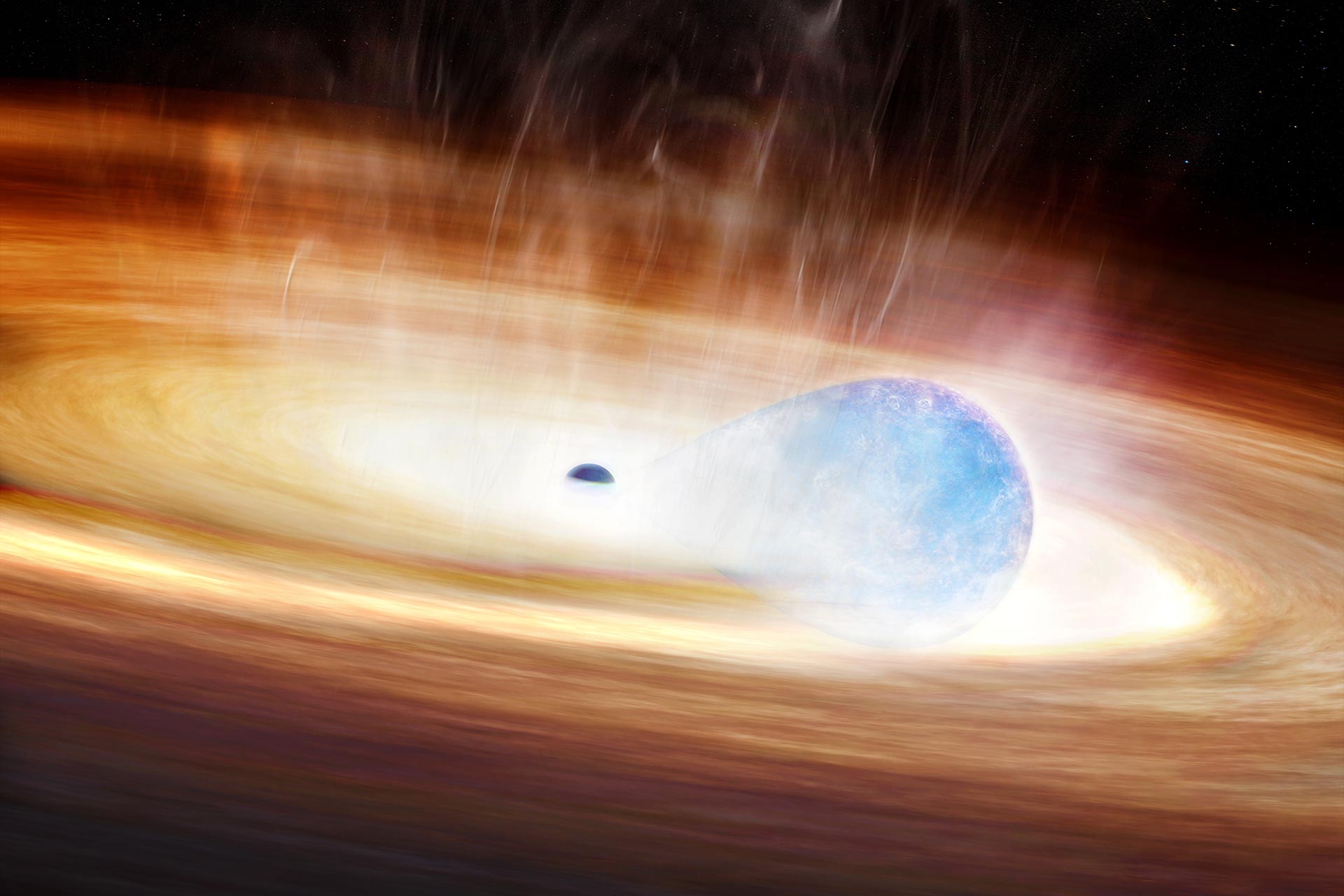
AI helped uncover a one-of-a-kind stellar explosion, where a black hole may have triggered or destroyed its companion star.
- Astronomers using an AI-powered system led by UC Santa Cruz caught a rare stellar explosion, known as SN 2023zkd, just hours after it began. This early detection made it possible to gather crucial observations before the short-lived blast faded from view.
- Evidence points to a dramatic cause: the star’s violent interaction with a nearby black hole. The black hole may have partly consumed the star, triggering the explosion, or completely shredded it before it could detonate on its own.
- Scientists note that the same kind of real-time AI anomaly detection could eventually transform other areas of life, from spotting diseases earlier to preventing financial fraud and even strengthening national security.
AI Hunts a Star’s Final Blast
Astronomers have identified the violent death of a giant star caught in a fatal orbit with a black hole. The discovery was made possible through artificial intelligence developed by a team led by the University of California, Santa Cruz, which specializes in tracking stars in the earliest stages after they explode as supernovae.
In July 2023, the event, named SN 2023zkd, was detected using a new AI system designed to scan the sky in real time for unusual stellar blasts. Because the system issued an alert so quickly, researchers were able to begin detailed follow-up observations right away, a crucial step in piecing together the full sequence of the explosion.
Unprecedented Observations Across Telescopes
By the end of the event, SN 2023zkd had been monitored by an extensive network of telescopes on Earth and in orbit. Among them were two instruments at Hawaiʻi’s Haleakalāa Observatory, part of the Young Supernova Experiment (YSE) led by UC Santa Cruz.
“Something exactly like this supernova has not been seen before, so it might be very rare,” said Ryan Foley, associate professor of astronomy and astrophysics at UC Santa Cruz. “Humans are reasonably good at finding things that ‘aren’t like the others,’ but the algorithm can flag things earlier than a human may notice. This is critical for these time-sensitive observations.”
Surveying the Skies for Supernovae
Foley’s team runs YSE, which surveys an area of the sky equivalent to 6,000 times the full moon (4% of the night sky) every three days and has discovered thousands of new cosmic explosions and other astrophysical transients—dozens of them just days or hours after explosion.
The scientists behind the discovery of SN 2023zkd said the most likely interpretation is that a collision between the massive star and the black hole was inevitable. As energy was lost from the orbit, their separation decreased until the supernova was triggered by the star’s gravitational stress as it was partially swallowed the black hole.
The discovery was published on August 13 in the Astrophysical Journal. “Our analysis shows that the blast was sparked by a catastrophic encounter with a black hole companion, and is the strongest evidence to date that such close interactions can actually detonate a star,” said lead author Alexander Gagliano, a fellow at the NSF Institute for Artificial Intelligence and Fundamental Interactions.
An alternative interpretation considered by the team is that the black hole completely tore the star apart before it could explode on its own. In that case, the black hole quickly pulled in the star’s debris and bright light was generated when the debris crashed into the gas surrounding it. In both cases, a single, heavier black hole is left behind.
A Supernova That Glowed Twice
Located about 730 million light-years from Earth, SN 2023zkd initially looked like a typical supernova, with a single burst of light. But as the scientists tracked its decline over several months, it did something unexpected: It brightened again. To understand this unusual behavior, the scientists analyzed archival data, which showed something even more unusual: The system had been slowly brightening for more than four years before the explosion. That kind of long-term activity before the explosion is rarely seen in supernovae.
Detailed analysis done in part at UC Santa Cruz revealed that the explosion’s light was shaped by material the star had shed in the years before it died. The early brightening came from the supernova’s blast wave hitting low-density gas. The second, delayed peak was caused by a slower but sustained collision with a thick, disk-like cloud. This structure—and the star’s erratic pre-explosion behavior—suggest that the dying star was under extreme gravitational stress, likely from a nearby, compact companion such as a black hole.
From Skepticism to Confirmation
Foley said he and Gagliano had several conversations about the spectra, leading to the eventual interpretation of the binary system with a black hole. Gagliano led the charge in that area, while Foley played the role of “spectroscopy expert” and served as a sounding board—and often, skeptic.
At first, the idea that the black hole triggered the supernova almost sounded like science fiction, Foley recalled. So it was important to make sure all of the observations lined up with this explanation, and Foley said Gagliano methodically demonstrated that they did.
Power of AI and Team Collaboration
“Our team also built the software platform that we use to consolidate data and manage observations. The AI tools used for this study are integrated into this software ecosystem,” Foley said. “Similarly, our research collaboration brings together the variety of expertise necessary to make these discoveries.”
Co-author Enrico Ramirez-Ruiz, also a professor of astronomy and astrophysics, leads the theory team at UC Santa Cruz. Fellow co-author V. Ashley Villar, an assistant professor of astronomy in the Harvard Faculty of Arts and Sciences, provided AI expertise. The team behind this discovery was led by the Center for Astrophysics | Harvard & Smithsonian and the Massachusetts Institute of Technology as part of YSE.
This work was funded by the National Science Foundation, NASA, the Moore Foundation, and the Packard Foundation. Several students, including Gagliano, are or were NSF graduate research fellows, Foley said.
Funding Uncertainty Threatens Discoveries
But currently, Foley said the funding situation and outlook for continued support is very uncertain, forcing the collaboration to take fewer risks, resulting in decreased science output overall. “The uncertainty means we are shrinking,” he said, “reducing the number of students who are admitted to our graduate program—many of them being forced out of the field or to take jobs outside the U.S.”
Although predicting the path this AI approach will take is difficult, Foley said this research is cutting edge. “You can easily imagine similar techniques being used to screen for diseases, focus attention for terrorist attacks, treat mental health issues early, and detect financial fraud,” he explained. “Anywhere real-time detection of anomalies could be useful, these techniques will likely eventually play a role.”
Reference: “Evidence for an Instability-induced Binary Merger in the Double-peaked, Helium-rich Type IIn Supernova 2023zkd” by A. Gagliano, V. A. Villar, T. Matsumoto, D. O. Jones, C. L. Ransome, A. E. Nugent, D. Hiramatsu, K. Auchettl, D. Tsuna, Y. Dong, S. Gomez, P. D. Aleo, C. R. Angus, T. de Boer, K. A. Bostroem, K. C. Chambers, D. A. Coulter, K. W. Davis, J. R. Fairlamb, J. Farah, D. Farias, R. J. Foley, C. Gall, H. Gao, E. P. Gonzalez, D. A. Howell, M. E. Huber, C. D. Kilpatrick, C.-C. Lin, T. B. Lowe, M. E. MacLeod, E. A. Magnier, C. McCully, P. Mínguez, G. Narayan, M. Newsome, K. C. Patra, A. Rest, S. Rest, S. Smartt, K. W. Smith, G. Terreran, R. J. Wainscoat, Q. Wang, S. K. Yadavalli and Y. Zenati, 13 August 2025, The Astrophysical Journal.
DOI: 10.3847/1538-4357/adea38
Never miss a breakthrough: Join the SciTechDaily newsletter.
Follow us on Google and Google News.