
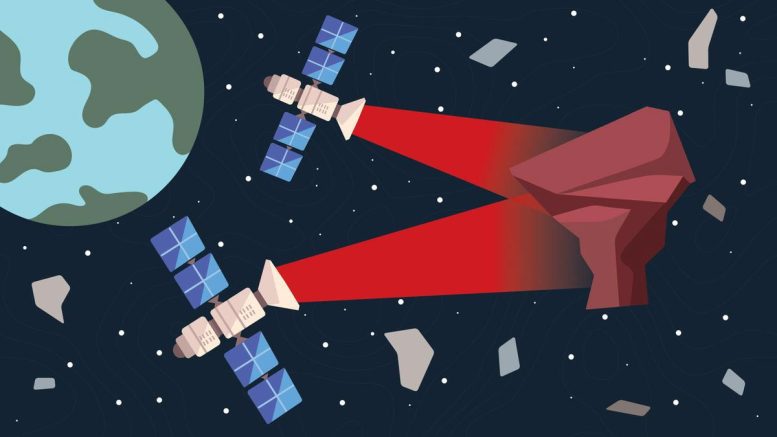
West Virginia University is researching the use of AI-powered space lasers to redirect space debris, reducing collision risks. Supported by NASA, the initiative aims to tackle debris of all sizes and is currently validating its algorithms and models.
If research pays off, debris that litters the planet’s orbit and poses a threat to spacecraft and satellites could get nudged off potential collision courses by a coordinated network of space lasers.
Hang Woon Lee, director of the Space Systems Operations Research Laboratory at WVU, said a junkyard of human-made debris, including defunct satellites, is accumulating around Earth. The more debris in orbit, the higher the risk that some of that debris will collide with manned and unmanned space assets. He said he believes the best chance for preventing those collisions is an array of multiple lasers mounted to platforms in space. The artificial intelligence-powered lasers could maneuver and work together to respond rapidly to debris of any size.

NASA’s Support and Research Progress
Lee, an assistant professor in mechanical and aerospace engineering at the Benjamin M. Statler College of Engineering and Mineral Resources, is a 2023 recipient of NASA’s prestigious Early Career Faculty award for potentially breakthrough research. NASA is supporting Lee’s rapid-response debris removal study with $200,000 in funding per year for up to three years.
The work is in its early stages and, currently, the research team is verifying the algorithms they propose developing to run the system of lasers would be a valid, cost-effective solution. But the long-distance vision is of “multiple space-based lasers actively performing orbital maneuvers and collaboratively addressing orbital debris,” Lee said.
This could lead to just-in-time collision avoidance with high-value space assets.
“Our goal is to develop a network of reconfigurable space-based lasers, along with a suite of algorithms. Those algorithms will be the enabling technology that makes such a network possible and maximize its benefits.”
The Rising Challenge of Space Debris
If a natural object, like a micrometeoroid, dings a human-made object, like the remains of a launch vehicle, the resultant debris can travel quickly enough that even a piece as small as a fleck of paint might have the force to puncture an observation or telecommunication satellite or the side of the International Space Station.
That has become an urgent problem because space is getting increasingly cluttered. In particular, Earth’s low orbit has attracted commercial telecommunications systems like SpaceX’s Starlink, which uses satellites to bring broadband internet to subscribers. Low orbit is also home to satellites used in weather forecasting and land-cover analysis, and it’s the staging ground for deep-space exploration.
“That increased population of objects heightens the risk of collisions, endangers manned missions, and jeopardizes high-value scientific and industrial missions,” Lee said. He added that collisions in space can trigger a domino effect called the “Kessler Syndrome,” which induces a chain reaction increasing the risk of further collisions, “making space unsustainable and hostile.”
Laser Advantage Over Other Technologies
Other researchers are developing debris removal technologies like hooks, harpoons, nets, and sweepers, but those only work on large debris. Lee’s approach should be able to handle debris of almost any size.
The suite of algorithms Lee’s team will develop might work on lasers that are mounted on large satellites, or it might power lasers that live on their own dedicated platforms. He will evaluate the various forms a laser network might take as part of the study. Either way, the technology will be able to make many decisions on its own, independently performing maneuvers and setting priorities.
The system will dictate what combination of lasers target which pieces of debris, while ensuring that the resulting trajectories remain collision-free.
When a laser beam shoots a piece of debris, it doesn’t zap it into oblivion. Rather, the debris gets nudged into a new orbit, often through laser ablation. That means the laser beam vaporizes a small portion of the debris, generating a high-velocity plasma plume that pushes the debris off course.
“The process of laser ablation and photon pressure induces a change in velocity in the target debris, which ultimately alters the size and shape of its orbit. This is where the motivation for using lasers comes into play. The ability to change the orbit of debris can be effectively controlled by a network of lasers to nudge or deorbit space debris, avoiding potentially catastrophic events such as collisions,” Lee explained.
“Using a system of multiple lasers can create multiple engagement opportunities with debris and lead to more efficient control of the trajectories. Several lasers can act simultaneously on a single target at a greater spectrum of intensity, altering its trajectory in a way that would be impossible with a single laser.”
Lee will collaborate with Scott Zemerick, chief systems engineer of TMC Technologies, located in Fairmont, to validate all models and algorithms developed throughout the project within a “digital twin environment.” That will ensure the products are flight software-ready, Lee said.
Never miss a breakthrough: Join the SciTechDaily newsletter.
Follow us on Google and Google News.