

Ceres, the largest object in the asteroid belt, holds fascinating clues about the origins of organic molecules in our Solar System. Research reveals that these compounds, the building blocks of life, may have arrived on Ceres through asteroid impacts rather than forming locally.
The organic material detected in a few locations on the surface of the dwarf planet Ceres is likely of exogenic origin, meaning it was delivered by external sources. Researchers suggest that asteroids from the outer asteroid belt may have brought these compounds during impacts. In a study published in AGU Advances, a team led by the Max Planck Institute for Solar System Research (MPS) in Germany conducted the most detailed analysis yet of this intriguing material and its geological context. For the first time, the researchers used artificial intelligence to examine observational data collected by NASA’s Dawn spacecraft. Their findings indicate that Ceres’s unique cryovolcanism — where salty brine from the interior reaches the surface — is not responsible for the organic deposits identified so far. These results shed new light on where and how habitable conditions could have emerged in the Solar System.
Organic Molecules: Building Blocks of Life
Organic molecules are essential ingredients for life-friendly environments. On Earth, these compounds — composed of carbon, hydrogen, and smaller amounts of other elements — serve as the foundation for all life. In recent years, scientists have discovered similar molecules in distant regions of the Solar System, such as on trans-Neptunian objects, comets, and remote asteroids. These bodies are considered to be relatively unchanged remnants from the early Solar System, suggesting that the building blocks of life may have been part of their composition from the very beginning and only later made their way into the inner Solar System.
In this study, researchers searched for previously unknown deposits of organic material on the dwarf planet Ceres. Positioned in the middle of the asteroid belt between Mars and Jupiter, Ceres occupies a unique location, neither clearly part of the inner nor the outer Solar System. Some studies suggest it could have even formed in this region. This raises a critical question for scientists: did the organic material on Ceres originate locally in the asteroid belt, or was it delivered there later?
Searching for Organics from Afar
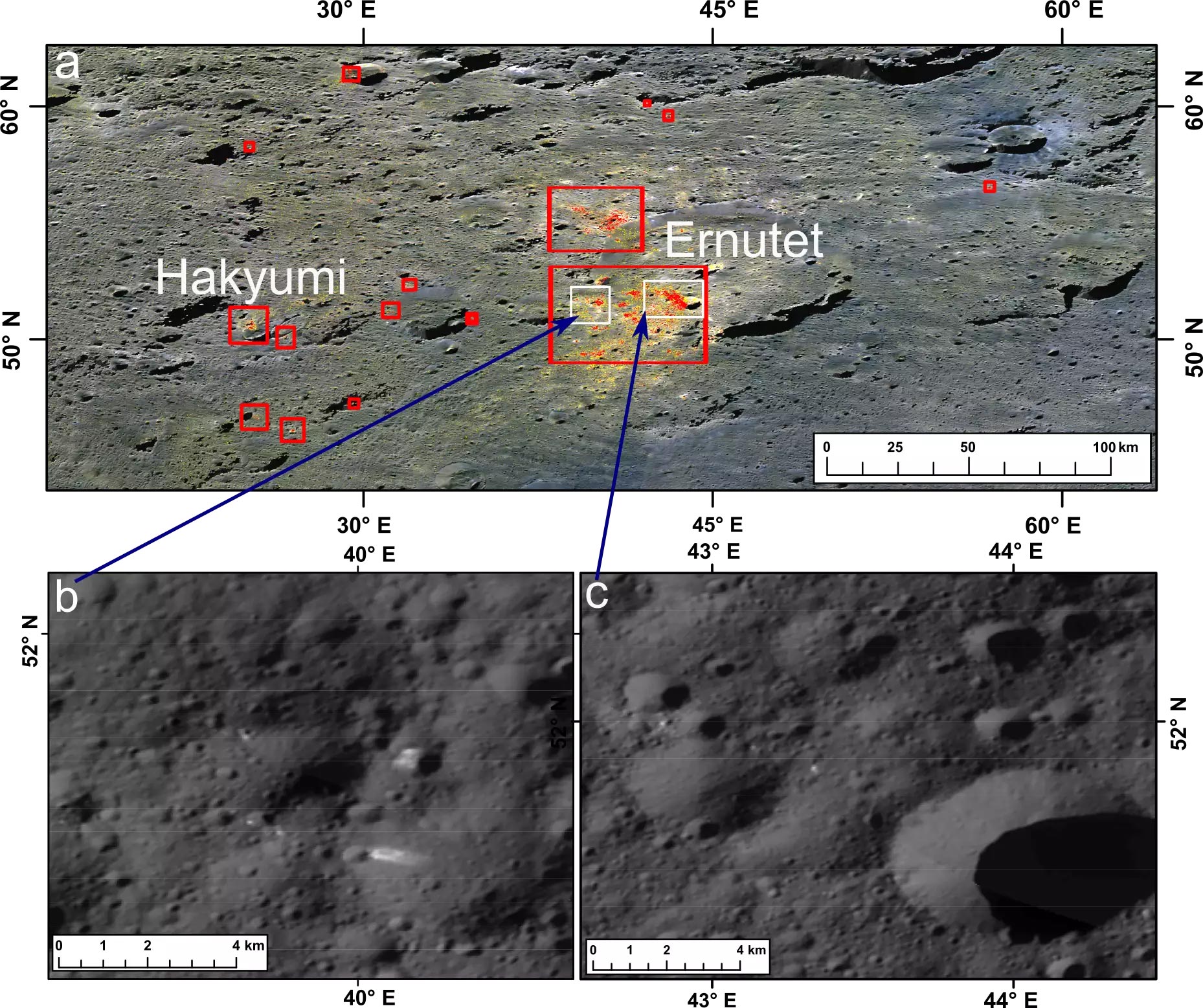
Evidence of deposits of organic material was already found during the early stages of the Dawn mission. The Dawn spacecraft reached Ceres in March 2015 and accompanied it for about three and a half years. During this time, the scientific camera system and the spectrometer on board scanned the entire surface of the dwarf planet. Potential patches of organic material can be detected from the camera data: the brightness of the light reflected from these areas increases noticeably with increasing wavelength. The spectrometer splits the light into many more wavelengths than the camera and can therefore prove or disprove the presence of organics. Unfortunately, remote data is not sufficient to identify individual types of molecules beyond doubt. However, it is certain that the discovered deposits consist of organic compounds that have a chain-like structure. Researchers refer to such molecules as aliphatic hydrocarbons.
The authors of the current study have now used artificial intelligence to comb the entire surface of the dwarf planet for traces of aliphatic organic molecules. “Sites of such organic molecules are actually rare on Ceres, and devoid of any cryovolcanic signatures,” says first author Ranjan Sarkar from the MPS, summarizing the results. The vast majority of deposits can be found along the edge or near the large Ernutet crater in the northern hemisphere of the dwarf planet. Only three are located at a greater distance from it. Two patches were not previously known. A closer look at the geological structures at the locations of the organic material allows further conclusions. “At none of the deposits do we find evidence of current or past volcanic or tectonic activity: no trenches, canyons, volcanic domes or vents. Furthermore, there are no deep impact craters nearby,” says Martin Hoffmann from MPS.
Impacts from Distant Neighbors
During the Dawn mission, Ceres had turned out to be an extraordinary, cryovolcanic world. Under its surface, a watery brine is hidden, which in some places has been seeping to the surface until recently. “Of course, the first assumption is that Ceres’ unique cryovolcanism has transported the organic material from the interior of the body to the surface,” says Andreas Nathues from MPS, head of the camera team. “But our results show otherwise,” he adds. At the sites of cryovolcanic activity, there is no proof of organic matter. And where organic compounds have been reliably detected, there is no evidence of deep or surface activity.
The researchers therefore argue that the impact of one or more asteroids from the outer asteroid belt introduced the organic material. Computer simulations show that these bodies are among the ones that most frequently collided with Ceres. Since the not-too-distant neighbors do not pick up much speed, only a little heat is generated upon impact. Organic compounds can survive these temperatures.
“Unfortunately, Dawn can’t detect all types of organic compounds,” Andreas Nathues points out. It is quite likely that building blocks of life were also formed in Ceres’ underground ocean and perhaps even reached the surface – or are still doing so. “However, the organic deposits that have been reliably detected with Dawn so far likely do not originate Ceres itself,” he explains. Nathues continues by saying that a future lander mission would be needed to detect organic material from the interior of Ceres.
Reference: “Ceres: Organic-Rich Sites of Exogenic Origin?” by R. Sarkar, A. Nathues, M. Hoffmann, E. Cloutis, K. Mengel, P. Singh, G. Thangjam, J. Hernandez, S. Karunatillake and M. Coutelier, 27 January 2025, AGU Advances.
DOI: 10.1029/2024AV001362
About the mission
NASA’s Dawn mission studied two bodies in the asteroid belt up close: the protoplanet Vesta from 2011 to 2012, and the dwarf planet Ceres from 2015 to 2018. The mission’s scientific camera system, the Dawn Framing Cameras, were developed, built, and operated during the mission under the leadership of MPS. The VIR spectrometer was provided by the Italian Space Agency ASI.
Never miss a breakthrough: Join the SciTechDaily newsletter.
Follow us on Google and Google News.