

A Johns Hopkins study revealed alarmingly high ethylene oxide levels in Louisiana, suggesting underreported cancer risks and the urgency for better air quality monitoring and regulatory enforcement.
A cutting-edge mobile air-testing lab detected ethylene oxide, a toxic gas, at levels thousands of times higher than what is considered safe across parts of Louisiana. The concentrations discovered were far above Environmental Protection Agency (EPA) estimates for the region.
Research led by environmental engineers at Johns Hopkins University indicates a significantly higher cancer risk for residents near facilities that produce and use ethylene oxide. The study underscores the need for more accurate and reliable tools to monitor emissions.
“I don’t think there’s any census track in the area that wasn’t at higher risk for cancer than we would deem acceptable,” said senior author Peter DeCarlo, an associate professor of Environmental Health and Engineering who studies air quality. “We expected to see ethylene oxide in this area. But we didn’t expect the levels that we saw, and they certainly were much, much higher than EPA’s estimated levels.”
The work will be published today (June 11) in Environmental Science & Technology.
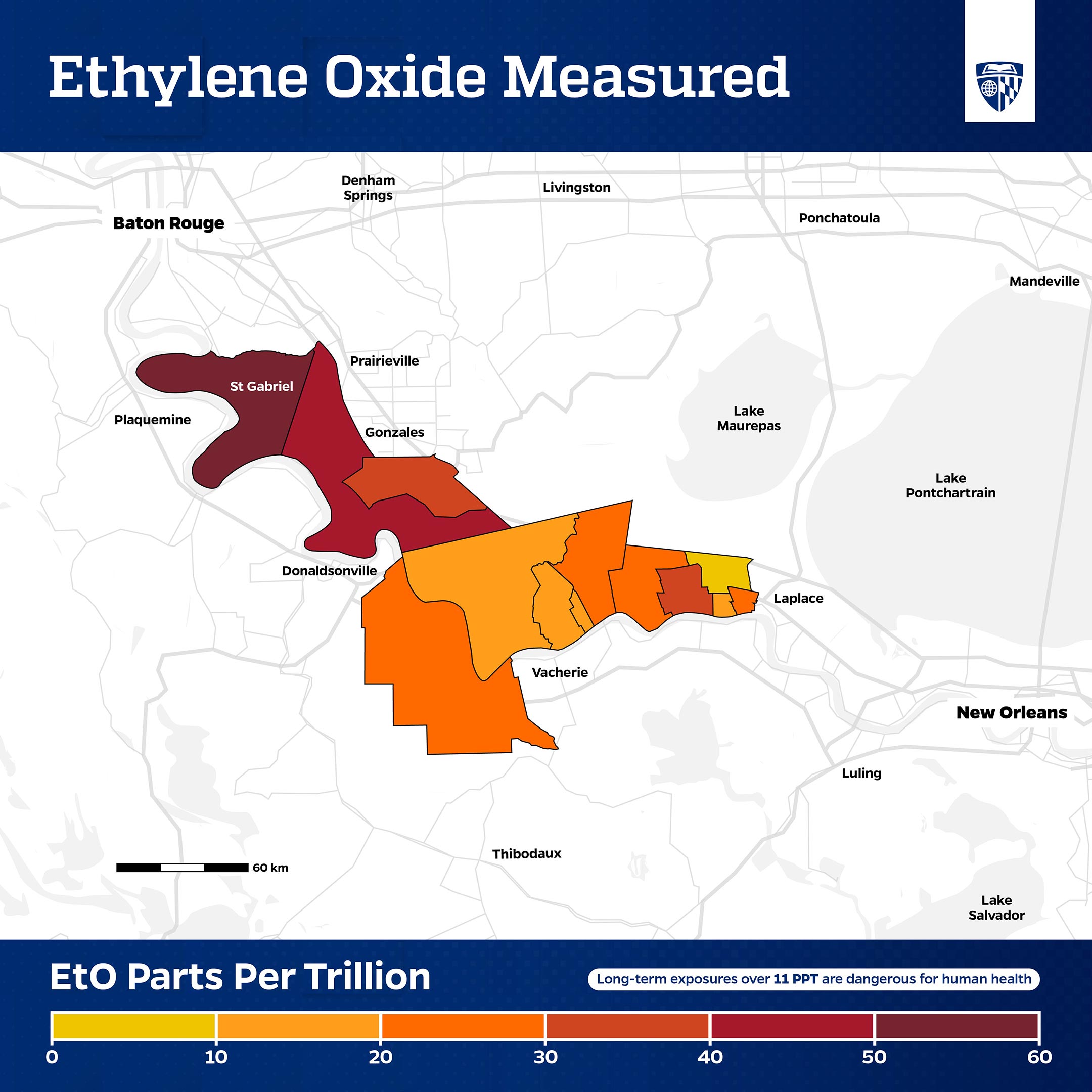
Ethylene oxide is so toxic, red flag levels for long term exposure and human health start at anything over 11 parts per trillion. The team found levels as high as 40 parts per billion in spots closed to industrial facilities. Credit: Khamar Hopkins/Johns Hopkins University
Characteristics and Dangers of Ethylene Oxide
Ethylene oxide is a man-made gas commonly used to manufacture other chemicals, to fumigate, and to sterilize medical and food production equipment. It’s very dangerous to humans, even at low concentrations, with inhalation being the primary route of exposure. Long-term ethylene oxide exposure has been linked to cancer—often for people who live near facilities that manufacture it or work with it.
The gas is difficult to detect or measure in the air through traditional monitoring methods that attempt to collect samples on site and bring them back to a lab for analysis. Studies have shown that the compound concentrations change over time so traditional measurement techniques are unlikely to reflect how much gas people living near testing sites are exposed to.
Lack of Data and Regional Concentrations
“There is just no available data, no actual measurements of ethylene oxide in air, to inform workers and people who live nearby what their actual risk is based on their exposure to this chemical,” DeCarlo said.
Although facilities everywhere work with ethylene oxide, these facilities are large and concentrated in southeastern Louisiana, where there is a history of significant environmental injustices related to exposures to toxic chemicals—the area has become known as “Cancer Alley.”
Innovative Mobile Lab Methodology
The researchers devised a way to directly measure ethylene oxide in the air at these facilities—a mobile lab.
“We went out to answer the question: how much ethylene oxide is in the air in this region and are the levels of concern for people’s health?” said lead author Ellis Robinson, an assistant research engineer at Johns Hopkins. “Making it happen involved putting cutting-edge analytical equipment in a giant mobile laboratory that we could drive all around, analyzing data for about a month.”
The mobile lab consisted of two vans, each equipped with different but highly sensitive technologies to measure ethylene oxide in real time. During winter 2023, the team repeatedly looped along a heavily industrialized route between New Orleans and Baton Rouge Mississippi River, collecting air and testing it as they drove past large industrial facilities and also many residential areas, some quite close to the plants.
“By driving the same route, over and over and over again at different times of day over the over the course of an entire month we were able to build up statistics and get average concentrations throughout the region,” DeCarlo said. “The two testing methods agreed really well and provided us with confidence in measurements that we took.”
Findings: High Levels and Implications for Health
Ethylene oxide is so toxic, red flag levels for long-term exposure and human health start at anything over 11 parts per trillion. The team found levels as high as 40 parts per billion in spots closed to industrial facilities. They were also able to follow air flow and detected concerning amounts of the gas as much as 10 kilometers downwind from the plants.
“We’d drive through the industrial areas and saw concentrations hitting 40 parts per billion, which is more a thousand times higher than the accepted risk for lifetime exposure,” DeCarlo said.
When the team compared their measurements with those able to be detected with the EPA’s current screening tools, their own measurements were significantly higher, translating to much greater risks for cancer for the nearby communities.
Policy Implications and Future Steps
“Our findings have really important implications for community residents, especially infants and children,” said Keeve Nachman, associate professor of Environmental Health and Engineering and the co-director of the Risk Sciences and Public Policy Institute. “Ethylene oxide has been shown to directly damage DNA, meaning that exposures that occur in early life are more dangerous.”
The EPA just announced stricter rules on ethylene oxide that would require commercial sterilizing outfits to dramatically reduce emissions. The findings here could help regulators identify and more tightly monitor hot spots.
Our study demonstrates the need for more accurate measurements to help identify locations to install monitors for more long-term monitoring and so we can best protect the health of people who are living in those areas,” DeCarlo said
Reference: “Ethylene Oxide in Southeastern Louisiana’s Petrochemical Corridor: High Spatial Resolution Mobile Monitoring during HAP-MAP” by Ellis S. Robinson, Mina W. Tehrani, Amira Yassine, Shivang Agarwal, Benjamin A. Nault, Carolyn Gigot, Andrea A. Chiger, Sara N. Lupolt, Conner Daube, Anita M. Avery, Megan S. Claflin, Harald Stark, Elizabeth M. Lunny, Joseph R. Roscioli, Scott C. Herndon, Kai Skog, Jonathan Bent, Kirsten Koehler, Ana M. Rule, Thomas Burke, Tara I. Yacovitch, Keeve Nachman and Peter F. DeCarlo, 11 June 2024, Environmental Science & Technology.
DOI: 10.1021/acs.est.3c10579
Authors include: Mina Tehrani, Amira Yassine, Shivang Agarwal, Carolyn Gigot, Andrea Chiger, Sara Lupolt, Benjamin A Nault, Kirsten Koehler, Ana Rule, Thomas Burke, and Keeve Nachman, all from Johns Hopkins; Tara Yacovitch, Conner Daube, Anita Avery, Megan Claflin, Harald Stark, Elizabeth Lunny, Joseph Roscioli, Scott and Herndon, all of Aerodyne Research Inc.; and Kai Skog and Jonathan Bent of Picarro Inc.
Never miss a breakthrough: Join the SciTechDaily newsletter.
Follow us on Google and Google News.