
Close Menu
    Facebook X (Twitter) Instagram
    SciTechDaily
    • Biology
    • Chemistry
    • Earth
    • Health
    • Physics
    • Science
    • Space
    • Technology
    Facebook X (Twitter) Pinterest YouTube RSS
    SciTechDaily
    Home»Space»ALMA Reveals Magnetic Fields in the Early Stages of Massive Star Formation
    Space

    ALMA Reveals Magnetic Fields in the Early Stages of Massive Star Formation

    By Harvard-Smithsonian Center for AstrophysicsSeptember 23, 2020No Comments3 Mins Read
    Facebook Twitter Pinterest Telegram LinkedIn WhatsApp Email Reddit
    Share
    Facebook Twitter LinkedIn Pinterest Telegram Email Reddit
    Filament of Young Star-Forming Cores
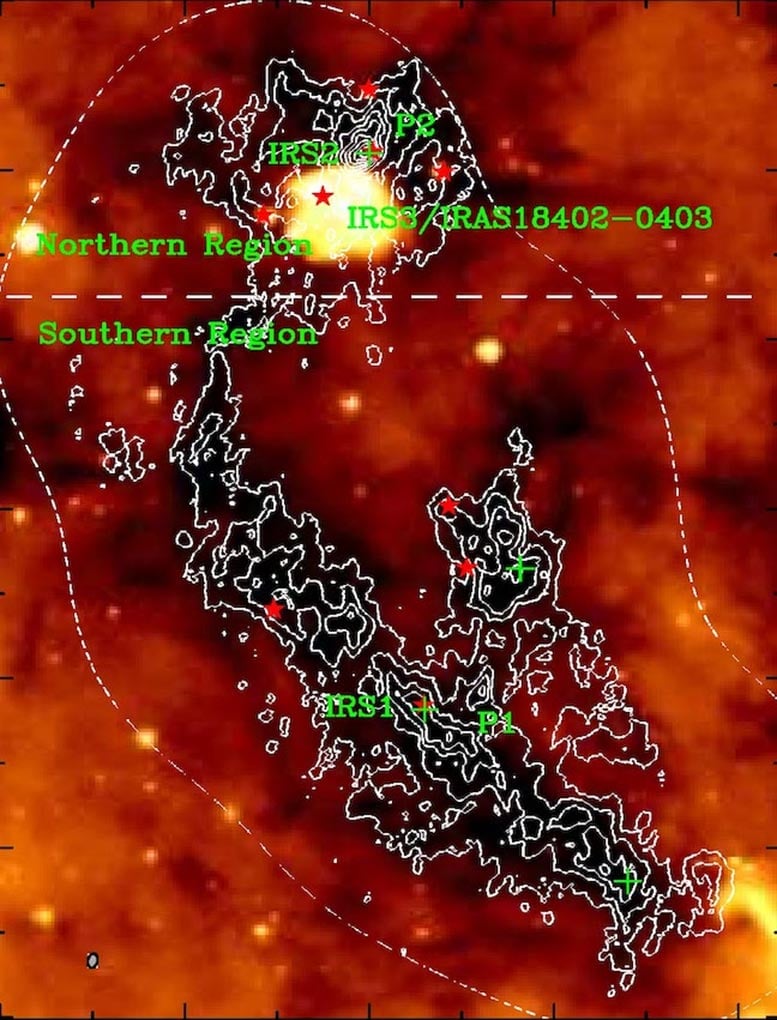
    An IRAC infrared image of a filament of young star-forming cores, with the intensity of the dense gas emission overlaid in contours. New submillimeter observations have mapped the magnetic field structures in three of the massive cores along the filament, and found that although the fields do not dominate the collapse, at least as compared to gas turbulence, they appear to be influencing the development of disks around the new stars. Credit: NASA/ Spitzer-IRAC, and Wang et al., 2008

    Star formation in molecular clouds usually occurs in a two-step process. Supersonic flows first compress the clouds into dense filaments light-years long, after which gravity collapses the densest material in the filaments into cores. Massive cores, each more than about twenty solar–masses, preferentially form at intersections where filaments cross, producing sites of clustered star formation. The process is expected to be efficient yet the observed rate of star formation in dense gas is only a few percent of the rate expected if the material really were freely collapsing. To solve the problem, astronomers have proposed that turbulence and/or magnetic fields support the cores against gravitational collapse.

    Magnetic fields are difficult to measure. One common approach is to measure the polarized light, because magnetic fields can align elongated dust grains in the interstellar medium which then scatter light with a preferred polarization direction enabling the field strengths to be estimated. CfA astronomers Junhao Liu and Qizhou Zhang led a team that used the ALMA submillimeter facility to study the polarized emission in three massive cores in a dark cloud with a spatial resolution of about 0.7 light-years, small enough to probe the spatial structures of the cores. The region is in our galaxy, about fifteen thousand light-years away, and is known to have more than ten potentially star-forming cores with masses between one hundred and one thousand solar masses. Three of them show signs that star formation is underway, and the scientists observed these three in their submillimeter continuum emission and the molecular emission from their carbon monoxide gas and several other species.

    Each of the three cores is slightly different in mass, temperature, gas motions, and substructure, perhaps in part because they are in different stages in their star formation activity. The astronomers find magnetic fields in all three of the clumps, but the strengths also differ slightly from between 1.6 and 0.32 milliGauss (for comparison, the strength of the magnetic field at the Earth’s surface is on average about 500 milliGauss). Their analysis of the energetics shows that turbulence in the gas motions dominates (or compares to) the effects of magnetic fields and that the magnetic force alone cannot prevent gravitational collapse. However the fields may play a key role in another way: There are twelve outflows from the young stars in these cores, and half of them are roughly aligned with the magnetic field directions. Since outflows are related to the disk structures around young stars, it suggests that the fields play a key role in shaping the disks as they develop in the early stages of star formation.

    Reference: “Magnetic Fields in the Early Stages of Massive Star Formation as Revealed by ALMA” by Junhao Liu, Qizhou Zhang, Keping Qiu, Hauyu Baobab Liu, Thushara Pillai, Josep Miquel Girart, Zhi-Yun Li and Ke Wang, 5 June 2020, The Astrophysical Journal.
    DOI: 10.3847/1538-4357/ab9087

    Never miss a breakthrough: Join the SciTechDaily newsletter.
    Follow us on Google and Google News.

    ALMA Astronomy Astrophysics Harvard-Smithsonian Center for Astrophysics Stars
    Share. Facebook Twitter Pinterest LinkedIn Email Reddit

    Related Articles

    Mega-Flares From Stars: 10 Million Times More Energetic Than the Most Powerful Flare Ever Observed on the Sun

    Mind the Gap: Direct Link Uncovered Between Protoplanetary Disk Structures and Giant Exoplanets

    The Give and Take of Stellar Mega-Flares: By Studying Thousands of Young Stars, New Information Has Emerged

    Young Chaotic Star System Reveals Secrets of Planet Formation

    Massive Stars Are Formed Not From Dust Disk but From Debris – “A Chaotic Mess”

    Growing up Stardust: Astronomers Discover That Stars and Planets May Be Siblings

    Distant Colliding Galaxy Dying Out As It Loses the Ability to Form Stars – Ejecting 10,000 Suns-Worth of Gas a Year

    Massive Rotating Stars in the Pleiades Cluster

    Chandra Studies Extraordinary Magnetar: Fastest Spinning and Possibly the Youngest Magnetar Known

    Leave A Reply Cancel Reply

    • Facebook
    • Twitter
    • Pinterest
    • YouTube

    Don't Miss a Discovery

    Subscribe for the Latest in Science & Tech!

    Trending News

    Scientists Discover Stem Cells That Could Regrow Teeth and Bone

    Early Cannabis Use May Stall Key Brain Skills in Teens

    Popular Vitamin D Supplement Has “Previously Unknown” Negative Effect, Study Finds

    Study Reveals Malaria’s Hidden Role in Human Evolution

    The Hidden Risk of Taking Breaks From Weight-Loss Drugs Like Ozempic

    Scientists Warn That This Common Pet Fish Can Wreck Entire Ecosystems

    Scientists Make Breakthrough in Turning Plastic Trash Into Clean Fuel Using Sunlight

    This Popular Supplement May Interfere With Cancer Treatment, Scientists Warn

    Follow SciTechDaily
    • Facebook
    • Twitter
    • YouTube
    • Pinterest
    • Newsletter
    • RSS
    SciTech News
    • Biology News
    • Chemistry News
    • Earth News
    • Health News
    • Physics News
    • Science News
    • Space News
    • Technology News
    Recent Posts
    • Scientists Just Built a Quantum Battery That Charges Almost Instantly
    • Researchers Unveil Groundbreaking Sustainable Solution to Vitamin B12 Deficiency
    • Scientists Identify Immune Protein That Could Mimic Anti-Aging Effects of Calorie Restriction
    • This Tiny Creature Survived a World of Dinosaurs and Changed What Came Next
    • Millions of People Have Osteopenia Without Realizing It – Here’s What You Need To Know
    Copyright © 1998 - 2026 SciTechDaily. All Rights Reserved.
    • Science News
    • About
    • Contact
    • Editorial Board
    • Privacy Policy
    • Terms of Use

    Type above and press Enter to search. Press Esc to cancel.