
Close Menu
    Facebook X (Twitter) Instagram
    SciTechDaily
    • Biology
    • Chemistry
    • Earth
    • Health
    • Physics
    • Science
    • Space
    • Technology
    Facebook X (Twitter) Pinterest YouTube RSS
    SciTechDaily
    Home»Space»New Research Reveals the Role of Magnetic Fields in Star Formation
    Space

    New Research Reveals the Role of Magnetic Fields in Star Formation

    By Harvard-Smithsonian Center for AstrophysicsNovember 10, 2014No Comments3 Mins Read
    Facebook Twitter Pinterest Telegram LinkedIn WhatsApp Email Reddit
    Share
    Facebook Twitter LinkedIn Pinterest Telegram Email Reddit
    Role of Magnetic Fields in Star Formation
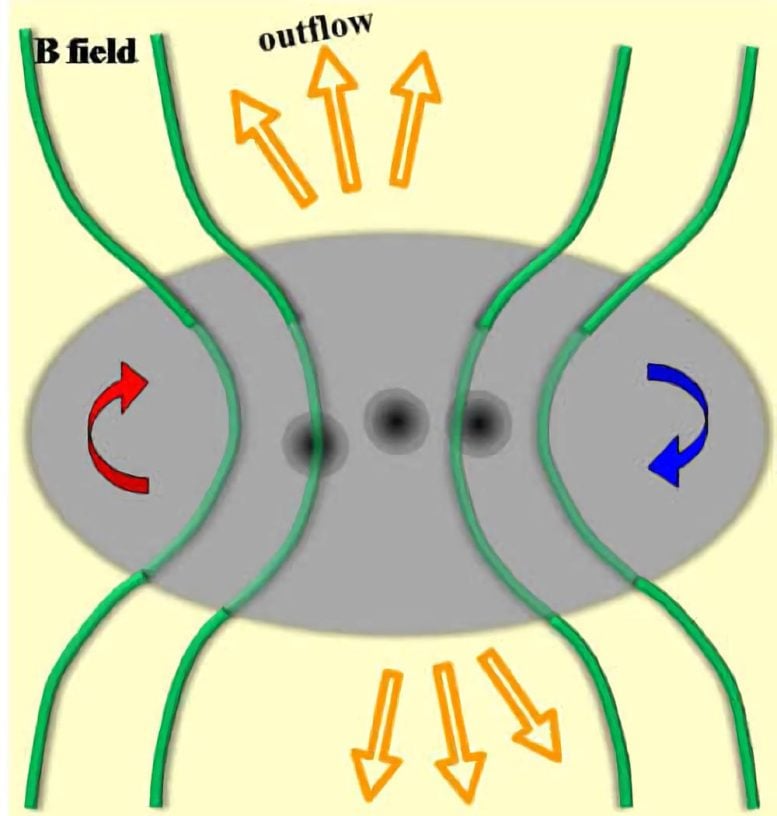
    A schematic illustration of the magnetic field and motions found in a massive star forming cluster. The core (gray-filled ellipse) is a flattened, rotating cloud of gas and dust (blue and red arrows indicate the sense of the rotation). It is fragmenting into new stars (evidenced by the three condensations/gray dots), and is threaded by an hourglass magnetic field (“B field” green lines) largely aligned with a bipolar outflow indicated with the arrows. Credit: Keping Qiu, et al.

    Using the Submillimeter Array to study the magnetic field in a massive star cluster, astronomers were able to determine the properties of the magnetic field and the role it plays in star formation.

    Massive stars tend to form in clusters as the gas and dust in molecular clouds collapses and fragments under the influence of gravity. In the classic picture of star formation, gravity must eventually compete against the thermal pressure that develops in the collapsing core as the material heats up.

    Astronomers think they understand those steps, but there is a debate about the possible role of two other physical processes: turbulent motions and magnetic fields. One school argues that the turbulence that develops as the cloud shrinks leads to fragmentation and the formation of multiple young stars in a young cluster. The other camp argues that there are magnetic fields present in the original clouds, and calculates that as the cloud shrinks the fields become stronger, take on an hourglass shape, and produce a flattened cloud and stars with bipolar flows ejected along the direction of the field.

    Harvard-Smithsonian Center for Astrophysics (CfA) astronomer Qizhou Zhang and five colleagues used the Submillimeter Array (SMA) to study the magnetic field in one massive young cluster known to have a flattened shape and a bipolar outflow. The region has a luminosity of about thirty thousand Suns, and is located about seventeen thousand light-years away. The team determined the properties of the magnetic field by using the SMA’s ability to measure the polarization of the millimeter light from the region: Magnetic fields cause elongated dust grains in the cloud to line themselves up along the field, and arrange in this coherent pattern they scatter light preferentially in one polarization.

    The scientists report detecting the clear signature of an hourglass-shaped magnetic field that is remarkably consistent with the theoretical predictions of the classic paradigm. This is the first time that such an hourglass field, aligned with a well-defined outflow system, has been seen in a high-mass region. The new observations provide strong evidence that massive star and cluster formation proceeds in a way that astronomers think resembles the processes in the formation of Sun-like stars. Not least, the team notes that the magnetic field dominates over the turbulence.

    Reference: “Submillimeter Array Observations of Magnetic Fields in G240.31+0.07: An Hourglass in a Massive Cluster Forming Core” by Keping Qiu, Qizhou Zhang, Karl M. Menten, Hauyu B. Liu, Ya-Wen Tang and Josep M. Girart, 30 September 2014, The Astrophysical Journal Letters.
    DOI: 10.1088/2041-8205/794/1/L18

    Never miss a breakthrough: Join the SciTechDaily newsletter.
    Follow us on Google and Google News.

    Astronomy Astrophysics Harvard-Smithsonian Center for Astrophysics Star Formation
    Share. Facebook Twitter Pinterest LinkedIn Email Reddit

    Related Articles

    Magnetic Fields Influence Star Formation on a Variety of Scales

    The Formation of a Quadruple Star System

    CfA Astronomers Examine the Dynamics of Collapsing Cores and Star Formation

    Dark Stars – Astronomers Investigate if Dark Matter Influenced the Development of Stars

    Astronomers Probe the Transition Disk Around Sz 91

    Astronomers Examine Star Formation in Luminous, Colliding Galaxies

    SMA Reveals New Insights Into How Cosmic Seeds Grow Into Massive Stars

    Researchers Calibrate the Strength of X-Ray Emission against Star Formation Rate

    A Link Between Black Hole Accretion Rate and Star Formation Rate

    Leave A Reply Cancel Reply

    • Facebook
    • Twitter
    • Pinterest
    • YouTube

    Don't Miss a Discovery

    Subscribe for the Latest in Science & Tech!

    Trending News

    Millions Take These IBS Drugs, But a New Study Finds Serious Risks

    Scientists Unlock Hidden Secrets of 2,300-Year-Old Mummies Using Cutting-Edge CT Scanner

    Bread Might Be Making You Gain Weight Even Without Eating More Calories

    Scientists Discover Massive Magma Reservoir Beneath Tuscany

    Europe’s Most Active Volcano Just Got Stranger – Here’s Why Scientists Are Rethinking It

    Alzheimer’s Symptoms May Start Outside the Brain, Study Finds

    Millions Take This Popular Supplement – Scientists Discover a Concerning Link to Heart Failure

    The Universe Is Expanding Too Fast and Scientists Can’t Explain Why

    Follow SciTechDaily
    • Facebook
    • Twitter
    • YouTube
    • Pinterest
    • Newsletter
    • RSS
    SciTech News
    • Biology News
    • Chemistry News
    • Earth News
    • Health News
    • Physics News
    • Science News
    • Space News
    • Technology News
    Recent Posts
    • U.S. Waste Holds $5.7 Billion Worth of Crop Nutrients
    • Scientists Say a Hidden Structure May Exist Inside Earth’s Core
    • Doctors Surprised by the Power of a Simple Drug Against Colon Cancer
    • Why Popular Diabetes Drugs Like Ozempic Don’t Work for Everyone: The “Genetic Glitch”
    • Scientists Create Improved Insulin Cells That Reverse Diabetes in Mice
    Copyright © 1998 - 2026 SciTechDaily. All Rights Reserved.
    • Science News
    • About
    • Contact
    • Editorial Board
    • Privacy Policy
    • Terms of Use

    Type above and press Enter to search. Press Esc to cancel.