
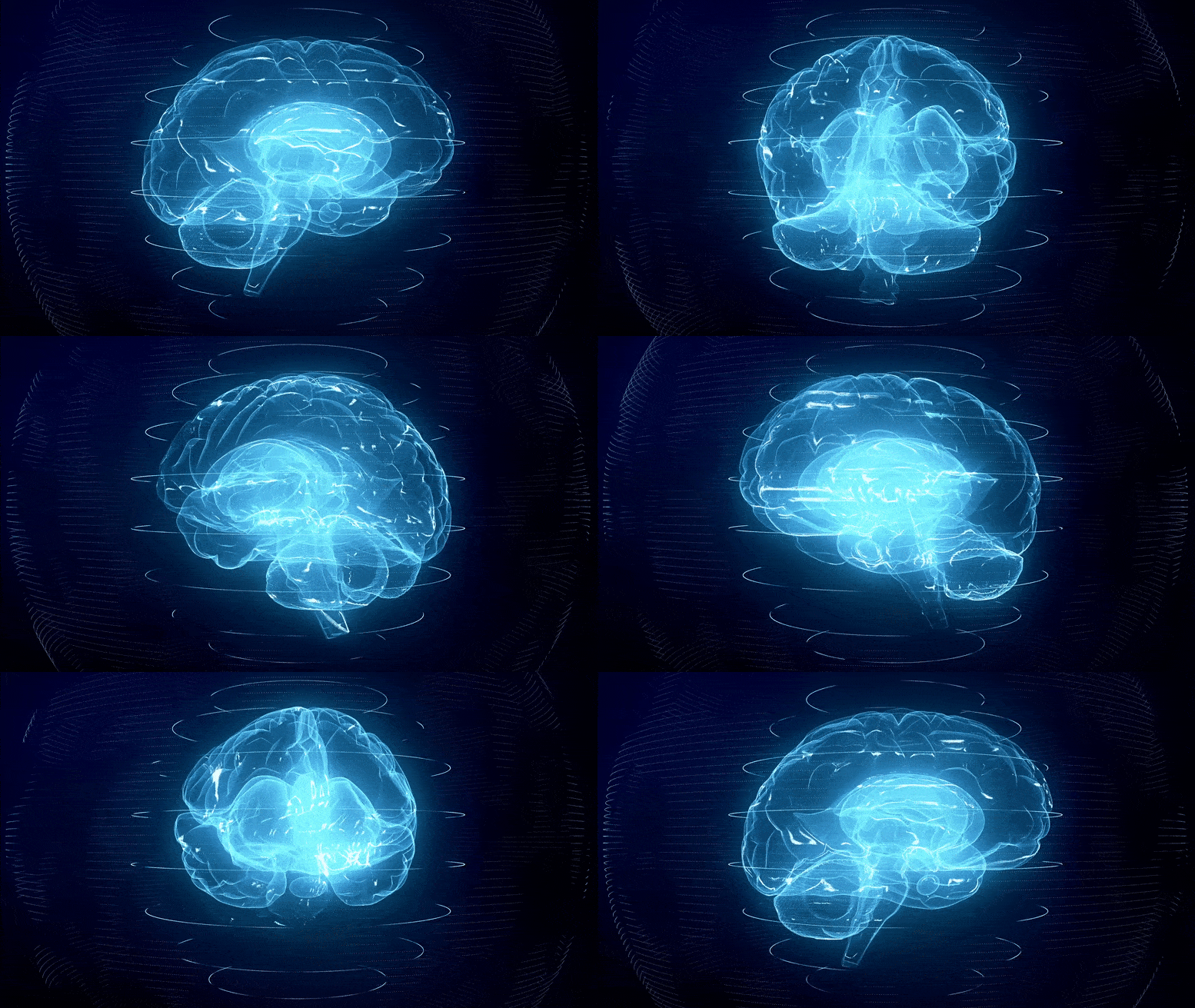
- New findings demonstrate how the brain’s memory center operates at a ‘watershed’ making it especially vulnerable to damage
- Study suggests increasing blood flow in the hippocampus may be really effective at preventing damage and memory loss
- Findings underline the importance of exercise and a low-cholesterol diet in long-term brain health, by boosting blood vessel health and brain blood flow
In a world first, researchers from the University of Sussex have recorded blood oxygen levels in the hippocampus and provided experimental proof for why the area, commonly referred to as “the brain’s memory center,” is vulnerable to damage and degeneration, a precursor to Alzheimer’s disease.
To understand why this region is so sensitive, the University of Sussex scientists, headed up by Dr. Catherine Hall from the School of Psychology and Sussex Neuroscience, studied brain activity and blood flow in the hippocampus of mice. The researchers then used simulations to predict that the amount of oxygen supplied to hippocampal neurons furthest from blood vessels is only just enough for the cells to keep working normally.
Hippocampal Blood Flow: A Crucial Key to Brain Health
Dr. Catherine Hall, Senior Lecturer in Psychology at the University of Sussex says:
“These findings are an important step in the search for preventative measures and treatments for Alzheimer’s because they suggest that increasing blood flow in the hippocampus might be really effective at preventing damage from happening.
“If it’s right that increasing blood flow in the hippocampus is important in protecting the brain from diseases like Alzheimer’s, then it will throw further weight behind the importance of regular exercise and a low-cholesterol diet to long-term brain health.
“We think that the hippocampus exists at a watershed. It’s just about OK normally, but when anything else happens to decrease brain blood flow, oxygen levels in the hippocampus reduce to levels that stop neurons from working. We think that’s probably why Alzheimer’s disease first causes memory problems – because the early decrease in blood flow stops the hippocampus from working properly.
Shared Risk Factors for Heart and Brain Diseases
“The same factors that put you at risk of having a heart attack make you more likely to develop dementia. That’s because our brains need enough blood flow to provide energy – in the form of oxygen and glucose – so brain cells can work properly, and because blood flow can clear away waste products such as the beta amyloid proteins that build up in Alzheimer’s disease.
“Now we want to discover whether the lower blood flow and oxygen levels in the hippocampus are what causes beta-amyloid to start to build up in Alzheimer’s disease. Understanding what causes early damage will be really important to help us learn how to treat or prevent disease.”
Dr. Kira Shaw, a psychology researcher at the University of Sussex who undertook the main experiments, said:
“We found that blood flow and oxygen levels in the hippocampus were lower than those in the visual cortex. Also, when neurons are active, there is a large increase in blood flow and oxygen levels in the visual cortex. This provides energy to hungry neurons. But in the hippocampus, these responses were much smaller.”
Molecular Differences in Blood Vessels Reveal More Clues
The scientists also found that blood vessels in the hippocampus contained fewer mRNA transcripts (codes for making proteins) for proteins that shape blood vessel dilation. Additionally, the cells that dilate small blood vessels, called pericytes, were a different shape in the hippocampus than in the visual cortex.
Dr. Shaw concluded: “We think blood vessels in the hippocampus are less able to dilate than in the visual cortex.”
Reference: “Neurovascular coupling and oxygenation are decreased in hippocampus compared to neocortex because of microvascular differences” by K. Shaw, L. Bell, K. Boyd, D. M. Grijseels, D. Clarke, O. Bonnar, H. S. Crombag and C. N. Hall, 27 May 2021, Nature Communications.
DOI: 10.1038/s41467-021-23508-y
The full research paper, ‘Neurovascular coupling and oxygenation are decreased in hippocampus compared to neocortex because of microvascular differences’ is published in Nature Communications. This research was funded by the Medical Research Council, the Academy of Medical Sciences, and the Wellcome Trust.
Never miss a breakthrough: Join the SciTechDaily newsletter.
Follow us on Google and Google News.
21 Comments
This is quite revealing and educating.
I am a psychology student, and this is really worth to be told to my teachers
This is great
Info
If ine does Pranayam every day he will never ever have Alzheimer in his old age.
I have been saying exactly this for years. Having worked in memory care facilities as a music therapist for the last decade and a half convince me that increased oxygen levels would impede the onset of memory loss.
I have been saying exactly this for years. Having worked in memory care facilities as a music therapist for the last decade and a half convinced me that increased oxygen levels would impede the onset of memory loss.
So when will research take this study to the next level and confirm sleep apnea can cause Alzheimer’s?
I suffered from a watershed stroke 11 yrs ago. It affected my short term memory and problem solving skills. Interesting article.
Interesting. What is the relavance of a low cholesterol diet? I believe they may have meant low cholesterol number is important. If so, which number? Total? LDL? HDL?
Well that’s going to screw a lot of Marijuana users because it has been documented that teenage MJ use causes the hippocampus to shrink
Cholesterol has to do with plaque breeding found in the brain just like in the heart. I believe that was in an earlier study on alzheimers also had something related to unhealthy teeth.
Cholesterol has to do with plaque being found in the brain just like in the heart. I believe that was in an earlier study on alzheimers also had something related to unhealthy teeth.
This is interesting because it wasn’t until my mother-in-law had to have open heart surgery that she was diagnosed with Alzheimers not too long after that. Then my mom had a stroke and was diagnosed not too long after the stroke. It was awful to see both of them suffer with it.
I’m not certain why but one day after eating a pizza with parmesan cheese on it I suffered from stroke like symptoms, two or three others I know of suffered strokes after eating cheeses or dairy products, tyramine???
So would oxygen help those at risk? Or statins? Or aspirin? I’ve heard stories of people who have dementia who hit their head knocking everything loose and they regain cognition temporarily.
I am curious to know about the hippocampus. As I am obese and have not heard of it I would have thought it was a name for a weight loss program. My father suffered from alzheimer’s and dementia,along with Parkinson’s disease. He died of a major stroke.I’m scared that I might have it also.For that I read whatever I can on the subject,that’s why I read this article. Is music and word puzzles the only way known to help prevent it? Is there any chance that it’s genetic? Would be glad to see more on this.
Maria: A simple primer on cholesterol. A quick way to remember is HDL means healthy -LDL means lousy. You want to make sure your HDL is higher than your LDL. The reason is that cholesterol clogs blood vessels,
I would like to add something to this that may help others.My mother fell and had a brain bleed and then had to have a shunt for water build up. She had lost her memory completely. The neurologist told us to give her a vitamin B-Complex of any brand daily.He said it would help to restore some of her memory and help her keep it.After two weeks of taking B-Complex her memory was back better than ever!
When you take a shower massage your scalp, face and around your neck to help the arteries clear, massage middle of your chest, if you have high blood pressure try to relax , remember stress come with stroke. Get massage also help blood circulation.
When I was young I always feel nauseous every time I stand up, one day i went to the market to buy some lemons, after picked some lemons it’s time to pay I couldn’t count money, in my brain I can hear a voice told me pretend like nothing happened keep give the money slowly until sale person stop me. When I saw blood I felt sick I fainted. Now after become massage therapist I learned so many things about our body, our body like a car if we don’t take good care from the begin one day will get old and damaged.
I agree with the facts. I also think if your heart is not beating correct that it doesn’t deliver the proper amount of oxygen to vital organs as the brain. One possibility could be Sleep Apnea.