
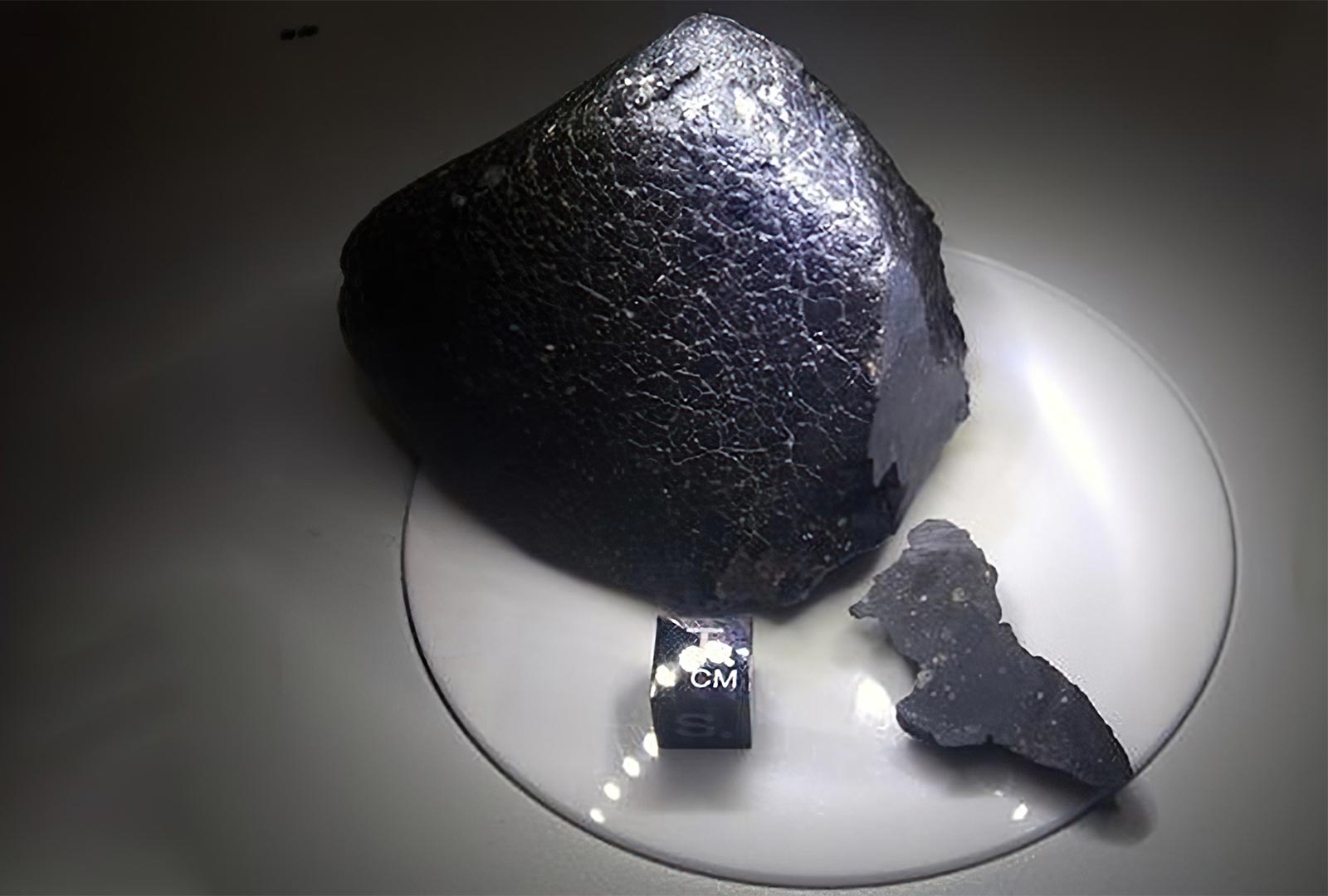
A new study shows that simple hand magnets erase a meteorite’s magnetic memory.
A new MIT study reveals that hand magnets, commonly used by meteorite hunters and collectors to verify meteorites’ identities, often erase the rocks’ magnetic memory, thereby destroying valuable scientific data. The researchers found that hand magnets reorient the microscopic grains within the rocks, eliminating traces of their magnetic origins. The team has analyzed multiple samples of a meteorite known as Northwest Africa (NWA) 7034 or “Black Beauty,” only to find that all samples have been remagnetized since landing on Earth. To avoid further destruction of magnetic records, the researchers recommend using susceptibility meters instead of hand magnets, despite the higher cost.
Each year, thousands of space rocks pierce through the Earth’s atmosphere and hit the ground as meteorites. These fragments of comets and asteroids can land anywhere but are most often spotted in open terrain, such as the deserts of Africa and the Antarctic blue ice, where a meteorite’s blackened exterior can stand out.
Still, these extraterrestrial remnants can resemble Earth rocks, and to tell the difference meteorite hunters often expose their “finds” to hand magnets, which can attract more strongly to metal-rich meteorites than to terrestrial rocks. Meteorite hunters, dealers, collectors, and curators often rely on hand magnets to verify a meteorite’s identity.
But a new MIT study finds that the same magnets used to identify a meteorite usually erase its magnetic memory. They show that exposure to a magnet can reorient a rock’s microscopic grains, undoing their original orientation and any trace of its magnetic origins.
The researchers make their case with Northwest Africa (NWA) 7034, a meteorite known in collectors’ circles as “Black Beauty” for its obsidian exterior. Multiple shards of the meteorite were first discovered in the deserts of northwest Africa, and scientists determined that the rock contained crystals that formed on Mars more than 4.4 billion years ago.
Black Beauty is thought to have formed at a time when the Red Planet harbored a magnetic field, much like the Earth does today. If the rock bears any trace of Mars’ ancient field, this could give scientists valuable clues to the planet’s past climate and composition.
Unfortunately, the MIT team found that multiple samples of Black Beauty have been remagnetized since landing on Earth, and that any hint of an ancient Martian field has been wiped clean.
“There was an incredible record there, and a unique opportunity to understand the early history of Mars’ magnetism,” says study author Benjamin Weiss, professor of planetary sciences at MIT. “But we found it’s all been obliterated by magnets.”
With their new study, published on April 6 in the Journal of Geophysical Research: Planets, the researchers hope to raise awareness in the planetary science community about the destructive effects of hand magnets. Weiss’ co-authors are MIT postdoc Foteini Vervelidou and France Lagroix of the Paris Institute of Planetary Physics.
Dead Ends
Tens of thousands of meteorites have been discovered to date. Nearly every found meteorite has been traced to about 100 parent bodies across the solar system, including asteroids, the moon, and Mars. Scientists attempting to read the history of these rocks have only recently come to realize that some interpretations were way off the mark, due to the influence of hand magnets.
For instance, samples of Allende, the largest and most studied meteorite on Earth, bear traces of exposure to a strong magnetic field. Scientists assumed this field was evidence that the meteorite formed long ago in a solar nebula that hosted an extremely high magnetic field. Only later did they realize that hand magnets were to blame for the meteorite’s curiously strong pull.
Weiss has also been duped by artificially reset rocks. When he first joined the MIT faculty, he discovered signs of strong magnetism in fallen samples of an asteroid. The findings would have been the first evidence that asteroids can differentiate and form metallic cores like the Earth. But he later discovered, much to his frustration, that the meteorite had been reset by hand magnets.
“There’s a long history of dead ends and confusion over remagnetized rocks,” Weiss says.
For the MIT team, the tipping point came with NWA 7034. In 2014, fellow paleomagnetist Jérôme Gattacceca measured a sample of Black Beauty and found its original magnetism, which was set more than 4.4 billion years ago, had been entirely undone by much stronger hand magnets on Earth. Weiss and Vervelidou recently analyzed numerous other samples of Black Beauty, hoping to find at least one magnetically preserved sample.
“Our initial hope was that by testing as many [samples] of this meteorite as possible, we would end up finding a few non-remagnetized ones,” Vervelidou says. “Once we concluded that all of the samples we studied have been remagnetized, the motivation was to spread the word about the destructive effects of hand magnets.”
Shifting a Field
In their new study, the team laid out the ways in which hand magnets can affect a rock’s natural magnetism. They first developed a numerical model, based on the physics of magnetism, to calculate the field surrounding a typical hand magnet and how it affects rocks of various sizes.
They then carried out experiments, exposing samples of the same terrestrial rock to magnetic fields of varying strengths and at various distances, and measured how each sample’s inherent magnetism changed in response. These measurements matched the model’s predictions, showing that the model can be used to determine whether a rock has been remagnetized. The model can also be used to estimate, based on a rock’s magnetization, the depth at which a rock may still be unaffected.
Finally, the team reported their measurements of nine Black Beauty samples and confirmed with their model that every found piece of the meteorite had indeed been exposed to hand magnets.
“What we have in this paper is finally a clear, unambiguous work plan for establishing whether your rock has been hit by a magnet,” Weiss says.
Instead of hand magnets, the researchers are recommending that meteorite hunters, collectors, and museum curators use susceptibility meters — handheld instruments that have been shown to quickly and accurately identify a meteorite without scrambling its magnetic memory.
Weiss acknowledges that susceptibility meters are a hard sell — commercial models are worth several thousand dollars, compared to some hand magnets that cost next to nothing. Within the meteorite trade, he hopes first to convince people upstream, such as museum curators and collectors. From there, word may trickle down to those making discoveries on the ground.
“There’s been this incredible explosion of meteorite diversity and number in the last 20 years or so, and we owe meteorite hunters a thanks for finding these things,” Weiss says. “But the tradeoff, the devil’s bargain, is that often they are using magnets to find them, and are immediately destroying their magnetic record in the process.”
Reference: “Hand Magnets and the Destruction of Ancient Meteorite Magnetism” by Foteini Vervelidou, Benjamin P. Weiss and France Lagroix, 6 April 2023, Journal of Geophysical Research: Planets.
DOI: 10.1029/2022JE007464
This research was funded, in part, by the European Union’s Horizon 2020 research and innovation program.
Never miss a breakthrough: Join the SciTechDaily newsletter.
Follow us on Google and Google News.
1 Comment
It’s too bad, but it’s a question of if you want the meteorites or not. Magnets cost a few pennies, these susceptibility meters cost thousands of dollars. Weiss would be better served convincing institutions to buy these detectors for the best meteorite hunters, and then the question is how much is this magnetic data worth to institutions.