
Close Menu
    Facebook X (Twitter) Instagram
    SciTechDaily
    • Biology
    • Chemistry
    • Earth
    • Health
    • Physics
    • Science
    • Space
    • Technology
    Facebook X (Twitter) Pinterest YouTube RSS
    SciTechDaily
    Home»Science»Amber Captured Cretaceous Period Spider Attacking a Wasp
    Science

    Amber Captured Cretaceous Period Spider Attacking a Wasp

    By SciTechDailyOctober 9, 20122 Comments2 Mins Read
    Facebook Twitter Pinterest Telegram LinkedIn WhatsApp Email Reddit
    Share
    Facebook Twitter LinkedIn Pinterest Telegram Email Reddit
    amber-spider-wasp-original
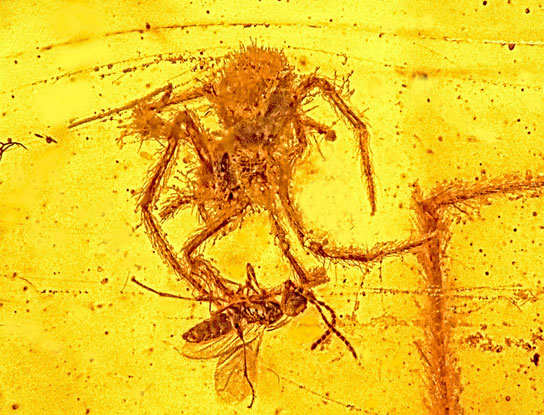
    This is the only fossil ever discovered that shows a spider attacking prey in its web. Preserved in amber, it’s about 100 million years old. Credit: Photo courtesy of Oregon State University

    A Cretaceous period juvenile spider was trapped in amber before it could devour a male wasp caught in its web. This is the first time that such a scene has been found in the fossil record.

    The scientists published their findings in the journal Historical Biology. This event occurred in the Early Cretaceous period, about 97 to 110 million years ago, in the Hukawng Valley, in Myanmar. Undoubtedly, dinosaurs were around this area as well. The spider is a social orb-weaver spider (Geratonephila burmanica) and the wasp is of the species Cascoscelio incassus, both of which are extinct today.

    Wasp species are known to parasitize spider eggs. This wasp was watching the spider just as it was about to be attacked. That’s when the tree resin flowed over and captured them both, states entomologist George Poinar Jr. of Oregon State University.

    Another spider was captured some distance away, also in amber, and could have been co-habiting the same web as the juvenile. Males of modern-day social orb-weavers are typically found living on female-constructed webs, where they usually assist in capturing insects and maintaining the web.

    There are also droplets on the fossil web that contain aerial plankton, which basically are pollen, spores, and dust particles from that time.

    Reference: “Predatory behaviour of the social orb-weaver spider, Geratonephila burmanica n. gen., n. sp. (Araneae: Nephilidae) with its wasp prey, Cascoscelio incassus n. gen., n. sp. (Hymenoptera: Platygastridae) in Early Cretaceous Burmese amber” by George Poinar Jr. and Ron Buckley, 2 December 2011, Historical Biology.
    DOI: 10.1080/08912963.2011.640399

    Never miss a breakthrough: Join the SciTechDaily newsletter.
    Follow us on Google and Google News.

    Amber Cretaceous Entomology Evolutionary Entomology Fossils Paleontology
    Share. Facebook Twitter Pinterest LinkedIn Email Reddit

    Related Articles

    35-Million-Year-Old Mystery: Strange Arachnid Discovered Preserved in Amber

    Scientists Discover 40-Million-Year-Old Ant Hidden in Historic Amber Collection

    Real-Life Monster: Scientists Discover Strange Wasp From 99 Million Years Ago

    Like Nothing Seen Before – New Type of Wasp Discovered With Mysterious, Cloud-Like Structures at Ends of Antennae

    33 Million Years Old: The Largest Flower Preserved in Amber

    3D Renderings of Carboniferous Period Insects

    Cretaceous Period Sankofa Pyrenaica Fossilized Eggs Are Unusually Shaped

    Jurassic Period Super-Sized Fleas Had Armored Mouthparts to Attack the Thick Hide of Dinosaurs

    Hundreds of Lost Fossils From the Darwin Collection Rediscovered by the British Geological Survey

    2 Comments

    1. kenny on October 9, 2012 5:51 pm

      Notice the lack of evolutionary evidence.. already exactly like they were created.. Hmm .. real scientists look at everything.. Darwidiots look only at false longings..

      Reply
    2. Bob on November 22, 2012 9:44 am

      “both of which are extinct today.”

      I hope you read your Bible better than you did the article your criticising.
      Could explain a lot.

      Reply
    Leave A Reply Cancel Reply

    • Facebook
    • Twitter
    • Pinterest
    • YouTube

    Don't Miss a Discovery

    Subscribe for the Latest in Science & Tech!

    Trending News

    Popular Sugar-Free Sweetener Linked to Liver Disease, Study Warns

    What Is Hantavirus? The Deadly Disease Raising Alarm Worldwide

    Scientists Just Discovered How the Universe Builds Monster Black Holes

    Scientists Unveil New Treatment Strategy That Could Outsmart Cancer

    A Simple Vitamin May Hold the Key to Treating Rare Genetic Diseases

    Scientists Think the Real Fountain of Youth May Be Hiding in Your Gut

    Ravens Don’t Follow Wolves, They Predict Them

    This Common Knee Surgery May Be Doing More Harm Than Good

    Follow SciTechDaily
    • Facebook
    • Twitter
    • YouTube
    • Pinterest
    • Newsletter
    • RSS
    SciTech News
    • Biology News
    • Chemistry News
    • Earth News
    • Health News
    • Physics News
    • Science News
    • Space News
    • Technology News
    Recent Posts
    • Why Are So Many New Fathers Dying? Scientists Say the U.S. Has a Dangerous Blind Spot
    • Scientists Identify Simple Supplement That Greatly Reduces Alzheimer’s Damage
    • You May Have a Dangerous Type of Cholesterol Even if Your Tests Look Normal
    • Study Reveals Dangerous Flaw in AI Symptom Checkers
    • New MRI Breakthrough Captures Stunningly Clear Images of the Eye and Brain
    Copyright © 1998 - 2026 SciTechDaily. All Rights Reserved.
    • Science News
    • About
    • Contact
    • Editorial Board
    • Privacy Policy
    • Terms of Use

    Type above and press Enter to search. Press Esc to cancel.