
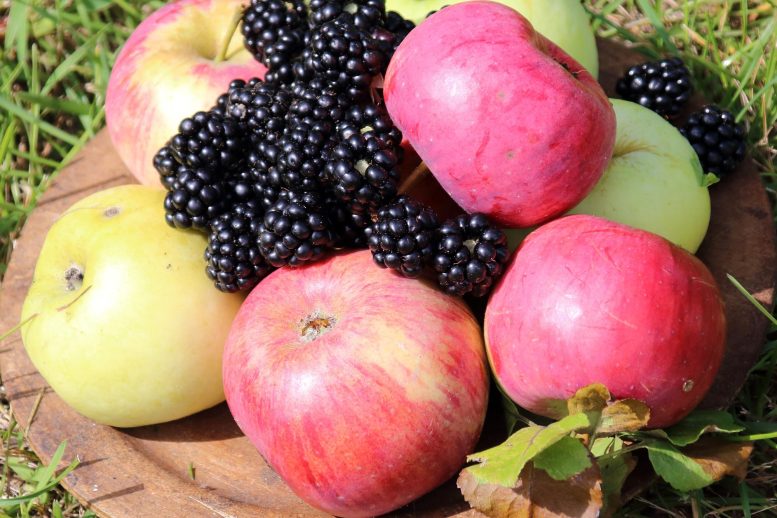
Foods rich in flavonoids like quercetin, found in apples and blackberries, could reduce the odds of frailty in older adults by 20%, according to a study published in the American Journal of Clinical Nutrition. Despite no significant link between overall flavonoid intake and frailty, a higher intake of flavonols (a subclass of flavonoids), especially quercetin, was strongly associated with preventing frailty.
Eating plant-based foods that contain dietary compounds called flavonols can lower your chances of developing frailty.
Foods like apples and blackberries that contain flavonoids called quercetin may be the most important for frailty prevention.
Approximately 10% to 15% of older adults experience frailty, a geriatric syndrome that leads to a greater risk of falls, fractures, disability, hospitalization, and mortality. Current dietary recommendations for frailty prevention primarily focus on protein intake. However, there are many other foods that may have health benefits
“There may be some validity to the old saying, an apple a day keeps the doctor (or frailty) away,” said the authors. “Our findings suggest that for every 10 mg higher intake of flavonols per day, the odds of frailty were reduced by 20%. Individuals can easily consume 10 mg of flavonols intake per day since one medium-sized apple has about 10 mg of flavonols.”
“Although there was no significant association between total flavonoid intake and frailty, higher flavonols intake (one of the subclasses of flavonoids) was associated with lower odds of developing frailty. Specifically, higher quercetin intake was the flavonoid that had the strongest association with frailty prevention. This data suggests that there may be particular subclasses of flavonoids that have the most potential as a dietary strategy for frailty prevention,” said coauthor Shivani Sahni, PhD, of Department of Medicine, Beth Israel Deaconess Medical Center, Harvard Medical School, and the Hinda and Arthur Marcus Institute for Aging Research, Hebrew SeniorLife; and Courtney L. Millar, PhD, of the Department of Medicine, Beth Israel Deaconess Medical Center, Harvard Medical School, and the Hinda and Arthur Marcus Institute for Aging Research, Hebrew SeniorLife.
The authors suggest that future research should focus on dietary interventions of flavonols or quercetin for the treatment of frailty. Research is also needed in racially and ethnically diverse participants.
The findings were published in the American Journal of Clinical Nutrition.
Reference: “Higher Intake Of Dietary Flavonols, Specifically Dietary Quercetin, Is Associated With Lower Odds Of Frailty Onset Over 12-Years Of Follow-Up Among Adults In The Framingham Heart Study” by Steven Oei, MSc, Courtney L. Millar, PhD, Thuy Nga Nguyen, RN, BSN, Kenneth J. Mukamal, MD, MPH, Douglas P. Kiel, MD, MPH, Lewis A. Lipsitz, MD, Marian T. Hannan, DSc, MPH and Shivani Sahni, PhD, 13 April 2023, American Journal of Clinical Nutrition.
DOI: 10.1016/j.ajcnut.2023.04.013
This is one of the first community-based studies that comprehensively examined the role of dietary flavonoids for frailty prevention.
This study utilizes data from the Framingham Heart Study – Offspring Cohort to determine the association between flavonoid intake and frailty onset. There were 1,701 individuals included in this analysis. All were free of frailty at baseline and followed from ~12 years to evaluate frailty status (evaluated by the Fried Frailty Phenotype). After ~12 years, 13.2% of the participants developed frailty. Total flavonoids intake was not significantly associated with frailty onset. However, flavonols intake (a type of flavonoid, in particular quercetin) was associated with lower odds of frailty onset.
This study was funded by the National Institute on Aging (NIA) grant number R01 AG051728, the National Heart, Lung and Blood Institute’s Framingham Heart Study (contract numbers HHSN268201500001I and N01-HC 25195). Dr. Millar was supported by the NIA/NIH T32-AG023480 and the Beth and Richard Applebaum Research Fund. Ms. Nguyen was supported by the NIA through the Medical Student Training in Aging Research (MSTAR) Program. DPK was funded by R01 AR041398 and R01 AR061445. Dr. Lipsitz was supported by R21 AG073886 from the NIA. He also holds the Irving and Edyth S. Usen Chair in geriatric medicine at Hebrew SeniorLife. Dr. Mukamal was supported by K24 AG065525.
Never miss a breakthrough: Join the SciTechDaily newsletter.
Follow us on Google and Google News.