
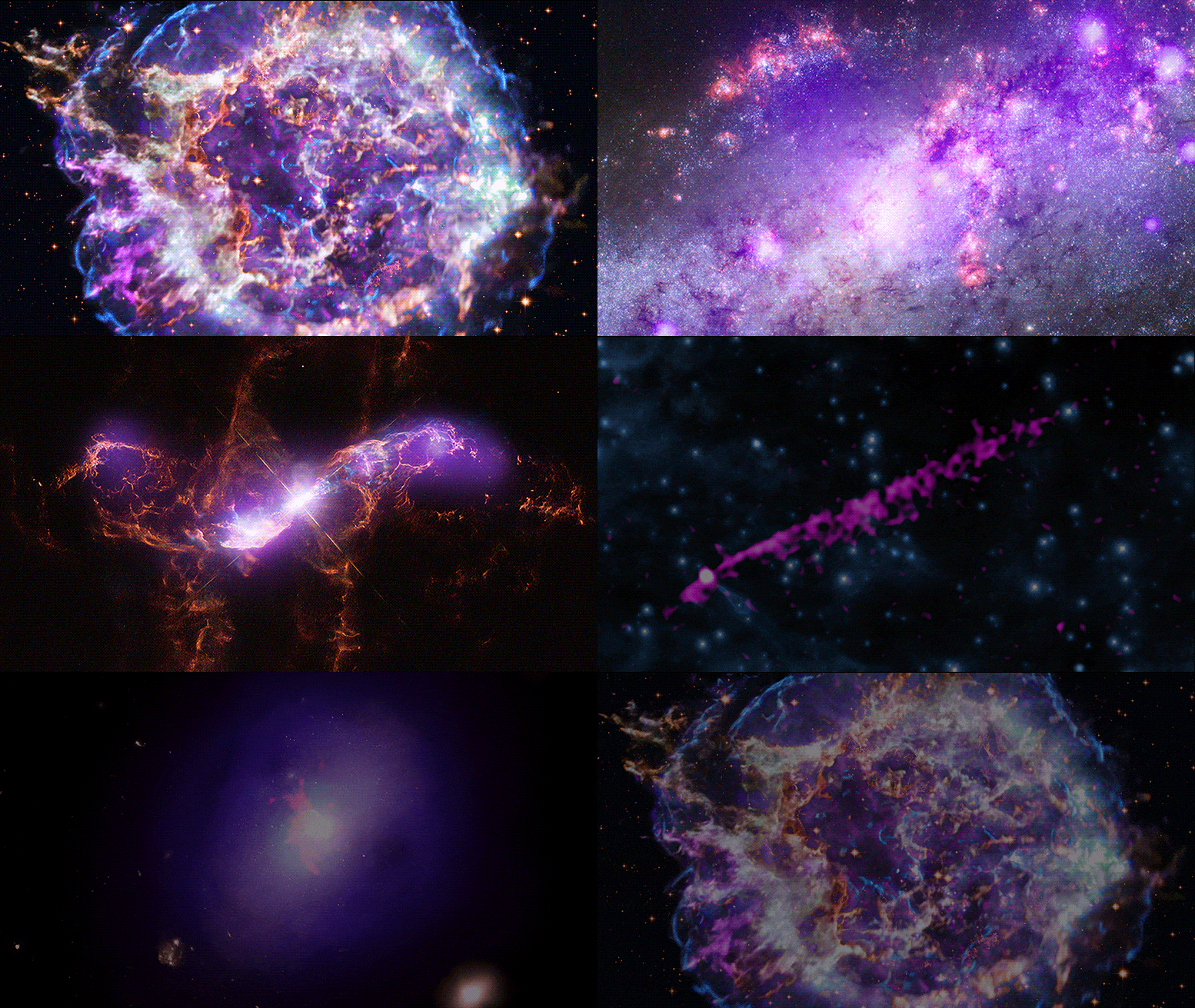
- A new gallery of images combining X-ray data from Chandra with those from other telescopes is being released.
- The objects range from a supernova remnant within the Milky Way to a galaxy cluster millions of light years away.
- The layers of data are colored in each image to enhance various features.
- This is a demonstration of how new telescopes like JWST and IXPE will work with other observatories to explore the Universe.
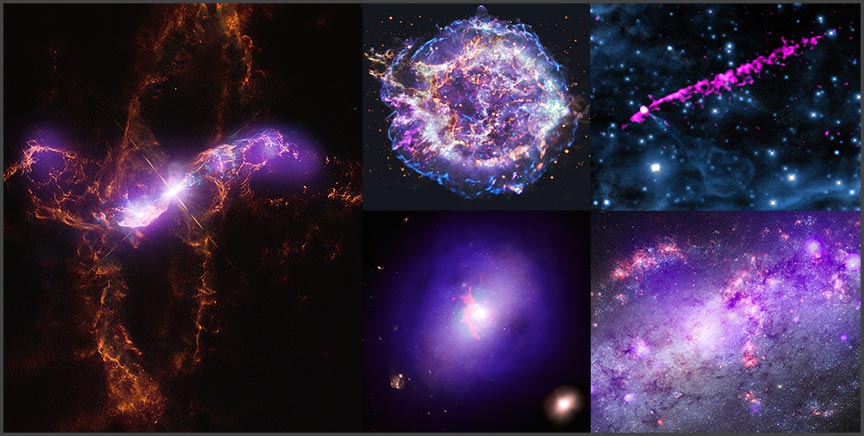
The recent launches of the James Webb Space Telescope (Webb) and the Imaging X-ray Polarimetry Explorer (IXPE) by NASA and its international partners are excellent reminders that the universe emits light or energy in many different forms. To fully investigate cosmic objects and phenomena, scientists need telescopes that can detect light across what is known as the electromagnetic spectrum.
This gallery provides examples of the ways that different types of light from telescopes on the ground and in space can be combined. The common thread in each of these selections is data from NASA’s Chandra X-ray Observatory, illustrating how X-rays — which are emitted by very hot and energetic processes — are found throughout the Universe.
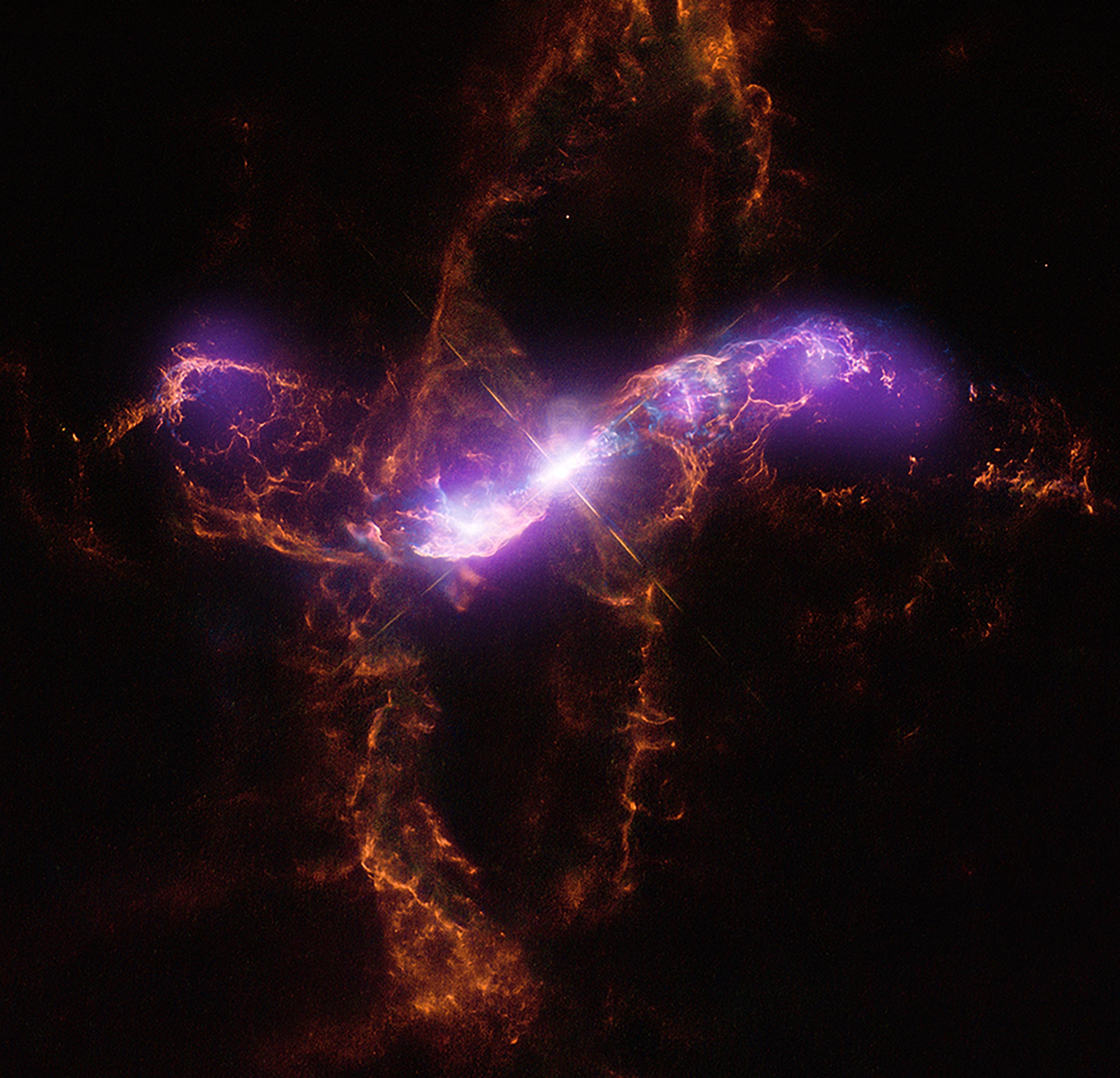
R Aquarii
This object is, in fact, a pair: a white dwarf star that steadily burns at a relatively cool temperature and a highly variable red giant. As they orbit each other, the white dwarf pulls material from the red giant onto its surface. Over time, enough of this material accumulates and triggers an explosion. Astronomers have seen such outbursts over recent decades. Evidence for much older outbursts is seen in the spectacular structures observed by NASA’s Hubble Space Telescope (red and blue). X-ray data from Chandra (purple) shows how a jet from the white dwarf is striking material surrounding it and creating shock waves, similar to sonic booms from supersonic planes.
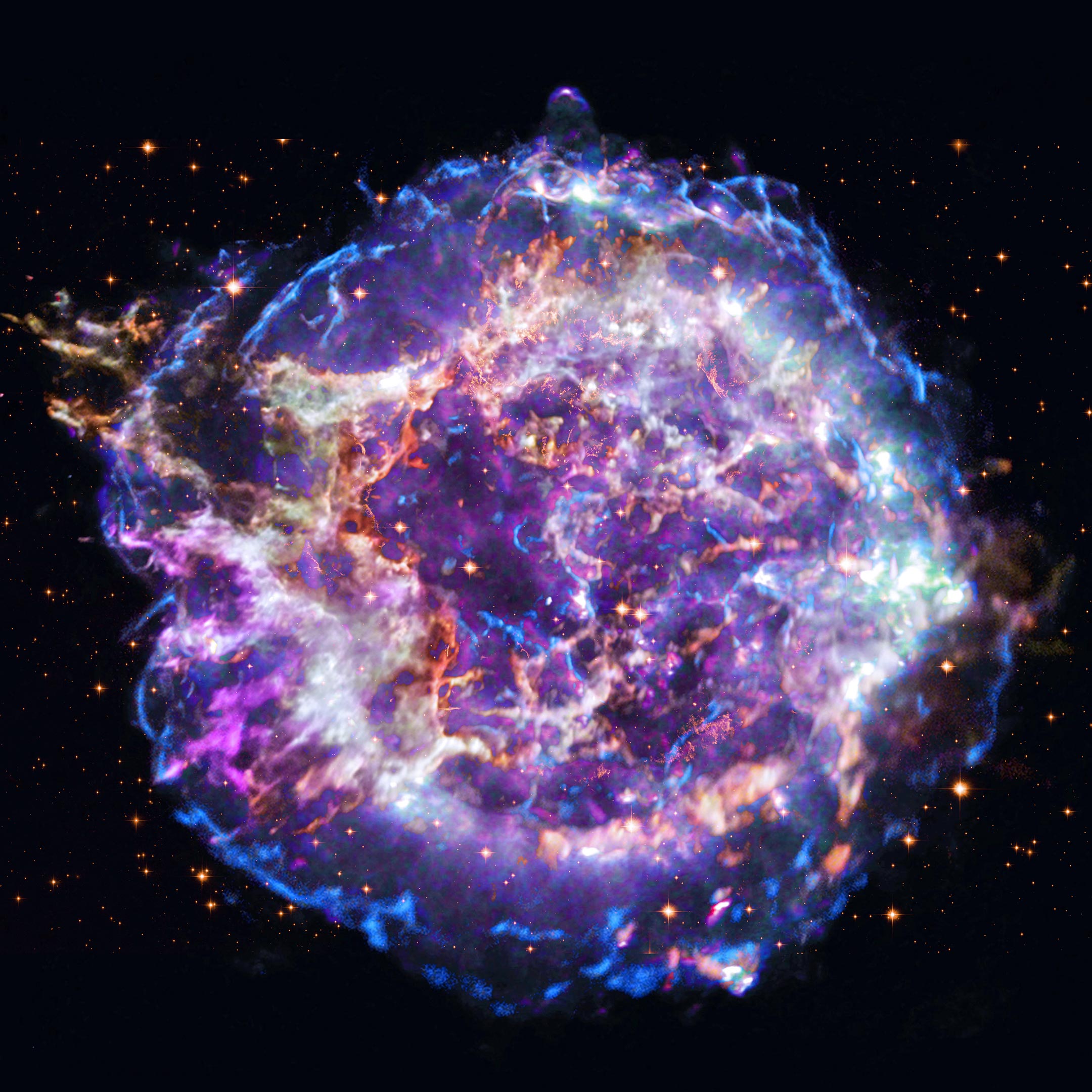
Cassiopeia A
Chandra’s observations of the Cassiopeia A supernova remnant have shown how individual elements from the exploded star are being cast off into space. In this image, X-rays reveal silicon (red), sulfur (yellow), calcium (green), and iron (light purple). The blue around the rim of the remnant reveals the blast wave from the explosion as it travels outward. This image also adds a layer of radio data of Cassiopeia A from the National Science Foundation’s Karl Jansky Very Large Array (dark purple, blue, and white) and an optical image from Hubble (orange). Like X-rays, radio waves can penetrate thick clouds of gas and dust that lie between Earth and Cassiopeia A, providing additional information about this famous stellar explosion.
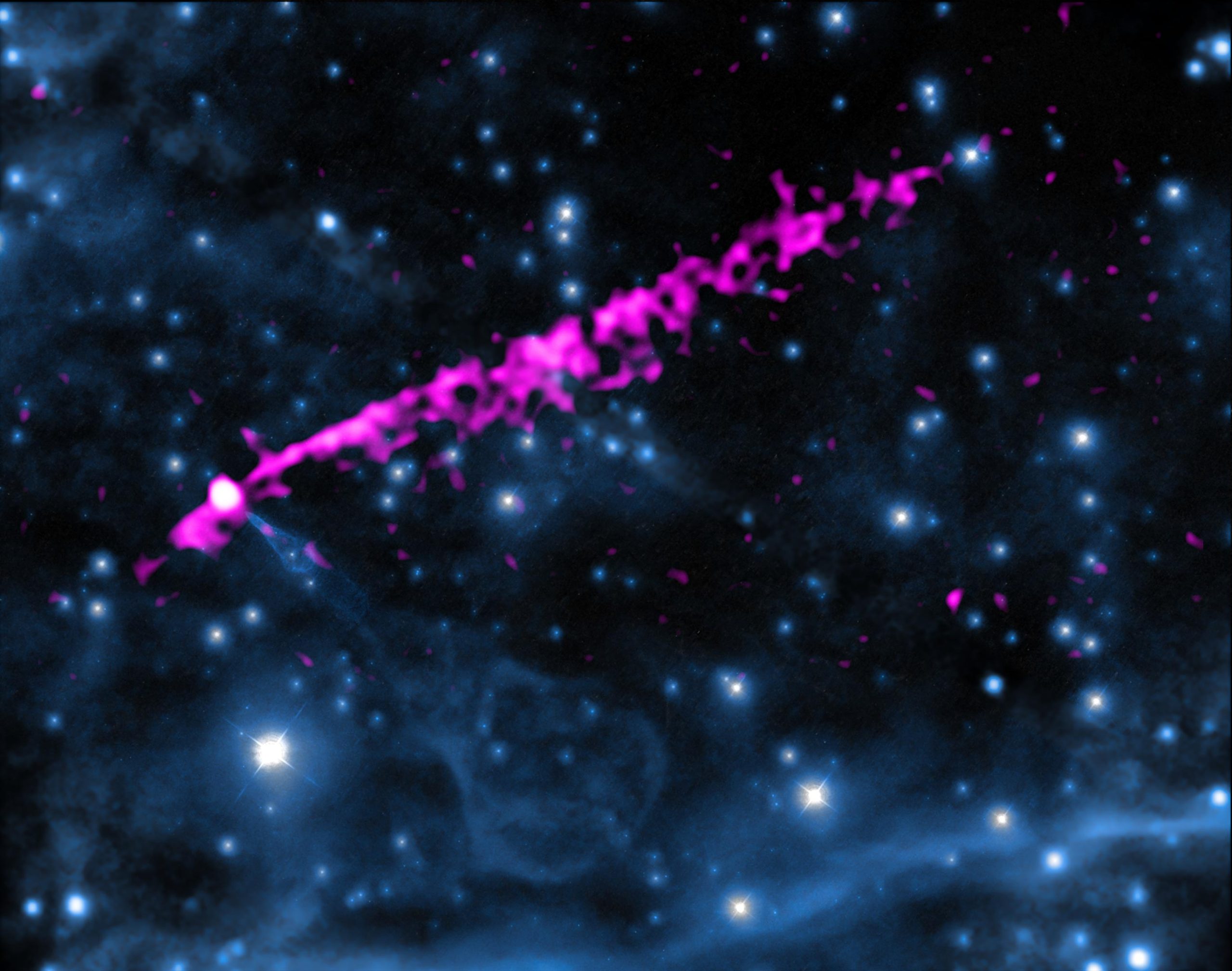
Guitar Nebula
For the last decade or so, astronomers have been puzzled by the alignment of some jets of X-rays coming from very fast-moving pulsars (that is, spinning neutron stars) that shoot out into interstellar space at odd, unexpected angles. This is what astronomers see with PSR B2224+65, a pulsar found near the structure nicknamed the “Guitar Nebula” due to its shape in optical light (blue). An X-ray stream (pink) captured by Chandra is pointed nearly perpendicular to the guitar-shaped structure, originating from the magnetic poles of the pulsar.
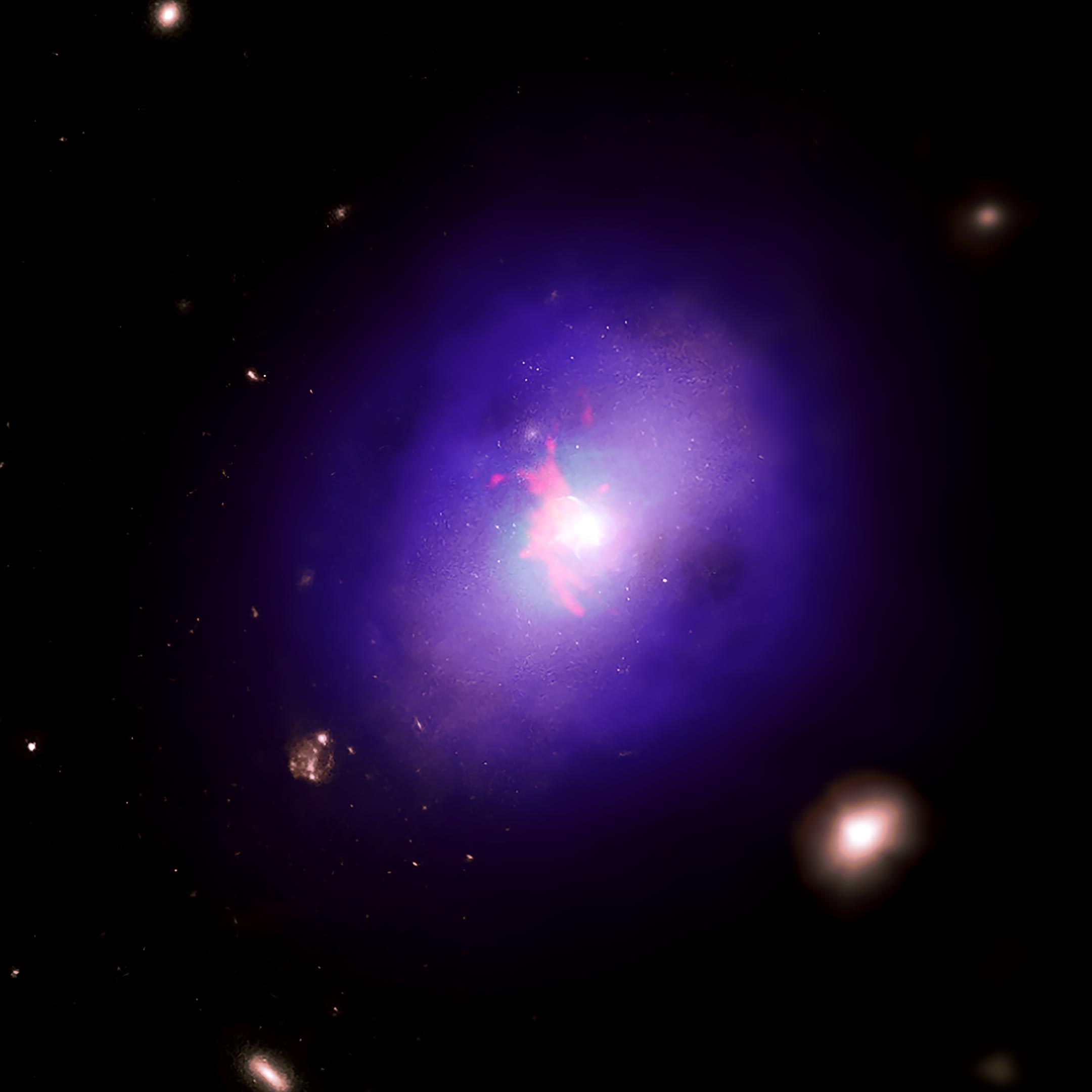
Abell 2597
Galaxy clusters, the largest structures in the universe held together by gravity, are dynamic environments containing individual galaxies and huge amounts of hot gas and dark matter. Often, an enormous black hole in the center of a cluster can help drive its behavior. In the galaxy cluster Abell 2597, a giant central supermassive black hole is driving the gas outward and creating bubbles, or voids, within it. This composite image of Abell 2597 includes X-rays from Chandra (blue), optical data from the Digitized Sky Survey (orange), and emission from hydrogen atoms in optical light from the Las Campanas Observatory in Chile (red).
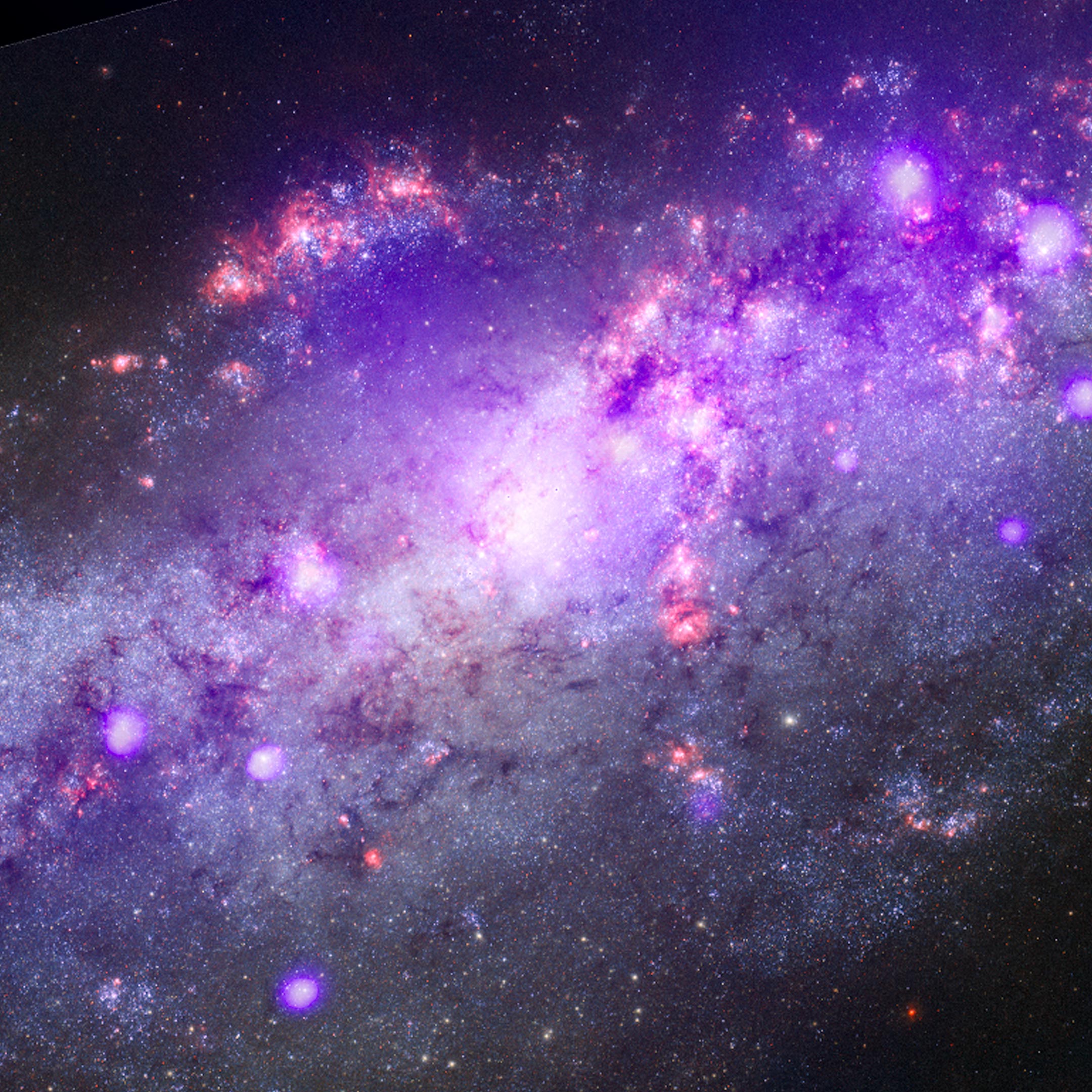
NGC 4490
When two galaxies are in the process of merging, the gravitational interaction can trigger waves of star formation. This is the case for NGC 4490, a spiral galaxy that has collided with a smaller galaxy to the upper right but not seen in this image. Scientists think that these two galaxies have already had their closest approach and are now separating from one another. Some of the point-like sources of X-rays represent stellar-mass black holes and neutron stars within the galaxy. In this image of NGC 4490, X-rays from Chandra (purple) have been combined with an optical image from Hubble (red, green, and blue).
NASA’s Marshall Space Flight Center manages the Chandra program. The Smithsonian Astrophysical Observatory’s Chandra X-ray Center controls science operations from Cambridge, Massachusetts, and flight operations from Burlington, Massachusetts.
Never miss a breakthrough: Join the SciTechDaily newsletter.
Follow us on Google and Google News.
2 Comments
Imagine over decades, now j webb telescope will add to more understanding;of universe…Believe my eyes. Onk onk🐢🐢
Extremely Interesting .
Here are some thhoughts for cosideration.
1. Think of Energy-Matter as a spectrum.
2. Now correlate all the data and observations gathered till date , on the above spectrum to determine the mix which exists in each of the above. Map it on a appropriate dimensional level for understanding.
3. Keep in mind that the sum total of Energy-Matter must be a constant. Principle of Conservation of the whole, energy-matter AND /Or Matter Energy.
4. The composition of the potential and kinetic forms of the Matter-Energy or Energ-Matter mix can vary .
5. We use Rongten Rays in Medicine to see through the flesh and oberve the bones/ skeleton.
6. The ability of the Human Species to see through the gas and dust clouds, depending purely on the Sense of Sight or the other five Gross Senses alone may be limited, regardless of how great a telescope we make. Higher Senses need to be dveloped and honed, to get a much better understanding of the Universe and why it is the way it is.
Views exressed are personal and not binding on anyone. .