
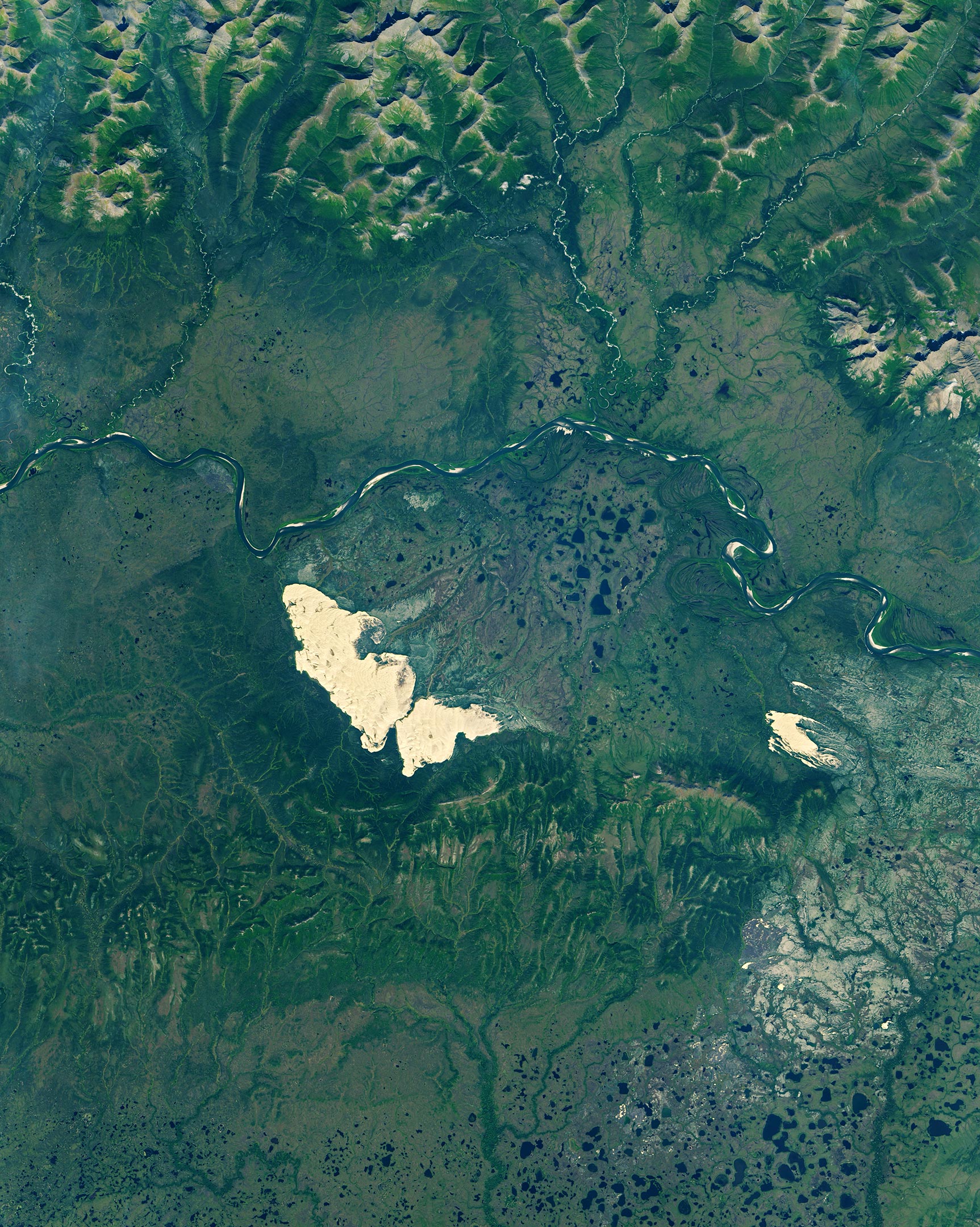
Within an expanse of boreal forest in northwestern Alaska, two treeless stretches of sand stand out—the Great Kobuk Sand Dunes. With crests that rise as high as 100 feet (30 meters) above the surrounding forests, the dunes look like they belong in the Saharan Desert more than in the Arctic.
The dunes owe their existence to glacial ice. During recent ice age cycles, massive sheets of ice bulldozed mountains and other rocky surfaces in the region, creating an abundance of sand, silt, and loess that collected along the banks of glacial streams. Over time, sediment-laden streams and dust-filled winds deposited much of that material in the ice-free Kobuk Valley, which is sheltered by the Baird Mountains to the north and the Waring Mountains to the south.
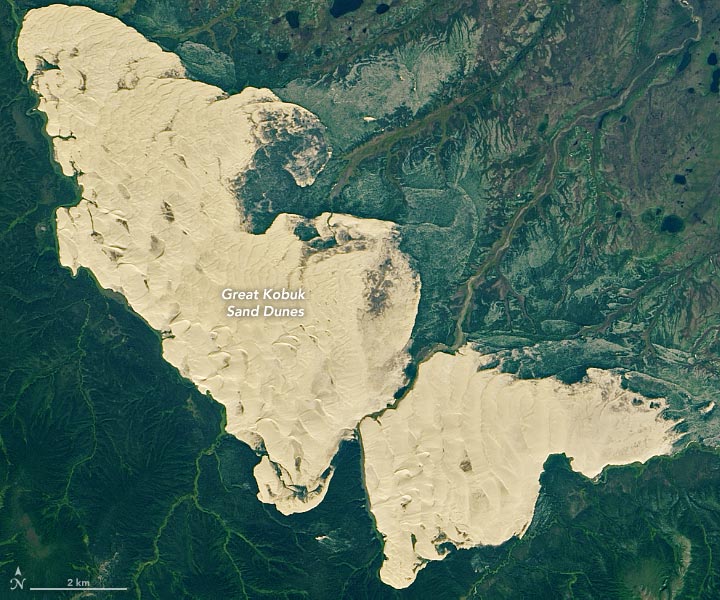
The Operational Land Imager (OLI) on Landsat 8 acquired this image of the Kobuk Valley and its dunes on August 16, 2020. While tundra grasses and forests have encroached upon and now cover about 90 percent of the sand that blankets Kobuk Valley, shifting winds still freely sculpt roughly 25 square miles (65 square kilometers) of active dune fields. Ridge-like transverse dunes are common in the northern part of the Great Kobuk Dune Field, while crescent-shaped barchan and parabolic dunes appear in significant numbers in the southern part.
The dunes are one of the highlights of Kobuk Valley National Park—one of the most remote sites in the U.S. National Park System. While hundreds of thousands of caribou migrate through the park each year, the absence of roads and other facilities means the number of human visitors to the park is typically less than 20,000, and often much lower.
One notable group has made the journey to Kobuk: geologists who study dunes on Mars. Since the Great Kobuk dunes are frozen and crusted with snow and frost for much of the year, they move quite slowly in comparison to dunes in warmer areas. They are akin to sand dunes on Mars, some of which have ice-like layers of frozen carbon dioxide frost during the winter. In fact, scientists from the Southwest Research Institute first discovered that sand dunes on Mars can move by using a satellite-based technique that they initially developed and tested among the Great Kobuk dunes.
NASA Earth Observatory images by Lauren Dauphin, using Landsat data from the U.S. Geological Survey.
Never miss a breakthrough: Join the SciTechDaily newsletter.
Follow us on Google and Google News.
1 Comment
Very , Very Interesting.
Some Ideas and Thoughts for consideration.
1. Always Wondered why Sands are there as a Separator between the Oceans, Seas and the Land on which ALL Land Based Creatures Dwell. Amphibins Dwell in Both.
2. Now I can see a Connection to Climate Change and Past Ice Ages and the Creationof the Planet Earth, which is like a Blue Jewel when viewed from Space!
3.Everything has a Reason and a Purpose. The Sands on the beaches protect us from the Waves which are attempting to re-capture the Land!, Humans have Pushed back the Seas and recaptured the Land from the Seas and Oceans —-across the Globe as their population has grown across the Globe —–using modern Technology.
4. USE Existing Computing Power and Parallel Processing Methodolofgies to increase the Power of getting Answers plaguimg Humanity and Scientific Progress. This Coupled with Quantum Computing (Currently in its Infancy) can help us get answers faster.
5. The Sand Dunes in Alaskis is an indication of the fact that the Mother is predicting and attempting to provide such protection by using ICE AGES and WARMING CLIMATE and has Created these Sand Dunes to protect the Forests , which is 100 feet higher than the surroundng forests !!
6. Climate Change is evident in the shorter -term timeframe AS is evident to Climate Scientists. HOWEVER, the Understanding of Climate Change and Past ICE Ages and its impact on the Shaping of the Earths Crust , as a result of Various Catosptrophic events from the Past like Erathquakes, Volcanoes, Asteroid Strikes, and other such events, is rather poorly understood and ability to anticipate the same and provide protectionfor AND survival of alll of Gods Creatures appears to be limited.
7. So, the Mother is providing a Helping Hand! (Mother Nature). Look at the time frames of the various aspscts of Science carefully when doing scientific Research in terms of the existence of te Sun, Moon, Planets, AND Stars and their evolution in terms of Infinite Time at the Gross Level as well as Time Frames ” Without a Second” at the Quantum Level to Connect the Quantum Processes with the Gross Processes. Assumptions about Linear Nature of Time and Spehrical Nature of Space (In a Three Dimensional / Two Dimensional Universe we inhabit) may be highly exaggerated and fallacious. Interesting insights from attempting to Understand Light in its Diiferent Forms are becoming evident! Will share when I get some time! SOON.