
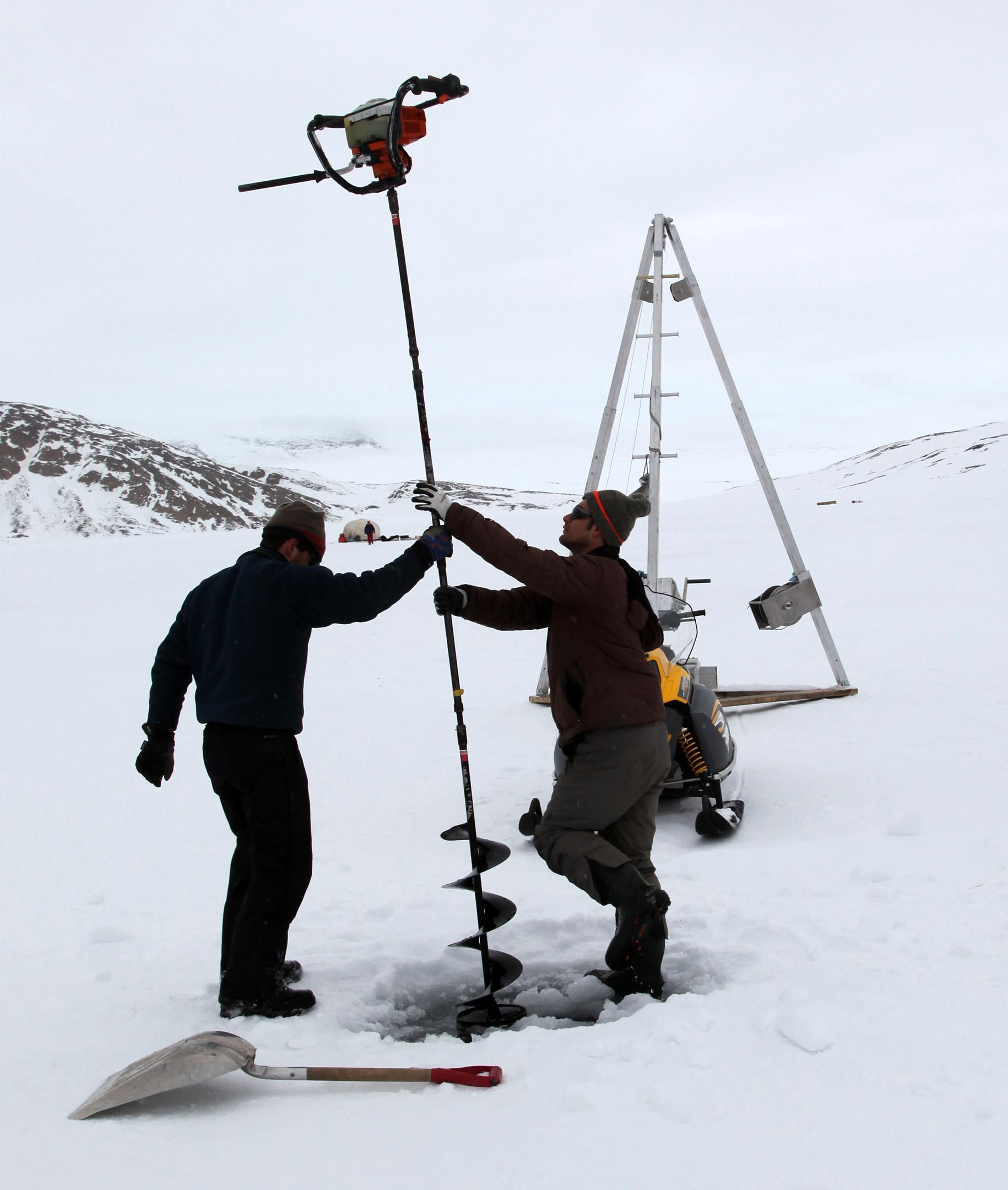
University of Massachusetts Amherst, Canadian research uses ancient lake sediments to extend climate record.
Taking advantage of the unique properties of sediments from the bottom of Sawtooth Lake in the Canadian High Arctic, climate scientists have extended the record of Atlantic sea-surface temperature from about 100 to 2,900 years, and it shows that the warmest interval over this period has been the past 10 years.
A team led by Francois Lapointe and Raymond Bradley in the Climate System Research Center of the University of Massachusetts Amherst and Pierre Francus at University of Québec-INRS analyzed “perfectly preserved” annual layers of sediment that accumulated in the lake on northern Ellesmere Island, Nunavut, which contain titanium left over from centuries of rock weathering. By measuring the titanium concentration in the different layers, scientists can estimate the relative temperature and atmospheric pressure over time.
The newly extended record shows that the coldest temperatures were found between about 1400-1600 A.D., and the warmest interval occurred during just the past decade, the authors report. Francus adds, “Our unique data set constitutes the first reconstruction of Atlantic sea surface temperatures spanning the last 3,000 years and this will allow climatologists to better understand the mechanisms behind long-term changes in the behavior of the Atlantic Ocean.”

When temperatures are cool over the North Atlantic, a relatively low atmospheric pressure pattern is found over much of the Canadian High Arctic and Greenland. This is associated with slower snow melt in that region and higher titanium levels in the sediments. The opposite is true when the ocean is warmer – atmospheric pressure is higher, snow melt is rapid and the concentration of titanium decreases.
Lapointe says, “Using these strong links, it was possible to reconstruct how Atlantic sea surface temperatures have varied over the past 2,900 years, making it the longest record that is currently available.” Details were published on October 12, 2020, in Proceedings of the National Academy of Sciences.
The researchers report that their newly reconstructed record is significantly correlated with several other independent sediment records from the Atlantic Ocean ranging from north of Iceland to offshore Venezuela, confirming its reliability as a proxy for the long-term variability of ocean temperatures across a broad swath of the Atlantic. The record is also similar to European temperatures over the past 2,000 years, they point out.
Fluctuations in sea surface temperatures, known as the Atlantic Multidecadal Oscillation (AMO), are also linked to other major climatic upheavals such as droughts in North America and the severity of hurricanes. However, because measurements of sea surface temperatures only go back a century or so, the exact length and variability of the AMO cycle have been poorly understood.
Climate warming in the Arctic is now twice or three times faster than the rest of the planet because of greenhouse gas emissions from burning fossil fuels, warming can be amplified or dampened by natural climate variability, such as changes in the surface temperature of the North Atlantic, which appear to vary over cycles of about 60-80 years.
Lapointe, who has carried out extensive fieldwork in the Canadian Arctic over the past decade, notes that “It has been common in recent summers for atmospheric high-pressure systems – clear-sky conditions – to prevail over the region. Maximum temperatures often reached 20 degrees Celsius, 68 degrees Fahrenheit, for many successive days or even weeks, as in 2019. This has had irreversible impacts on snow cover, glaciers and ice caps, and permafrost.”
Bradley adds that “The surface waters of the Atlantic have been consistently warm since about 1995. We don’t know if conditions will shift towards a cooler phase any time soon, which would give some relief for the accelerated Arctic warming. But if the Atlantic warming continues, atmospheric conditions favoring more severe melting of Canadian Arctic ice caps and the Greenland ice sheet can be expected in the coming decades.”
In 2019, Greenland Ice Sheet lost more than 500 billion tons of mass, a record, and this was associated with unprecedented, persistent high-pressure atmospheric conditions.”
Lapointe notes, “Conditions like this are currently not properly captured by global climate models, underestimating the potential impacts of future warming in Arctic regions.”
Reference: “Annually resolved Atlantic sea surface temperature variability over the past 2,900 y” by Francois Lapointe, Raymond S. Bradley, Pierre Francus, Nicholas L. Balascio, Mark B. Abbott, Joseph S. Stoner, Guillaume St-Onge, Arnaud De Coninck, and Thibault Labarre, 12 October 2020, Proceedings of the National Academy of Sciences.
DOI: 10.1073/pnas.2014166117
Never miss a breakthrough: Join the SciTechDaily newsletter.
Follow us on Google and Google News.
1 Comment
Where was Captain Obviouis in your time of need
Your article claims temperatures are warmer than ever ,
but U make a point of how difficult it is to get through the ice
Why is there ice if it is so warm?
How did the titanium sink to the bottom through the ice cover?
Given that the sediment only accumulates on the lake bottom when there is open water,
How many years accumulation of atmospheric fallout are in the present ice cover?
biggest question though, why is there such thick ice if it is so much warmer than ever before?