
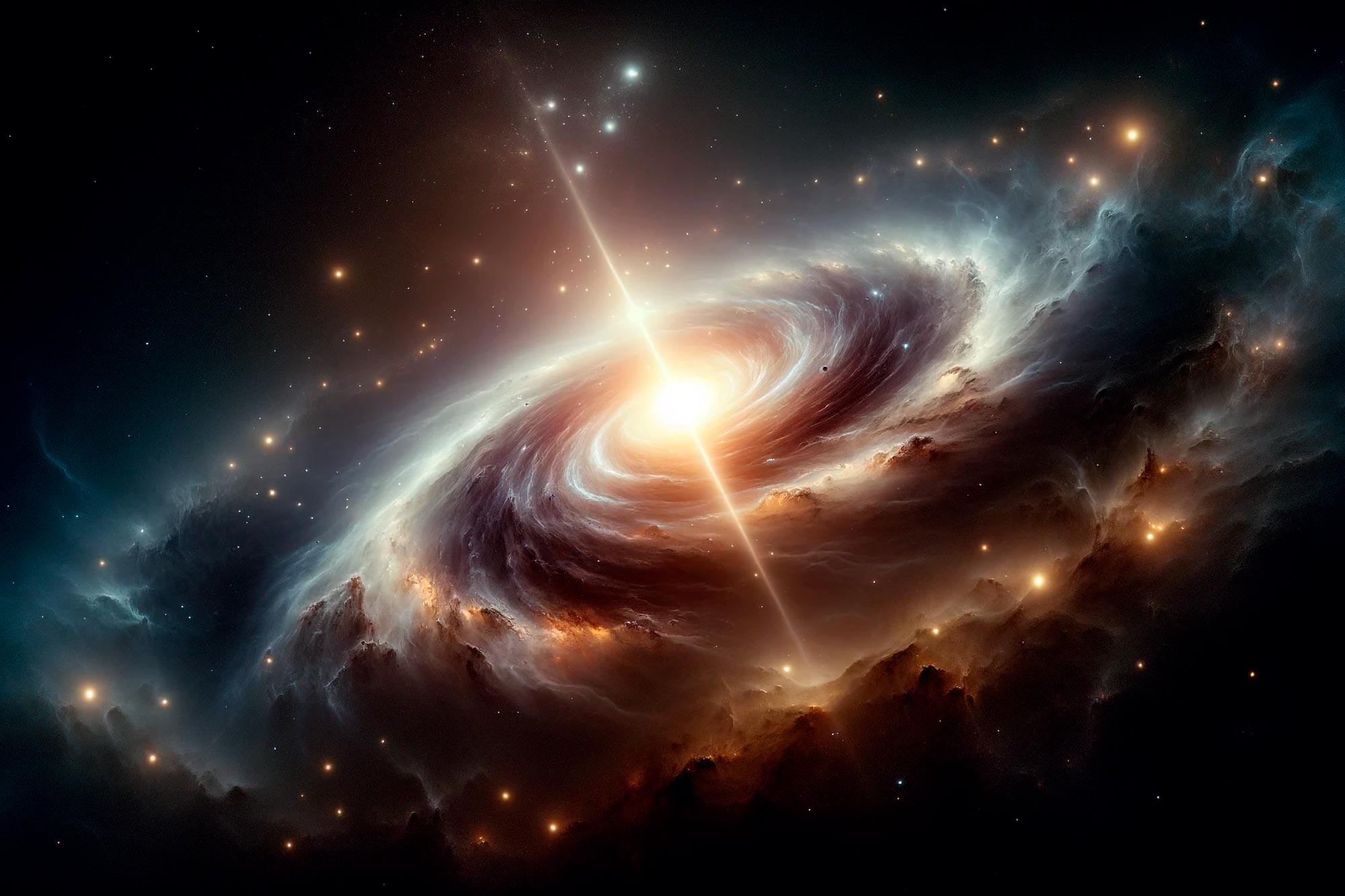
Ancient starlight from the earliest quasars has been captured by MIT astronomers, revealing that some of earliest “monster” black holes likely grew from massive cosmic seeds.
MIT astronomers have observed the faint starlight surrounding some of the earliest quasars in the universe. These distant signals, originating more than 13 billion years ago during the infancy of the universe, provide insights into the evolution of the very first black holes and galaxies.
Quasars are the blazing bright centers of active galaxies, which host an insatiable supermassive black hole at their core. Most galaxies host a central black hole that may sporadically feast on gas and stellar debris, generating a brief burst of light in the form of a glowing ring as material swirls in toward the black hole.
By contrast, quasars operate on a different scale. They can consume enormous amounts of matter over much longer stretches of time, generating an extremely bright and long-lasting ring — so bright, in fact, that quasars are among the most luminous objects in the universe.
Advances in Observational Astronomy
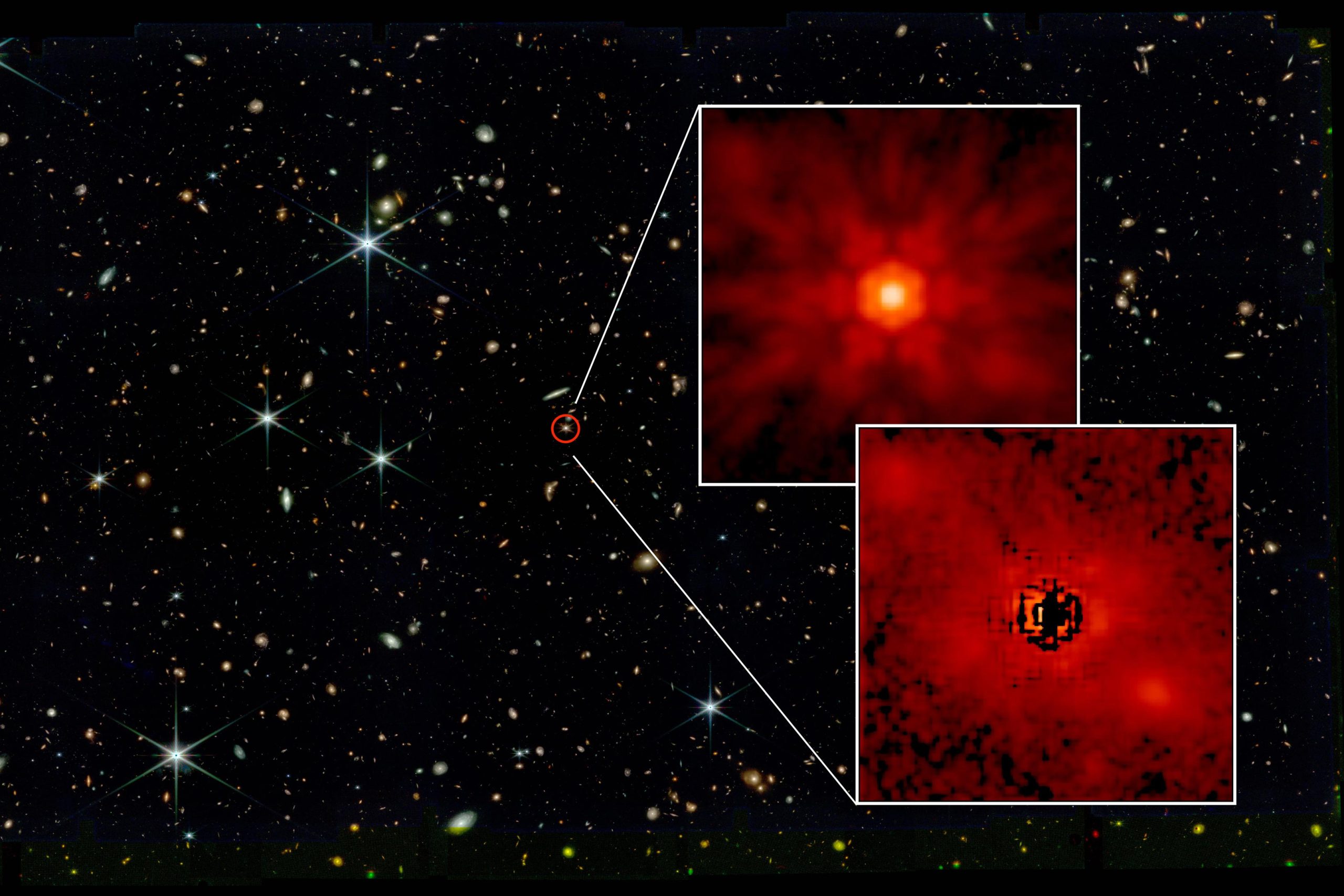
Because they are so bright, quasars outshine the rest of the galaxy in which they reside. But the MIT team was able for the first time to observe the much fainter light from stars in the host galaxies of three ancient quasars.
Based on this elusive stellar light, the researchers estimated the mass of each host galaxy, compared to the mass of its central supermassive black hole. They found that for these quasars, the central black holes were much more massive relative to their host galaxies, compared to their modern counterparts.
Evolution of Early Black Holes
The findings, published recently in the Astrophysical Journal, may shed light on how the earliest supermassive black holes became so massive despite having a relatively short amount of cosmic time in which to grow. In particular, those earliest monster black holes may have sprouted from more massive “seeds” than more modern black holes did.
“After the universe came into existence, there were seed black holes that then consumed material and grew in a very short time,” says study author Minghao Yue, a postdoc in MIT’s Kavli Institute for Astrophysics and Space Research. “One of the big questions is to understand how those monster black holes could grow so big, so fast.”
“These black holes are billions of times more massive than the sun, at a time when the universe is still in its infancy,” says study author Anna-Christina Eilers, assistant professor of physics at MIT. “Our results imply that in the early universe, supermassive black holes might have gained their mass before their host galaxies did, and the initial black hole seeds could have been more massive than today.”
Eilers’ and Yue’s co-authors include MIT Kavli Director Robert Simcoe, MIT Hubble Fellow and postdoc Rohan Naidu, and collaborators in Switzerland, Austria, Japan, and at North Carolina State University.
Dazzling Cores
A quasar’s extreme luminosity has been obvious since astronomers first discovered the objects in the 1960s. They assumed then that the quasar’s light stemmed from a single, star-like “point source.” Scientists designated the objects “quasars,” as a portmanteau of a “quasi-stellar” object. Since those first observations, scientists have realized that quasars are in fact not stellar in origin but emanate from the accretion of intensely powerful and persistent supermassive black holes sitting at the center of galaxies that also host stars, which are much fainter in comparison to their dazzling cores.
It’s been extremely challenging to separate the light from a quasar’s central black hole from the light of the host galaxy’s stars. The task is a bit like discerning a field of fireflies around a central, massive searchlight. But in recent years, astronomers have had a much better chance of doing so with the launch of NASA’s James Webb Space Telescope (JWST), which has been able to peer farther back in time, and with much higher sensitivity and resolution, than any existing observatory.
In their new study, Yue and Eilers used dedicated time on JWST to observe six known, ancient quasars, intermittently from the fall of 2022 through the following spring. In total, the team collected more than 120 hours of observations of the six distant objects.
“The quasar outshines its host galaxy by orders of magnitude. And previous images were not sharp enough to distinguish what the host galaxy with all its stars looks like,” Yue says. “Now for the first time, we are able to reveal the light from these stars by very carefully modeling JWST’s much sharper images of those quasars.”
Analyzing Ancient Starlight
The team took stock of the imaging data collected by JWST of each of the six distant quasars, which they estimated to be about 13 billion years old. That data included measurements of each quasar’s light in different wavelengths. The researchers fed that data into a model of how much of that light likely comes from a compact “point source,” such as a central black hole’s accretion disk, versus a more diffuse source, such as light from the host galaxy’s surrounding, scattered stars.
Through this modeling, the team teased apart each quasar’s light into two components: light from the central black hole’s luminous disk and light from the host galaxy’s more diffuse stars. The amount of light from both sources is a reflection of their total mass. The researchers estimate that for these quasars, the ratio between the mass of the central black hole and the mass of the host galaxy was about 1:10. This, they realized, was in stark contrast to today’s mass balance of 1:1,000, in which more recently formed black holes are much less massive compared to their host galaxies.
“This tells us something about what grows first: Is it the black hole that grows first, and then the galaxy catches up? Or is the galaxy and its stars that first grow, and they dominate and regulate the black hole’s growth?” Eilers explains. “We see that black holes in the early universe seem to be growing faster than their host galaxies. That is tentative evidence that the initial black hole seeds could have been more massive back then.”
“There must have been some mechanism to make a black hole gain their mass earlier than their host galaxy in those first billion years,” Yue adds. “It’s kind of the first evidence we see for this, which is exciting.”
Reference: “EIGER. V. Characterizing the Host Galaxies of Luminous Quasars at z ≳ 6” by Minghao Yue, Anna-Christina Eilers, Robert A. Simcoe, Ruari Mackenzie, Jorryt Matthee, Daichi Kashino, Rongmon Bordoloi, Simon J. Lilly and Rohan P. Naidu, 6 May 2024, The Astrophysical Journal.
DOI: 10.3847/1538-4357/ad3914
Never miss a breakthrough: Join the SciTechDaily newsletter.
Follow us on Google and Google News.