
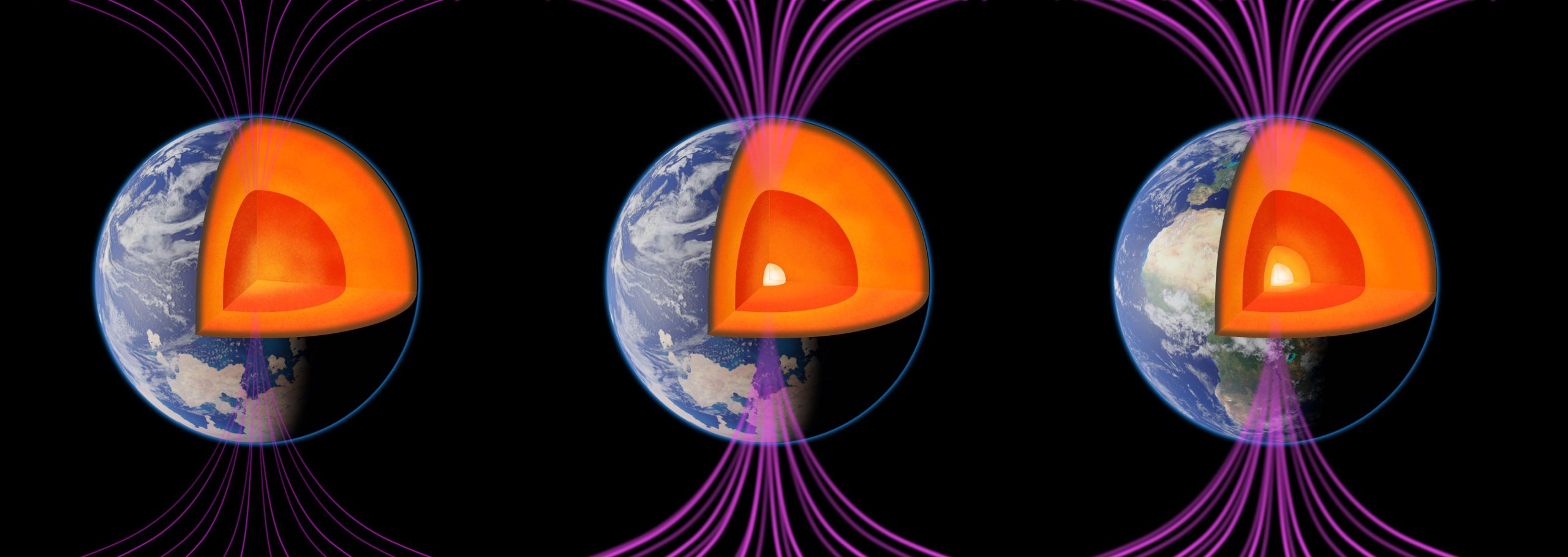
New paleomagnetic research suggests Earth’s solid inner core formed 550 million years ago and restored our planet’s magnetic field.
Swirling liquid iron in the Earth’s outer core, located approximately 1,800 miles (2,900 kilometers) beneath our feet, generates our planet’s protective magnetic field, called the magnetosphere. Although this magnetic field is invisible, it is vital for life on Earth’s surface. That’s because the magnetosphere shields the planet from solar wind—streams of radiation from the sun.
However, about 565 million years ago, the magnetic field’s strength dropped to 10 percent of its strength today. Then, mysteriously, the magnetic field bounced back, regaining its strength just before the Cambrian explosion of multicellular life on Earth.
What caused the magnetosphere to bounce back?
This rejuvenation happened within a few tens of millions of years according to new research from scientists at the University of Rochester. This is very rapid on geological timescales and coincided with the formation of Earth’s solid inner core, suggesting that the core is likely a direct cause.
“The inner core is tremendously important,” says John Tarduno, the William R. Kenan, Jr., Professor of Geophysics in the Department of Earth and Environmental Sciences and dean of research for Arts, Sciences & Engineering at Rochester. “Right before the inner core started to grow, the magnetic field was at the point of collapse, but as soon as the inner core started to grow, the field was regenerated.”
In the paper, published on July 19, 2022, in the journal Nature Communications, the scientists determined several key dates in the inner core’s history, including a more precise estimate of its age. The research provides new clues about the history and future evolution of Earth and how it became a habitable planet, as well as the evolution of other planets in the solar system.
Unlocking Information in Ancient Rocks
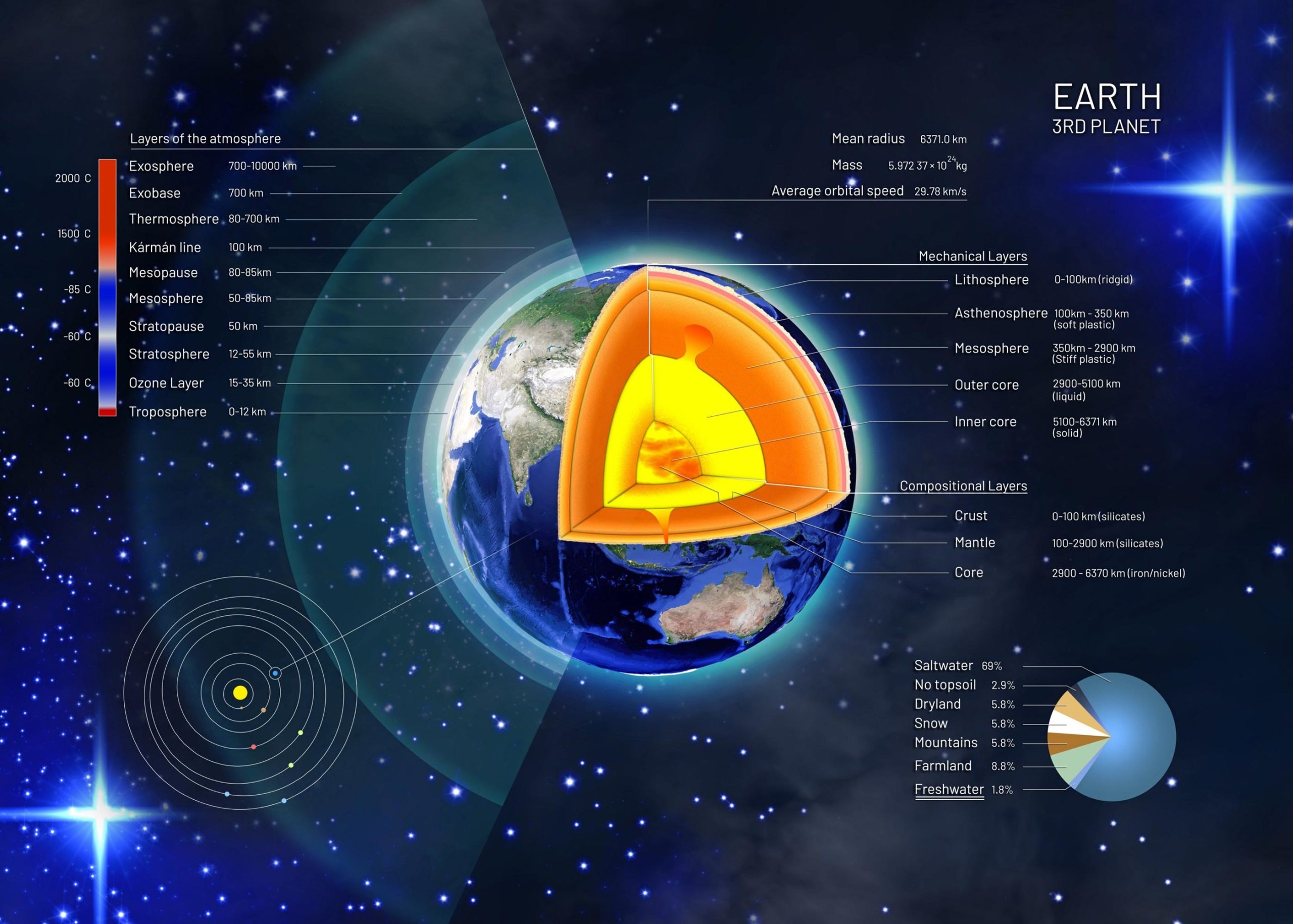
Earth is made up of layers: the crust, where life exists; the mantle, Earth’s thickest layer; the molten outer core; and the solid inner core, which is, in turn, composed of an outermost inner core and an innermost inner core.
Earth’s magnetic field is generated in its outer core. Swirling liquid iron there causes electric currents, driving a phenomenon called the geodynamo that produces the magnetic field.
Because of the magnetic field’s relationship to Earth’s core, scientists have been attempting for decades to ascertain how Earth’s magnetic field and core have changed throughout our planet’s history. They cannot directly measure the magnetic field due to the location and extreme temperatures of materials in the core. Fortunately, minerals that rise to Earth’s surface contain tiny magnetic particles that lock in the direction and intensity of the magnetic field at the time the minerals cool and solidify from their molten state.
To better constrain the age and growth of the inner core, Tarduno and his team used a CO2 laser and the lab’s superconducting quantum interference device (SQUID) magnetometer to analyze feldspar crystals from the rock anorthosite. These crystals have minute magnetic needles within them that are “perfect magnetic recorders,” Tarduno says.
By studying the magnetism locked in ancient crystals—a field known as paleomagnetism—the researchers determined two new important dates in the history of the inner core:
- 550 million years ago: the time at which the magnetic field began to renew rapidly after a near collapse 15 million years before that. The researchers attribute the rapid renewal of the magnetic field to the formation of a solid inner core that recharged the molten outer core and restored the magnetic field’s strength.
- 450 million years ago: the time at which the growing inner core’s structure changed, marking the boundary between the innermost and outermost inner core. These changes in the inner core coincide with changes around the same time in the structure of the overlying mantel, due to plate tectonics on the surface.
“Because we constrained the inner core’s age more accurately, we could explore the fact that the present-day inner core is actually composed of two parts,” Tarduno says. “Plate tectonic movements on Earth’s surface indirectly affected the inner core, and the history of these movements is imprinted deep within Earth in the inner core’s structure.”
Avoiding a Mars-Like Fate
A better understanding of the dynamics and growth of the inner core and the magnetic field has important implications, not only in uncovering Earth’s past and predicting its future, but in unraveling the ways in which other planets might form magnetic shields and sustain the conditions necessary to harbor life.
Researchers believe that Mars, for example, once had a magnetic field, but the field dissipated. That left the planet vulnerable to solar wind and the surface oceanless. While it is unclear whether the absence of a magnetic field would have caused Earth to meet the same fate, “Earth certainly would’ve lost much more water if Earth’s magnetic field had not been regenerated,” Tarduno says. “The planet would be much drier and very different than the planet today.”
In terms of planetary evolution, then, the research emphasizes the importance of a magnetic shield and a mechanism to sustain it, he says.
“This research really highlights the need to have something like a growing inner core that sustains a magnetic field over the entire lifetime—many billions of years—of a planet.”
Reference: “Early Cambrian renewal of the geodynamo and the origin of inner core structure” by Tinghong Zhou, John A. Tarduno, Francis Nimmo, Rory D. Cottrell, Richard K. Bono, Mauricio Ibanez-Mejia, Wentao Huang, Matt Hamilton, Kenneth Kodama, Aleksey V. Smirnov, Ben Crummins and Frank Padgett III, 19 July 2022, Nature Communications.
DOI: 10.1038/s41467-022-31677-7
Never miss a breakthrough: Join the SciTechDaily newsletter.
Follow us on Google and Google News.
6 Comments
The planets are conduits caught up in the sun’s magnetic field, permanent magnetic fields are just that! earth’s induced magnetism keeps shifting up to 40klms a day! GET IT.
No. Measurements show it is internally generated and shifts much more slowly. For instance:
“Polar drift is a geological phenomenon caused by variations in the flow of molten iron in Earth’s outer core, resulting in changes in the orientation of Earth’s magnetic field, and hence the position of the magnetic north- and south poles.
The North Magnetic Pole is approximately 965 kilometres (600 mi) from the geographic north pole. The pole drifts considerably each day, and since 2007 it moves about 55 to 60 km (34 to 37 mi) per year as a result of this phenomenon.”
Venus has no magnetic field so how has it retained it’s thick atmosphere?
It’s a bit of an oversell. The planets have different insolation (distance to Sun), masses and atmospheres, but given that Venus, Earth and Mars lose water at about the same rate – Earth fastest [see the thesis linked from the link below]. Water can be lost several ways, including into the mantle.
“For astronomers and geologists alike, the burning question is, how much of its water did Venus hold onto during this massive transition? According to research presented by Moa Persson of the Swedish Institute of Space Physics (IRF), Venus actually retained most of its water over the past 4 billion years. Contrary to what researchers previously thought, Venus lost only a small amount of its water to a runaway Greenhouse Effect.
For her thesis, Persson analyzed data gathered by the IRF’s Analyzer of Space Plasma and Energetic Atoms (ASPERA-4) instrument, which studied Venus’ atmosphere as part of the European Space Agency’s (ESA) Venus Express mission. This instrument measuring out-flowing particles escaping from Venus’ atmosphere to learn more about how it interacts with charged particles from the Sun (aka. solar wind).”
https://www.universetoday.com/148790/venus-held-onto-its-water-surprisingly-well-during-its-history/
How did the Earth avoid the fate Mars experienced?
It hasn’t. The core of our planet is cooling and will look like Mars one day. There is no water on Mars but look what is happening here. Water shortages are everywhere. Mars has a 300°F temperature difference between high and low temperatures. Guess what? Our higher and lower temperatures are going up as well.
A planet has a life and we see three of the phases right next to us. Venus is what this planet once looked like and Mars is what our planet will become. Our moon is an example of the end of all normal matter with no atmosphere at all.
Science doesn’t understand the entropy of of matter in our universe because it starts everything made out of gas and dust instead of plasma. Gas and dust doesn’t get to use gravity whenever it pleases to create energy. That makes gravity a free energy which is impossible. Gravity doesn’t create energy, energy creates gravity.
Every celestial object we see began its life as a mass of quark plasma, or, a black hole. Quark plasma creates all the naturally occurring elements all by itself from the outside of the mass inward. There is no such thing as “supernovae” to create elements. That only happens when a star gets struck by a meteor. Quark plasma is the energy at the core that is needed to create all the nucleosynthesis that happens, not supernovae.
Climate change is due to our core cooling which is lessening the energy needed for gravity. Our planet is slowly losing its atmosphere just like Mars and the Moon have. That’s why climate change is producing more high temperatures but also record low temperatures as well. Our atmosphere protects us from the radiation of the Sun but, just as importantly, protects us from the absolute zero temperature of space.
No, very different planets, see the article.
And don’t confuse rapid man made global warming and ground water pumping with slow geodynamo changes that started 0.5 billion years ago.