
Close Menu
    Facebook X (Twitter) Instagram
    SciTechDaily
    • Biology
    • Chemistry
    • Earth
    • Health
    • Physics
    • Science
    • Space
    • Technology
    Facebook X (Twitter) Pinterest YouTube RSS
    SciTechDaily
    Home»Biology»Ancient Wasp-Mimicking Fly Discovered – Named After PSY’s ‘Gangnam Style’
    Biology

    Ancient Wasp-Mimicking Fly Discovered – Named After PSY’s ‘Gangnam Style’

    By AKSON Russian Science Communication AssociationDecember 23, 2019No Comments2 Mins Read
    Facebook Twitter Pinterest Telegram LinkedIn WhatsApp Email Reddit
    Share
    Facebook Twitter LinkedIn Pinterest Telegram Email Reddit
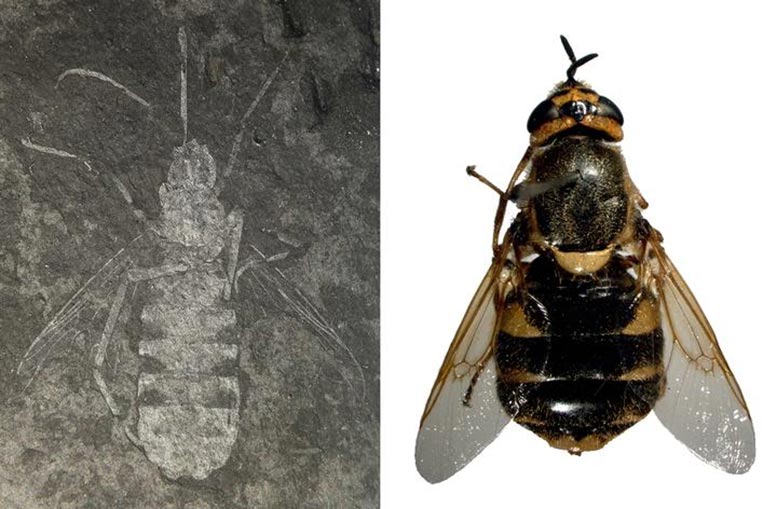
    Buccinatormyia gangnami Fossil with Stratiomys fly
    The fossil fly Buccinatormyia gangnami and the related living wasp mimic fly Stratiomys. Credit: Alexander Khramov, Gi-Soo Nam

    A newly discovered species of ancient wasp-mimicking flies was named Buccinatormyia gangnami, after a famous hit by a South Korean singer PSY. It was described based on six impression fossils found near Jinju city in South Korea. On average, members of this species were twice larger than the common house fly, with a probosci’s length up to 5 mm. Their darkish abdomen were embellished with four pairs of light spots, very similar to yellowjacket patterns which typically displayed by hoverflies and other extant flower-loving Diptera active during the day.

    The chief model for modern yellowjacket mimics are social wasps united into the Vespidae family. In our time these wasps are as really common as everyone knows who has ever seen them stuck in his or her jam. However, judging by the fossil record, vespid wasps were rare and represented by exclusively solitary taxa in the Early Cretaceous. So probably Buccinatormyia gangnami mimicked something else, or, alternatively, vespid wasps radiated early than currently thought.
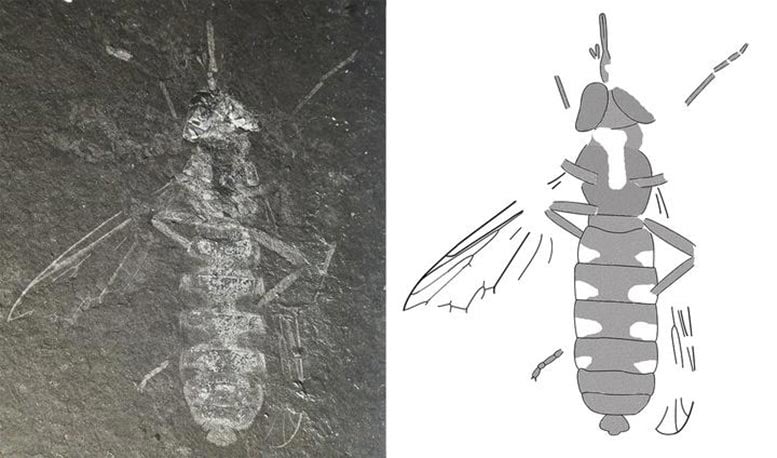
    Buccinatormyia gangnami
    The long-proboscid fly Buccinatormyia gangnami from the Lower Cretaceous of South Korea. Credit: Alexander Khramov, Gi-Soo Nam

    Buccinatormyia gangnami belongs to Zhangsolvidae, a dipteran family which prospered during the Early Cretaceous, but then went extinct due to unknown causes. “There were several lineages of long-proboscid flies during the Mesozoic, and all they were initially associated with gymnosperms. Some managed to survive into our time, while others disappeared, probably due to their inability to adapt themselves to angiosperm-dominated worlds. Why zhangsolvids were destined to lose, we cannot explain yet,” said Alexander Khramov, the study’s leading author and a senior researcher at the Borissiak Paleontological Institute (Moscow).

    Reference: “First long-proboscid flies (Diptera: Zhangsolvidae) from the Lower Cretaceous of South Korea” by Alexander V. Khramov, Gi-Soo Nam and Dmitry V. Vasilenko, 12 December 2019, Alcheringa: An Australasian Journal of Palaeontology.
    DOI: 10.1080/03115518.2019.1664634

    Never miss a breakthrough: Join the SciTechDaily newsletter.
    Follow us on Google and Google News.

    Biodiversity Entomology Evolution Paleontology
    Share. Facebook Twitter Pinterest LinkedIn Email Reddit

    Related Articles

    Tyrannosaurs to Modern Crows: Evolutionary Tracing to Discover How Birds Evolved Big Brains

    Map of Life Will Need to Be Redrawn and Textbooks Updated After Highly Surprising Discovery on Christmas Island

    Absolutely Massive Extinct Turtle Weighed 2,500 Pounds and Had Giant Horned Shell

    Study Traces Evolution of Acoustic Communication Back to 350 Million Years Ago

    Recently Discovered Parasitic Wasp Is Enemy of Serious Alien Pest in North America

    Lichens Are Way Younger Than Scientists Thought – Likely Evolved Millions of Years After Plants

    In a Twist of Fate, Ant Expert Discovers Distinct New Species in His Own Backyard

    The Unexpected Role Ant-Plant Partnerships May Play in Ant Evolution

    Frightening 500-Million-Year-Old Predator Unveils the Rise of Scorpions and Spiders

    Leave A Reply Cancel Reply

    • Facebook
    • Twitter
    • Pinterest
    • YouTube

    Don't Miss a Discovery

    Subscribe for the Latest in Science & Tech!

    Trending News

    New “Nanozyme Hypothesis” Could Rewrite the Story of Life’s Origins

    Anatomy Isn’t Finished: The Human Body Still Holds Secrets

    “Pretty Close to Home”: The Hidden Earthquake Threat Beneath Seattle

    The Surprising Reason You Might Want To Sleep Without a Pillow

    Scientists Say This Natural Hormone Reverses Obesity by Targeting the Brain

    35-Million-Year-Old Mystery: Strange Arachnid Discovered Preserved in Amber

    Is AI Really Just a Tool? It Could Be Altering How You See Reality

    JWST Reveals a “Forbidden” Planet With a Baffling Composition

    Follow SciTechDaily
    • Facebook
    • Twitter
    • YouTube
    • Pinterest
    • Newsletter
    • RSS
    SciTech News
    • Biology News
    • Chemistry News
    • Earth News
    • Health News
    • Physics News
    • Science News
    • Space News
    • Technology News
    Recent Posts
    • These New Molecules Could Change How We Treat Lupus and Arthritis
    • Saunas May Do More Than Raise Body Temperature – They Activate Your Immune System
    • Exercise in a Pill? Metformin Shows Surprising Effects in Cancer Patients
    • Saturn’s Magnetic Shield Isn’t What Scientists Expected
    • Hidden Oceans of Magma Could Be Protecting Alien Life
    Copyright © 1998 - 2026 SciTechDaily. All Rights Reserved.
    • Science News
    • About
    • Contact
    • Editorial Board
    • Privacy Policy
    • Terms of Use

    Type above and press Enter to search. Press Esc to cancel.