

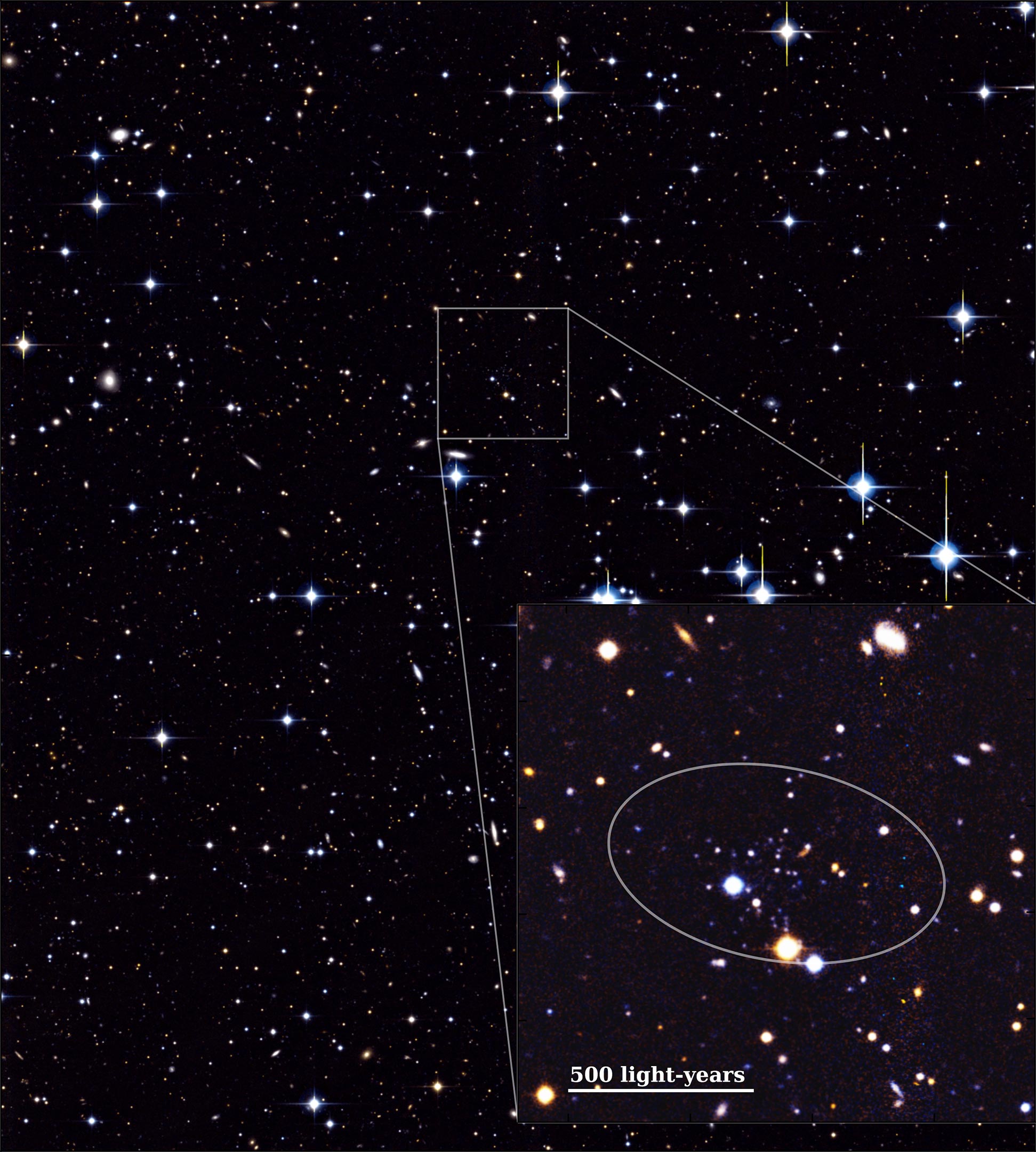
A major discovery on the outskirts of Andromeda is shaking up our understanding of galactic evolution. Astronomers have found the dimmest and smallest satellite galaxy yet—Andromeda XXXV—forcing them to rethink how galaxies form and survive.
This tiny galaxy defied expectations by forming stars billions of years longer than Milky Way satellites and surviving an era when it should have been obliterated. How? That’s the new mystery.
A Tiny Galaxy with Big Implications
A team of researchers led by the University of Michigan has made a discovery that challenges key ideas about galaxy formation, based on what we’ve learned from our own Milky Way.
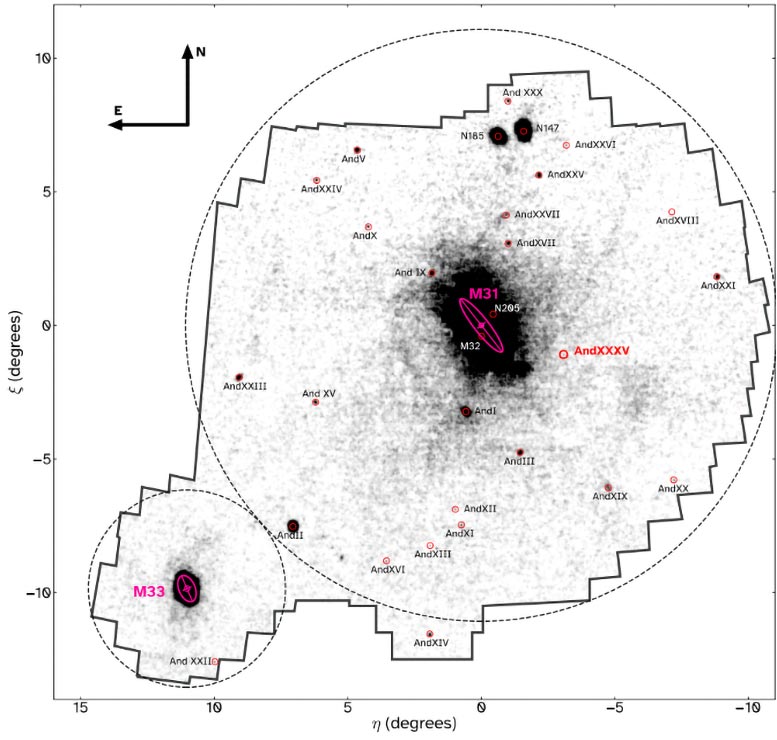
The finding comes from the outer edges of Andromeda, our galaxy’s closest major neighbor, where astronomers have identified its faintest and smallest known satellite galaxy.
This newly discovered dwarf galaxy, named Andromeda XXXV, sits about 3 million light-years away and is reshaping scientists’ understanding of how galaxies evolve in different cosmic environments and across various eras of the universe.
Rewriting the Story of Galactic Evolution
While the discovery raises more questions than answers, that’s the nature of studying the cosmos, says Marcos Arias, lead author of the study published today (March 11) in Astrophysical Journal Letters.
The universe still harbors many mysteries, he said, but this discovery helps correct what we do know and reveals more about what we don’t.
“We still have a lot to discover,” said Arias, who performed this work as an undergraduate student in the Department of Astronomy and is currently a post-baccalaureate researcher in astronomy and physics.
“There are so many things that we still need to learn—even about what’s near to us—in terms of galaxy formation, evolution and structure before we can reverse engineer the history of the universe and understand how we came to be where we are today.”
Our Milky Way system also hosts dozens of these satellite or companion galaxies, too, which explains why their story is still being written. These companions are distinct from their massive, central host galaxy, but still close enough to be caught in its gravitational grasp. The satellites are also much, much smaller.
A Breakthrough in Galactic Discovery
“These are fully functional galaxies, but they’re about a millionth of the size of the Milky Way,” said the study’s senior author, Eric Bell, U-M professor and associate chair of astronomy. “It’s like having a perfectly functional human being that’s the size of a grain of rice.”
Because they’re so much smaller, these satellite galaxies are also a lot dimmer and harder to spot. It’s only been within the last couple decades that astronomers have had technology sensitive enough to discover most of the Milky Way’s known satellites. And it’s currently impossible for observers to spot extremely faint satellites that are orbiting hosts farther away than Andromeda, Bell said.
Because of their proximity to us, the Milky Way’s satellites have been our only source of information on these tiny galaxies. Although scientists have discovered satellite galaxies in Andromeda before—that’s why it’s Andromeda XXXV and not Andromeda I—they’ve been too big and bright to firmly challenge what we’ve learned from the Milky Way.
“This is, in part, why Marcos’ discovery is so important. This type of galaxy was only discoverable around one system, the Milky Way, in the past,” Bell said. “Now we’re able to look at one around Andromeda and it’s the first time we’ve done that outside our system.”
Using Hubble to Spot the Unseen
To discover Andromeda XXXV, Arias first pored over massive observational datasets to look for signs of potential companions. Once he had compiled a list of promising candidates, he and Bell secured time on the Hubble Space Telescope to take a closer inspection.
“The opportunities for high-impact research as an undergraduate in the astronomy department at U-M are extensive,” Arias said. The work was supported by the National Science Foundation and by NASA through the Space Telescope Science Institute.
Using Hubble, the researchers discovered that not only was Andromeda XXXV a satellite galaxy, but it was small enough to resculpt some of our notions of how galaxies evolve, such as how long they’re able to form stars.
“It was really surprising,” Bell said. “It’s the faintest thing you find around, so it’s just kind of a neat system. But it’s also unexpected in a lot of different ways.”
The team also included researchers from the University of Chicago, Utah Valley University, the Vatican Observatory, the University of La Serena in Chile, the University of Alabama, Montana State University and the Leibniz Institute for Astrophysics Potsdam in Germany.
A Celestial Whodunit
Although the discovery was surprising, Bell also stressed that it isn’t unusual for ideas in astronomy to become more complex once we leave our own backyard. When you have only one system to analyze, you can’t be sure what’s a generalizable characteristic and what’s an idiosyncrasy, he said.
Now, Andromeda XXXV has provided enough strong evidence to start confidently distinguishing those features. The most obvious difference between satellites in the Milky Way and in Andromeda was when they stopped forming stars.
The Mystery of Star Formation in Andromeda
“Most of the Milky Way satellites have very ancient star populations. They stopped forming stars about 10 billion years ago,” Arias said. “What we’re seeing is that similar satellites in Andromeda can form stars up to a few billion years ago—around 6 billion years.”
This information also helped the researchers solve what Bell framed as a murder mystery in Andromeda.
Whether a galaxy is huge or tiny, it needs to have a store of gas that’s available to condense into stars. When that gas is gone, star formation stops. A natural question to ask is whether this end comes about by a galaxy’s gas supply petering out on its own, or by being sapped away by the larger host.
For the Milky Way’s satellites, their earlier shut-off tracks with the unaided option. With star formation lasting longer in Andromeda’s small companions, it appears to be the latter.
“It’s a little dark, but it’s either did they fall or did they get pushed? These galaxies appear to have been pushed,” Bell said. “With that, we’ve learned something qualitatively new about galaxy formation from them.”
This extended star formation is even more interesting in the context of Andromeda XXXV’s size and the universe’s history.
Deep Fried Cosmology
The universe started out incredibly hot and dense, but by the time of its first billionth birthday, it had expanded and cooled off to the temperature of a cool spring day. This idyllic temperature was also conducive to the universe’s gas condensing into stars, which gathered into galaxies.
But as these stars churned out energy, and as black holes formed and gobbled up matter, the universe got really hot again. For small galaxies—galaxies with less mass than about 100,000 suns—this was thought to be a death sentence for star formation. The heat would basically cook off the gas needed to seed stars.
“We thought they were basically all going to be fried because the entire universe turned into a vat of boiling oil,” Bell said. But Andromeda XXXV was not fried.
“We thought that it would completely lose its gas, but apparently that doesn’t happen, because this thing is about 20,000 solar masses and yet it was forming stars just fine for a few extra billion years.”
How it survived is now an open question.
The Universe Always Has More Surprises
“I don’t have an answer,” Bell said. “It is also still true that the universe did heat up, we’re just learning the consequences are more complicated than we thought.”
Organizations like NASA are planning on launching missions capable of discovering more satellite galaxies over the coming years, which will help piece together new solutions.
While Arias and Bell are obviously excited for that and to learn as much as they can from the tools currently at their disposal, they’re also comfortable living in the unknown. For Arias, it’s what drew him to the field.
“It’s the universe,” he said. “There will always be something new to discover.”
Reference: “Andromeda XXXV: The Faintest Dwarf Satellite of the Andromeda Galaxy” by Jose Marco Arias, Eric F. Bell, Katya Gozman, In Sung Jang, Saxon Stockton, Oleg Y. Gnedin, Richard D’Souza, Antonela Monachesi, Jeremy Bailin, David Nidever and Roelof S. de Jong, 11 March 2025, The Astrophysical Journal Letters.
DOI: 10.3847/2041-8213/adb433
Never miss a breakthrough: Join the SciTechDaily newsletter.
Follow us on Google and Google News.
1 Comment
Reads title: *GASP*