

The Antarctic Peninsula is rapidly greening, with vegetation increasing tenfold since 1986 due to warming temperatures and glacial retreat.
Mosses dominate the landscape, raising ecological concerns such as biodiversity loss and nonnative species invasions. Scientists highlight the need for biosecurity and detailed field research to understand these changes.
A Changing Antarctic Landscape
Antarctica, a continent defined by its icy, monochromatic landscapes, is becoming greener—at least along parts of its edges. A 35-year analysis of Landsat satellite data reveals that vegetated areas on the Antarctic Peninsula have expanded more than tenfold since 1986.
As glaciers retreat and temperatures rise, plants are finding new opportunities to grow in this and other cold regions. Researchers believe this spread of vegetation could mark a significant ecological shift for the peninsula, sparking questions about its future.
Tracking Vegetation Growth With Satellite Observations
Using data from Landsat 5 through Landsat 8, scientists measured the increase in vegetated land on the Antarctic Peninsula, which grew from 0.86 to 11.95 square kilometers (0.33 to 4.61 square miles) between 1986 and 2021. Remarkably, this greening trend accelerated after 2016. The study, published in Nature Geoscience in October 2024, was led by environmental scientist Tom Roland from the University of Exeter and remote sensing expert Olly Bartlett from the University of Hertfordshire.
Their results are encapsulated in the maps above. The panels show the amount of green on the peninsula’s ice-free land below 300 meters (1,000 feet) elevation at select years in the study period. The shade of each hexagon corresponds to the amount of land area where levels of plant greenness and density, as determined by the satellite-based Normalized Difference Vegetation Index (NDVI), were high enough to indicate the “almost certain” presence of vegetation. The NDVI values were derived from cloud-free Landsat observations from March of each year, which typically encompasses the end of the growing season. The maps show significant expansion in vegetation cover across the South Shetland Islands (at the top-left of each panel) and down the western side of the peninsula to nearly the southern limit for plant growth.
Mosses and Their Expanding Role
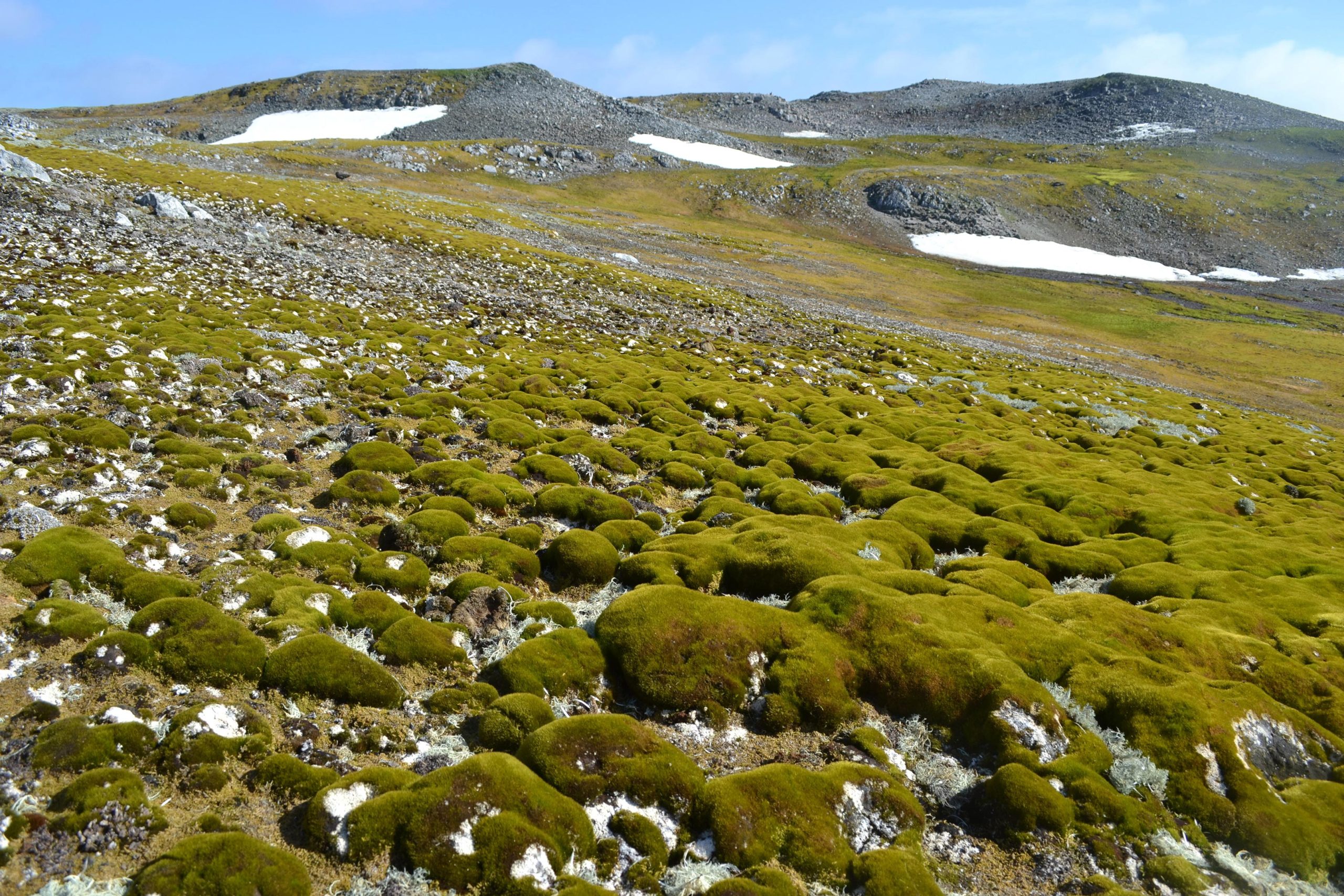
Past field studies on the Antarctic Peninsula have shown that mosses dominate its green areas, forming expansive “carpets,” like on Ardley Island in the photo below, and vertically accumulating “banks.” Both build up layers of new growth each year. In earlier work, Roland and colleagues carbon-dated core samples taken from moss banks along the western side of the peninsula. They discovered that the rates at which moss was accumulating had increased in the past 50 years, indicating an uptick in biological activity amid climatic changes.
Surprising Findings in Vegetation Expansion
These results got scientists wondering if vegetation was not only expanding its territory upward but also outward. So Roland, Bartlett, and their team tapped into the decades-long Landsat record. “Based on the core samples, we expected to see some greening,” Roland said, “but I don’t think we were expecting it on the scale that we reported here.”
The pace of greening was surprising, as well. “When we first ran the numbers, we were in disbelief,” Bartlett said. But the results, based on two different measures of greenness, kept coming out the same. “The rate itself is quite striking, especially in the last few years.”
Climate Shifts Driving Greening Trends
The Antarctic Peninsula, jutting out into the Southern Ocean from West Antarctica, is one of the fastest warming places on Earth. Most of its glaciers are receding. The uptick in new vegetation in recent years also coincides with a decrease in Antarctic sea-ice extent, an increase in open water, and a strong positive phase in the Southern Annular Mode, which could be producing warmer, wetter conditions, the authors noted.
As plant life finds more favorable conditions for growth on the Antarctic Peninsula, questions about biodiversity in its unique habitats arise. “The narrative in these places has been dominated by glacial retreat,” Roland said. “We’re starting to think about what comes next, after ice recession.” Of particular concern is that where there’s moss, soil formation tends to follow, creating more opportunity for nonnative plants to find a foothold. When that happens, said Bartlett, “you’re looking at potentially an erosion of biodiversity.”
The Risk of Non-Native Species
Antarctica hosts hundreds of native species of mosses, liverworts, lichens, and fungi, but only two native species of flowering plants. Human presence on the continent for tourism and research can result in the introduction of nonnative species (although seeds and spores can also arrive on the wind). Several cases of invasions have already been documented in the northern Antarctic Peninsula and nearby islands. “Biosecurity will become increasingly critical as temperature limitations on cold, high-latitude ecosystems decrease,” wrote the researchers.
Now, the scientists are keen to return to the field to understand the changes in finer detail. “We’re at the point that we’ve said the best we can say with the Landsat archives,” Roland said. Many questions remain as to what types of plant communities comprise these new green areas and what shifts in the structure and function of the Antarctic Peninsula’s ecosystems may already be underway. “We need to go to these places where we’re seeing the most distinctive changes and see what’s happening on the ground.”
Reference: “Sustained greening of the Antarctic Peninsula observed from satellites” by Thomas P. Roland, Oliver T. Bartlett, Dan J. Charman, Karen Anderson, Dominic A. Hodgson, Matthew J. Amesbury, Ilya Maclean, Peter T. Fretwell and Andrew Fleming, 4 October 2024, Nature Geoscience.
DOI: 10.1038/s41561-024-01564-5
NASA Earth Observatory maps by Michala Garrison, based on data from Roland, T.P., et al. (2024). Photo courtesy of Dan Charman (University of Exeter).
Never miss a breakthrough: Join the SciTechDaily newsletter.
Follow us on Google and Google News.
2 Comments
Awesome!
Tired of cold winters.
“The Antarctic Peninsula is rapidly greening, with vegetation increasing tenfold since 1986 due to warming temperatures and glacial retreat.”
Warming AND increasing CO2 fertilization.