
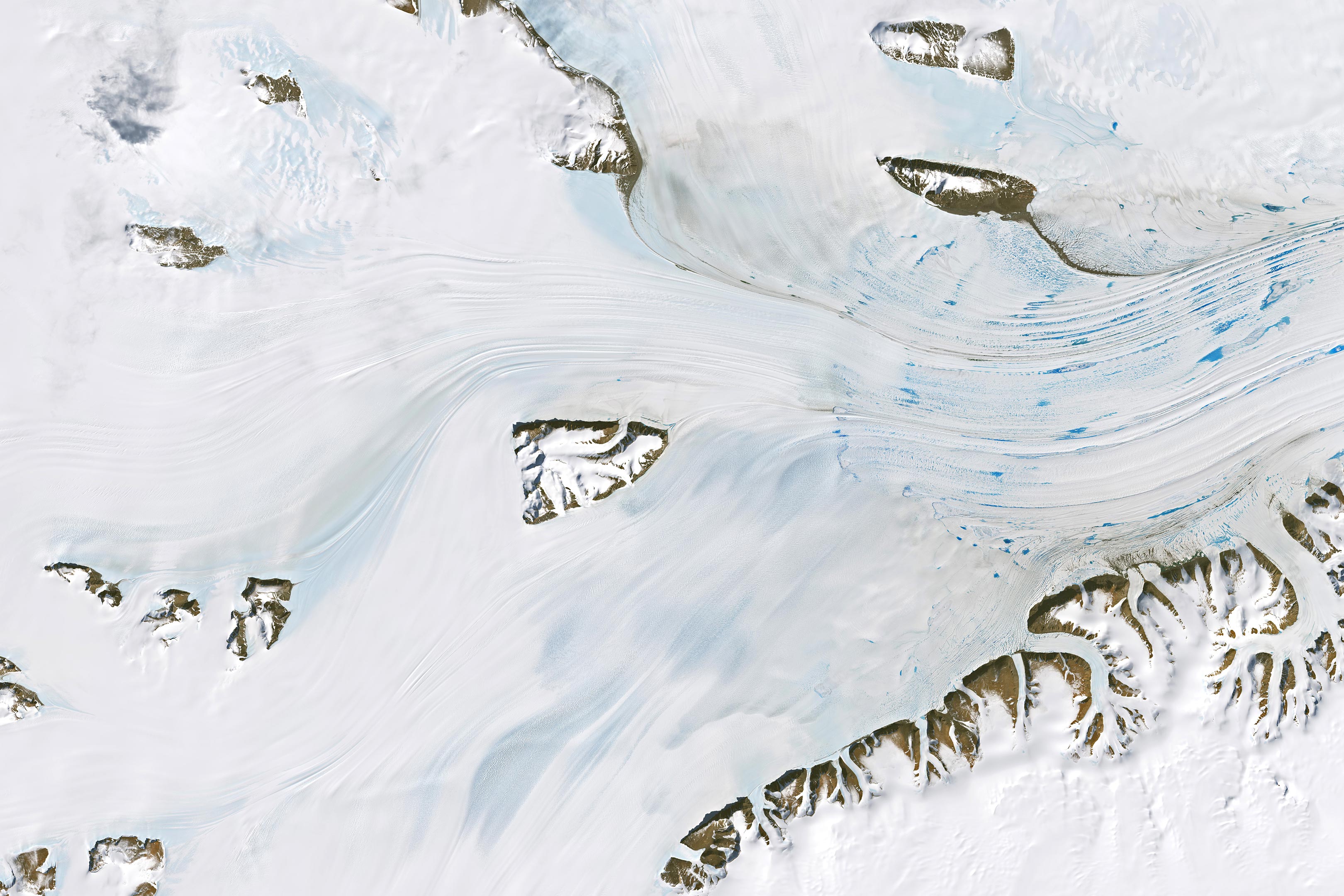
Satellite data from early 2025 revealed extensive melting at Antarctica’s Amery Ice Shelf, highlighting its vulnerability. As a natural barrier against ice flow, its weakening could accelerate sea level rise.
By late 2024, Antarctica experienced significant melting along its coastal regions, even though the melt season was less than halfway through. As 2025 began, meltwater was still visible on the ice sheet’s surface, stretching from the Antarctic Peninsula in the west to ice shelves in the east, including the Amery Ice Shelf in East Antarctica.
Satellite Observations and Glacial Dynamics
On January 1, 2025, the Operational Land Imager (OLI) on NASA’s Landsat 8 satellite captured images of the region. In these images, three major glaciers—the Lambert, Mellor, and Fisher—are seen converging near the edge of the continent. The ice from these glaciers flows outward, extending from the coast onto the ocean’s surface to form the Amery Ice Shelf, which fills Prydz Bay. The shelf’s southern, or interior, side is visible near its grounding line in the middle-right portion of the image above. A broader view of the entire ice shelf is available in this image captured by NASA’s Terra satellite.
The grounding line is the transition zone where a glacier or ice sheet shifts from resting on land to floating as part of an ice shelf. This boundary is not a single line but a gradual area where ice starts to lose contact with the bedrock.
“The Amery is unique among Antarctic ice shelves given its long interior extent—greater than 500 kilometers (300 miles)—and extensive bordering bedrock exposures,” said Christopher Shuman, a glaciologist at the University of Maryland, Baltimore County. “Yet, even in the deep chill of East Antarctica, the change of seasons causes surface melting far inland from the coastal ice front.”
Role of Ice Shelves in Climate Regulation
Ice shelves like the Amery play an important role in holding back, or buttressing, the flow of ice from inland and upstream. Such buttressing can slow the discharge of glacial ice into the ocean, limiting contributions to sea level rise compared to unbuttressed ice areas. Thick, stable ice shelves perform this buttressing role most effectively. But when meltwater drains through fractures within the ice, it can weaken the ice shelf.

Melting on the ice shelf is evident in the detailed image above. The blue puddles are melt ponds—areas where the snow has melted and pooled in low spots on the shelf. Melt ponds commonly form on the Amery during the Antarctic melt season, which occurs each year from November 1 through March 31 with the rising air temperatures of austral summer. Winds can also play a role, removing winter snow and exposing bare, blue ice that is more prone to melting because its dark color absorbs more heat.
Bert Wouters, a researcher at TU Delft, said that he has seen more extensive melt ponding atop the Amery in past seasons. “But on the other hand, it’s still relatively early, so it’s likely that we’ll see more ponding in the coming weeks,” he said.
Melting Trends and Future Projections
The ponding visible here came after a widespread melt event around the Antarctic Ice Sheet’s margins in mid-December 2024, followed by more melting toward the end of the month that culminated in an all-time record melt extent on December 25 and 26, according to the National Snow and Ice Data Center. At that time, satellite-based passive microwave sensors detected melting across more than 3 percent of the ice sheet’s surface.
Ponding on the Amery is generally limited to areas near the shelf’s grounding line, according to Wouters. He noted that closer to the ice shelf’s front (beyond this scene, to the right), ponding is prevented by colder and drier conditions that allow meltwater to refreeze within the snowpack. But research has shown, Wouters said, “that it only takes a few more degrees of warming to make these regions vulnerable to ponding.”
NASA Earth Observatory images by Wanmei Liang, using Landsat data from the U.S. Geological Survey.
Never miss a breakthrough: Join the SciTechDaily newsletter.
Follow us on Google and Google News.
10 Comments
“Bert Wouters, a researcher at TU Delft, said that he has seen more extensive melt ponding atop the Amery in past seasons. “But on the other hand, it’s still relatively early, so it’s likely that we’ll see more ponding in the coming weeks,” he said.”
Maybe your headline writer should read the text first.
When I was supervising the CRREL final closure survey for plastic deformation in an ice tunnel at Camp Tuto (Greenland) in the Summer of 1966 (58 years ago!) I observed deep icy slush and melt water ponds on the surface of the glacier east of what was formerly called Thule Air Base. This is not a new or unique phenomenon and was happening before the recent (early-’60s) warming event really got started. However, I guess one has to do what they have to do to get funding.
Thank you for all ur good work.God bless u
Save the Antarctic
Generic slogans don’t actually do anything except, perhaps, make the person voicing them feel good about themselves. They are usually referred to as “virtue signalling.” Do you have any constructive suggestions that would actually “save the Antarctic?” But, before you even think about that, decide on a time-frame because, even in the absence of humans, Antarctica will certainly eventually drift into warmer latitudes and melt. Therefore, for how long do you want to ‘save’ the Antarctic and how do you propose to do it?
……even in the absence of humans, Antarctica will certainly eventually drift into warmer latitudes and melt………
Now there is a fatuous comment born out of sarcasm. No doubt Trumpistan might also re-unite with Europe in the next 100 million years or so; it’s done that before. Might even drag Canada along with it for fun, as long as Greenland doesn’t object.
It would be the ice on Antarctica melting; Antarctica melting would certainly be an interesting hot-spot……….
I’m not sure what your point is, or that you even know what your point is when you introduce a concept like “Trumpistan.”
I was taking issue with the plea to “save Antarctica,” the meaning of which is ambiguous without defining what it means to ‘save’ something. Is January 23rd National TDS day?
Claiming that my point about wanting bounds on the act of ‘saving’ something was foolish, suggests that you aren’t a deep thinker. Are you content with the idea that slowing down melting of Antarctica is equivalent to saving it? That would imply you believe that spending $100 on Thursday instead of Wednesday means you have ‘saved’ $100 dollars. Common English language usage recognizes a difference between ‘saving’ something and delaying losing it.
“It would be the ice on Antarctica melting; Antarctica melting would certainly be an interesting hot-spot……….”
My apologies for initially missing your pedantic complaint about not making the distinction between ice and rock melting, albeit, ice behaves like a low-temperature melting monomineralic rock, covers most of Antarctica, and was the implied topic of discussion in the plea to “Save Antarctica.”
“Generic slogans don’t actually do anything” coming from a magat… lol
Were you looking over my shoulder in the voting booth to confirm how I voted? Because I’m sure you can’t read minds! When have I EVER said anything here about Trump that would support your claim that I’m a “magat?” While I support some of Trump’s policies, I also supported some of Biden’s policies. I’m an independent thinker and voter. While it appears that you suffer from what is commonly called TDS, causing you to compulsively bring politics into a science discussion by insulting someone you disagree with (called an ‘ad hominem’ attack) instead of offering any evidence to disprove what I said. Why are you reading a science website when you apparently don’t understand the Scientific Method?