
Close Menu
    Facebook X (Twitter) Instagram
    SciTechDaily
    • Biology
    • Chemistry
    • Earth
    • Health
    • Physics
    • Science
    • Space
    • Technology
    Facebook X (Twitter) Pinterest YouTube RSS
    SciTechDaily
    Home»Space»APEX Explores the Onset of Pulsation-Driven Winds in Giant Stars
    Space

    APEX Explores the Onset of Pulsation-Driven Winds in Giant Stars

    By Harvard-Smithsonian Center for AstrophysicsApril 12, 2016No Comments3 Mins Read
    Facebook Twitter Pinterest Telegram LinkedIn WhatsApp Email Reddit
    Share
    Facebook Twitter LinkedIn Pinterest Telegram Email Reddit
    Exploring the Onset of Pulsation-Driven Winds in Giant Stars
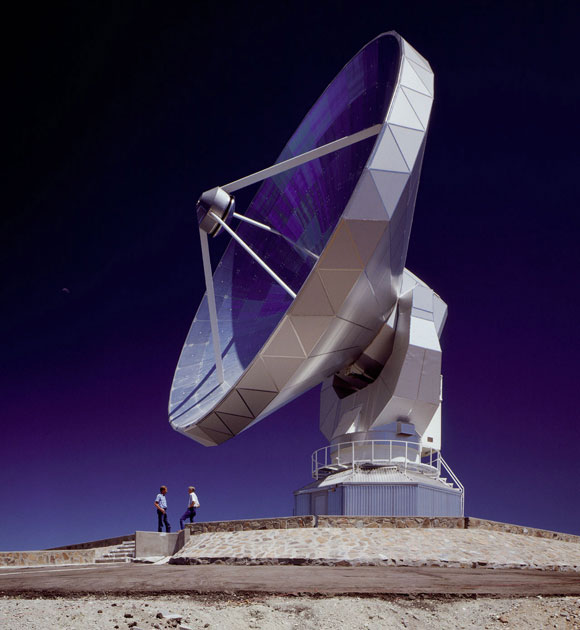
    The APEX (Atacama Pathfinder Experiment) telescope in Chile.

    Astronomers from the Harvard-Smithsonian Center for Astrophysics used the APEX submillimeter telescope to study the velocity of the CO gas in the wind of the giant star EU Del to help constrain the mechanism responsible for driving its wind.

    Nearly all stars have winds. The Sun’s wind, which originates from its hot outer layer (corona), contains charged particles emitted at a rate equivalent to about one-millionth of the moon’s mass each year. Some of these particles bombard the Earth, producing radio static, auroral glows, and (in extreme cases) disrupted global communications. The winds of stars more evolved than the Sun (like the so-called giant stars that are cooler and larger in diameter than the Sun) often contain dust particles which enrich the interstellar medium with heavy elements. These winds also contain small grains on whose surfaces chemical reactions produce complex molecules. The dust also absorbs radiation and obscures visible light. Understanding the mechanism(s) that produce these winds in evolved stars is important both for modeling the wind and the character of the stellar environment, and for predicting the future evolution of the star.

    The mechanism that drives the winds of giant stars is poorly determined. Astronomers think there are three possibilities: radiative, in which the pressure of the light pushes out the grains, magnetically driven, in which the stellar magnetic field plays a role in powering the flow, and pulsation driven, in which a periodic build-up of radiative energy in the stellar interior is suddenly released. Over the years scientific opinion has varied among these alternatives, depending on each particular stellar example. CfA astronomer Chris Johnson and his colleagues explored the problem of wind-driving mechanism in giant stars by measuring the motion of the outflowing CO gas around one the nearest and brightest giant stars, EU Del, which is only about 380 light-years away and shines with 1600 solar-luminosities. Its radius, if the star were placed at the position of the Sun, would extend past the orbit of Venus. EU Del is known to be a semi-regular variable star which pulses every sixty days or so (but with some secondary periods as well), and infrared observations suggest it has a circumstellar dust shell.

    The astronomers used the submillimeter APEX (Atacama Pathfinder Experiment) telescope to look at warm CO gas in the wind, making EU Del one of the first stars of its class to be studied with this relatively new tool. The team reports finding the CO moving at about ten kilometers per second (twenty-two thousand miles per hour) with a total mass-loss rate equal to about the mass of the Moon each year. Analyzing this and related behavior, they conclude that although a number of uncertainties remain, the most likely mechanism to power the wind is stellar pulsations. They strengthen this conclusion by comparing the EU Del wind results to winds in other giant stars which have different pulsation and wind properties.

    Reference: “EU Del: Exploring the Onset of Pulsation-Driven Winds in Giant Stars” by I. McDonald, A. A. Zijlstra, G. C. Sloan, E. Lagadec, C. I. Johnson, S. Uttenthaler, O. C. Jones and C. L. Smith, 23 January 2016, MNRAS.
    DOI: 10.1093/mnras/stv2942

    Never miss a breakthrough: Join the SciTechDaily newsletter.
    Follow us on Google and Google News.

    APEX Astronomy Cosmology Harvard-Smithsonian Center for Astrophysics
    Share. Facebook Twitter Pinterest LinkedIn Email Reddit

    Related Articles

    Astronomers Just Reconstructed a Galaxy’s 12-Billion-Year History

    Webb’s Mysterious “Little Red Dots” May Be the Cradle of the First Black Holes

    Mysterious Radio Signals Reveal What’s Hiding Between Galaxies

    Cosmic Mystery Solved: Astronomers Have Discovered the Universe’s “Missing” Matter

    Invisible Storm Lights Up Galaxy Cluster With Record-Breaking Radio Glow

    Herschel Observations Help Identify the Physical Processes Underway in Cold, Dense Clouds

    CfA Scientists Measure the Rate of Expansion of the Universe

    New Study Challenges Planck Results

    Calculations Show the Ideal Time to Study the Cosmos

    Leave A Reply Cancel Reply

    • Facebook
    • Twitter
    • Pinterest
    • YouTube

    Don't Miss a Discovery

    Subscribe for the Latest in Science & Tech!

    Trending News

    Popular Supplement Ingredient Linked to Shorter Lifespan in Men

    Scientists May Have Found a Way To Repair Nerve Damage in Multiple Sclerosis

    “Totally Unexpected” – Scientists Discover Pancreatic Cancer’s Fatal Addiction

    A Strange Quantum Effect May Explain One of Biology’s Greatest Mysteries

    James Webb Telescope Reveals the Universe’s Hidden Cosmic Web in Stunning Detail

    Scientists Identify Simple Supplement That Greatly Reduces Alzheimer’s Damage

    You May Have a Dangerous Type of Cholesterol Even if Your Tests Look Normal

    Your Blood Pressure Reading Could Be Wrong Because of One Simple Mistake

    Follow SciTechDaily
    • Facebook
    • Twitter
    • YouTube
    • Pinterest
    • Newsletter
    • RSS
    SciTech News
    • Biology News
    • Chemistry News
    • Earth News
    • Health News
    • Physics News
    • Science News
    • Space News
    • Technology News
    Recent Posts
    • Scientists Discover Hidden “Switch” That Burns Fat and Could Treat Bone Disease
    • Deadly Hantavirus Outbreak on Cruise Ship Sparks Global Health Alert
    • New Research Reveals Certain Fats Can Either Trigger or Suppress Cancer
    • After 50 Years of Mystery, Researchers Identify New Human Blood Group
    • Leading Climate Scientist Rebuts “Factually Incorrect” US Government Climate Claims
    Copyright © 1998 - 2026 SciTechDaily. All Rights Reserved.
    • Science News
    • About
    • Contact
    • Editorial Board
    • Privacy Policy
    • Terms of Use

    Type above and press Enter to search. Press Esc to cancel.