
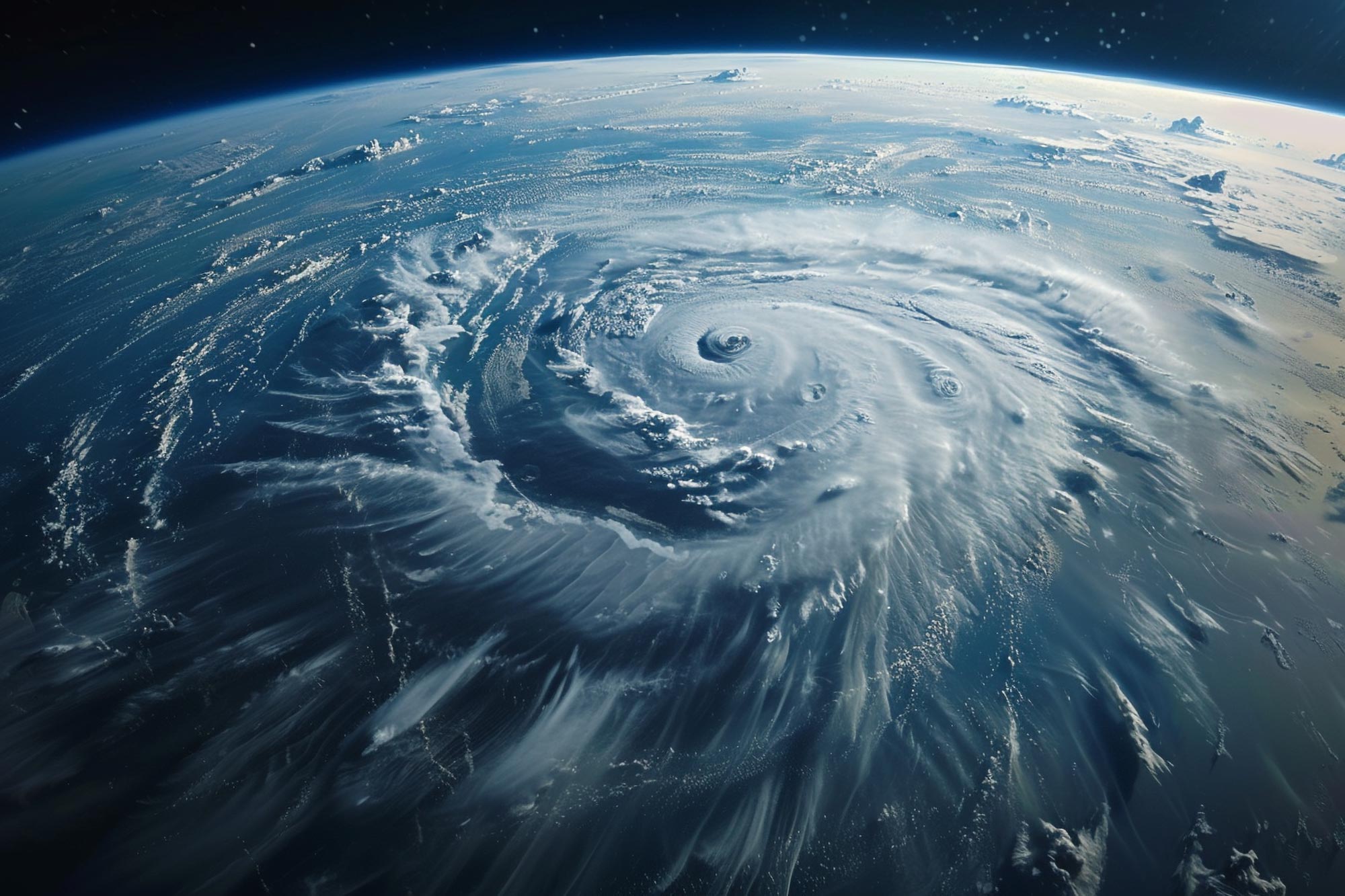
Arctic cyclones may be accelerating sea ice loss by breaking ice into smaller pieces and driving upwelling of warm water. A study links these storms to rapid ice depletion and suggests that tropopause polar vortices could improve cyclone forecasting.
A study published in Nature Communications Earth & Environment explores why climate models have underestimated Arctic sea ice loss and the role of Arctic cyclones in this process. Led by Steven Cavallo, a meteorology professor at the University of Oklahoma, the research could improve weather and climate models, leading to more accurate Arctic cyclone forecasts.
Since 1979, Arctic sea ice extent—the area of the Arctic Ocean covered by ice—has shrunk by 40% during late summer. However, global climate models have consistently underestimated this decline. The study focuses on “very rapid sea ice loss events” (VRILEs), periods of accelerated ice loss lasting between 5 and 18 days. The long-term decline in Arctic sea ice is the result of multiple VRILEs occurring over time.
Cavallo’s publication suggests that Arctic cyclones are at least partially to blame. Arctic cyclones are weather phenomena that are tricky to predict and even trickier to incorporate into models. Though the exact mechanisms of why these cyclones may accelerate the ice loss are not fully understood, Cavallo suggests two theories.
How Arctic Cyclones Accelerate Ice Loss
The first is the interaction of turbulent seas with ice.
“If the winds get strong and the ice is thin enough, [the cyclone] can create waves that break the larger ice floes. Breaking them up into smaller ice floes accelerates the melting; it can happen at a really fast time scale,” he said.
The second theory is that upwelling, the mixing of warmer water below the sea’s surface with cooler waters at the surface, increases temperatures that help melt the younger, thinner ice from below in a short amount of time.
Observations of these events and their effects are difficult. Ships avoid forecasted storms, and a plane could not fly into an Arctic cyclone close enough to the ocean’s surface to collect data on upwelling or wave–ice interactions.
The Role of Cyclone Location and Tropopause Polar Vortices
Cavallo says they’ve discovered that cyclones have to be in the right place to make such a drastic difference to the sea ice extent, needing to occur over an area of thin ice that is usually no more than a year old.
The research also suggests a connection between Arctic cyclones and tropopause polar vortices, or circulation in the upper troposphere over the polar regions.
Cavallo said tropopause polar vortices are sometimes present for months before an Arctic cyclone forms, while Arctic cyclones are usually only predicted several days in advance. Because the vortices are present so far ahead of a cyclone, they could lead to better forecasts of cyclones. This would benefit residents in areas such as Alaska, northern Canada, and Greenland and aid the shipping industry, which has made increased use of the Arctic as ice continues to recede.
“Now that we think these processes are occurring, the question is how do we get that information into the models so that we can get better predictions,” said Cavallo. “It’s a hard task.”
Cavallo says that the broader scientific community is still unsure when the Arctic will become ice-free, but that looming lack of ice could significantly impact large-scale atmospheric dynamics throughout the Northern Hemisphere.
“We’re still trying to figure out exactly how sea ice changes will affect any of the extreme weather that is happening right now.”
Reference: “Sea ice loss in association with Arctic cyclones” by Steven M. Cavallo, Madeline C. Frank and Cecilia M. Bitz, 22 January 2025, Communications Earth & Environment.
DOI: 10.1038/s43247-025-02022-9
Never miss a breakthrough: Join the SciTechDaily newsletter.
Follow us on Google and Google News.
1 Comment
“Since 1979, Arctic sea ice extent—the area of the Arctic Ocean covered by ice—has shrunk by 40% during late summer.”
That is no doubt true. However, it might be a case of not being able to see the trees because of the forest. That is, there may be short-term changes in the behavior of the ice that is hidden by using a starting point from what may be a different climate regime.
Point in fact, looking at the NASA sea ice map of annual minimums from 1979 ( https://climate.nasa.gov/vital-signs/arctic-sea-ice/?intent=121 ), it appears that the obvious decline stopped about 2007. The minimum reached in 2012 has not been exceeded during the subsequent 12 years. It seems to be varying around an average of about 4.2 million sq. km for the last dozen years. Could it change? Of course — either way!
The point is, the article, without showing the readily available graph, suggested that there has been a monotonic decrease in Arctic sea ice minimum coverage since 1979 when it has experienced a hiatus since at least about 2007, about 17 years, or more than half the time commonly used to define a climate. Furthermore, for the last dozen years, there has been no minimum less than what occurred in 2012.
Is it expecting too much to ask that people writing on this and similar topics present some of the caveats or details that impact the interpretation of the data? The science ISN’T settled (If it were, there would be no point in presenting this work on Arctic cyclones.) and there are legitimate concerns about alternative, viable working hypotheses.