
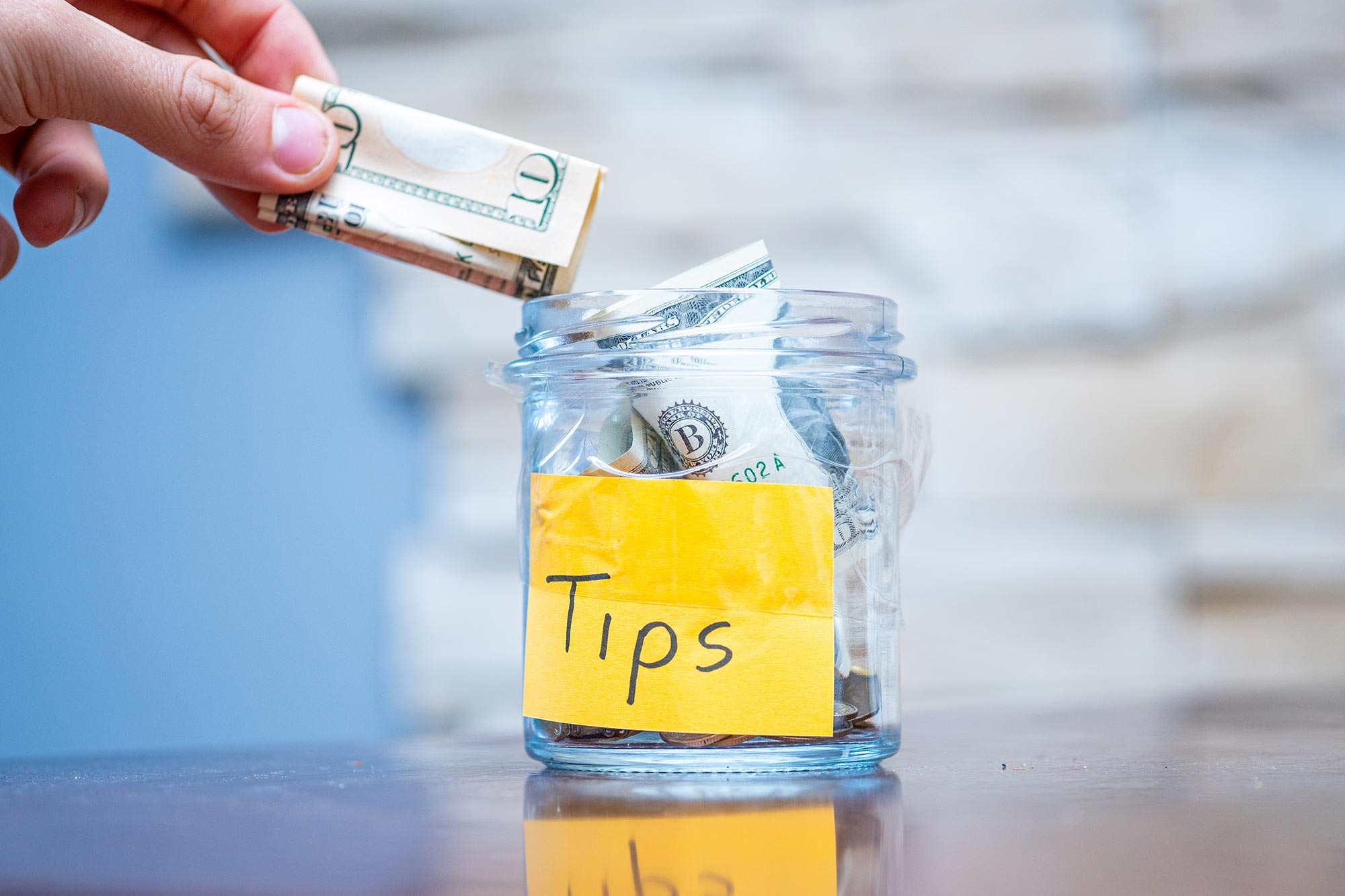
According to the researchers, an economically rational person would have no reason to leave a tip after the service has already been provided.
Why do people tip? A recent study suggests that two main motivations drive this behavior: genuine gratitude for the service received and the desire to follow social expectations. People who truly value the service often leave tips above the typical rate, while those motivated by conformity tend to match these higher amounts. Over time, this pattern causes average tipping percentages to increase in cultures where tipping is customary.
A new paper in Management Science by Dr. Ran Snitkovsky of the Coller School of Management at Tel Aviv University and Prof. Laurens Debo of the Tuck School of Business at Dartmouth College explores the intricate nature of tipping through a theoretical model.
“Tipping is a phenomenon that is difficult to explain using classical economic tools,” explains Dr. Snitkovsky. “The ‘homo economicus’, who is only interested in their own material wealth, has no reason to tip once the service has been provided. In the past, researchers suggested that tipping ensures better service in the future, but this doesn’t explain why we tip even when we are quite certain that we will never encounter that specific service provider again. For example, we tip a taxi driver in New York, when there is practically no chance of encountering them again—and even if we did, they would probably not remember us. Another common argument is that tipping provides an incentive for servers to give better service. Whether this is true or not, a self-interested customer would prefer others to tip and maintain the good service quality while avoiding the expense himself. The conclusion is that to understand this phenomenon in depth, we must examine psychological and behavioral considerations.”
Quantifying the Impact of Tipping
According to a report by USA Today, the average American now spends almost $500 a year tipping in restaurants and bars. Across the United States, the tipping system accounts for more than $50 billion annually, serving as a key source of income for millions of hospitality workers.

“We used a mathematical model and tools from game theory and behavioral economics to understand the motivations behind tipping,” says Dr. Snitkovsky. “Into this model we fed the two main reasons people report for tipping: the first is to express gratitude to the service provider, and the second is conformity —doing what everybody else does. The first reason relates to my personal valuation of the service I received or the server-customer interaction, and can stem from wanting to reward the server for doing their job or showing empathy towards them. The second reason is tied to how I perceive myself in society, i.e., my interaction with other customers. In other words, we can distinguish between ‘appreciators’ and ‘conformists.’”
The researchers found that in societies with stronger social pressure, where people feel a greater need to comply with the norm, the average tip tends to increase over time.
“The process is inherently driven by appreciators pulling the conformists upward, but not the other way around,” says Dr. Snitkovsky. “This might explain why tipping rates in the U.S. a few decades ago were around 10% and are now closer to 20%. Those who appreciate the service are willing to tip well above the average, while those who wish to comply with the customary practice ‘chase’ the average. Additionally, rising tipping rates may also reflect growing economic inequality — a hypothesis proposed by another researcher from Tel Aviv University, Prof. Yoram Margalioth of the Buchmann Faculty of Law, and supported by our model.”
Does Tipping Improve Service?
The researchers also explored whether tipping provides an effective incentive for servers to improve their performance. The model shows that while tips somewhat encourage servers to exert effort, it is a rather weak incentive, since many customers are conformists who will tip the standard amount in any case.
“If a server knows most customers are conformists, there’s little reason to put in extra effort since they will tip the customary amount anyway. This is indeed the situation in countries like the U.S. In an imaginary world where all customers are appreciators, unaffected by each other’s tipping rates, tipping would serve as a much stronger incentive. On the other hand, in such a world where tips only reflect appreciation, businesses might conclude that customers are willing to pay more for the service experience and charge higher prices upfront. This may trigger customers to adjust their expectations and reduce the tip percentage accordingly.”
The researchers also examined the ‘tip credit’ regulation applied in most U.S. states. This law allows employers to pay less than the minimum wage for tipped professions, covering the difference with tips. For instance, if the minimum wage is $8 per hour and the state has set the sub-minimum wage at $3, employers may pay servers only $3 and use tips to cover the $5 difference. Only if tips fall short of the minimum wage are employers required to make up the gap. If a server makes more than $8 after tips, they can keep the difference.
“We see that a higher tip credit allows businesses to reduce prices — because they rely more on tips to finance labor,” says Dr. Snitkovsky. “Consequently, they can increase supply and serve more customers. This suggests an element of economic efficiency, but the efficiency in this case comes at the expense of the individual server’s earnings. So essentially, tip credit is a mechanism allowing employers to cut into tips that ostensibly belong to servers, using them to pay wages.”
As for his personal view, Dr. Snitkovsky admits he dislikes tipping. “I came to this study with a bias. Personally, I don’t like this practice, and I wanted to understand what drives it. First of all, tipping puts customers in an uncomfortable position. Studies have shown that tipping can encourage sexist behavior toward female servers – who may refrain from setting boundaries to avoid losing tips. Other studies demonstrate that people tend to tip more generously when a server is of their own ethnicity, introducing an element of racism. It’s easy to find good reasons to do away tipping, but the custom also has some positive effects, making it a complex phenomenon. Ultimately, tipping allows those willing to pay more for the service to do so, thereby subsidizing the service for others. That’s a positive aspect. Additionally, tips do seem to encourage servers to provide better service, even though this effect is very limited. In my opinion, in the 21st century business owners have better tools to assess server performance, such as online reviews and even in-house cameras.”
Reference: “A Modeling Framework for Tipping in the Presence of a Social Norm” by Laurens G. Debo and Ran I. Snitkovsky, 18 August 2025, Management Science.
DOI: 10.1287/mnsc.2021.03422
Never miss a breakthrough: Join the SciTechDaily newsletter.
Follow us on Google and Google News.
1 Comment
It everything relies on the player’s control and strategy; character enhancements and equipping anything are not necessary to get an edge in
.