
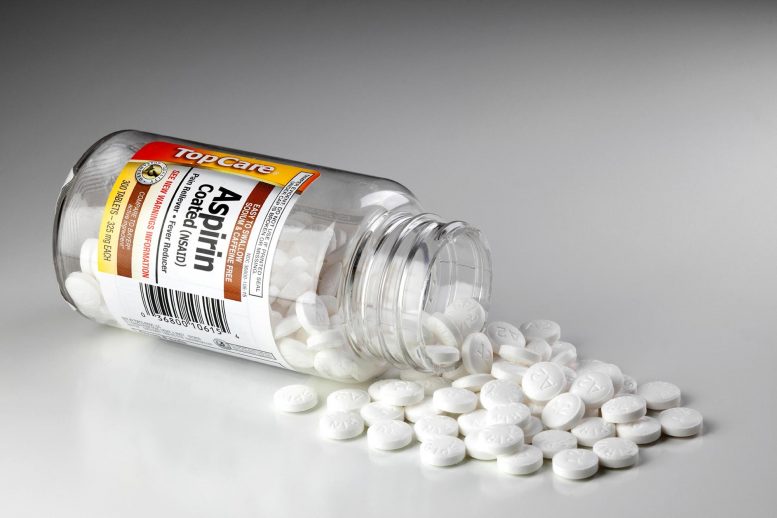
Hospitalized patients who were taking daily aspirin had lower risk of ICU admission, ventilation, and dying from SARS-CoV-2 virus.
Hospitalized COVID-19 patients who were taking a daily low-dose aspirin to protect against cardiovascular disease had a significantly lower risk of complications and death compared to those who were not taking aspirin, according to a new study led by researchers at the University of Maryland School of Medicine (UMSOM).
Aspirin takers were less likely to be placed in the intensive care unit (ICU) or hooked up to a mechanical ventilator, and they were more likely to survive the infection compared to hospitalized patients who were not taking aspirin, The study, published on October 21, 2020, in the journal Anesthesia and Analgesia, provides “cautious optimism,” the researchers say, for an inexpensive, accessible medication with a well-known safety profile that could help prevent severe complications.
“This is a critical finding that needs to be confirmed through a randomized clinical trial,” said study leader Jonathan Chow, MD, Assistant Professor of Anesthesiology at UMSOM. “If our finding is confirmed, it would make aspirin the first widely available, over-the-counter medication to reduce mortality in COVID-19 patients.”
To conduct the study, Dr. Chow and his colleagues culled through the medical records of 412 COVID-19 patients, age 55 on average, who were hospitalized over the past few months due to complications of their infection. They were treated at the University of Maryland Medical Center in Baltimore and three other hospitals along the East Coast. About a quarter of the patients were taking a daily low-dose aspirin (usually 81 milligrams) before they were admitted or right after admission to manage their cardiovascular disease.
The researchers found aspirin use was associated with a 44 percent reduction in the risk of being put on a mechanical ventilator, a 43 percent decrease in the risk of ICU admission, and — most importantly — a 47 percent decrease in the risk of dying in the hospital compared to those who were not taking aspirin. The patients in the aspirin group did not experience a significant increase in adverse events such as major bleeding while hospitalized.
The researchers controlled for several factors that may have played a role in a patient’s prognosis including age, gender, body mass index, race, hypertension, and diabetes. They also accounted for heart disease, kidney disease, liver disease, and the use of beta blockers to control blood pressure.
COVID-19 infections increase the risk of dangerous blood clots that can form in the heart, lungs, blood vessels and other organs. Complications from blood clots can, in rare cases, cause heart attacks, strokes and multiple organ failure as well as death.
Doctors often recommend a daily low-dose aspirin for patients who have previously had a heart attack or stroke caused by a blood clot to prevent future blood clots. Daily use, however, can increase the risk of major bleeding or peptic ulcer disease.
“We believe that the blood thinning effects of aspirin provides benefits for COVID-19 patients by preventing microclot formation,” said study co-author Michael A. Mazzeffi, MD, Associate Professor of Anesthesiology at UMSOM. “Patients diagnosed with COVID-19 may want to consider taking a daily aspirin as long as they check with their doctor first.” Those at increased bleeding risk due to chronic kidney disease, for example, or because they regularly use certain medications, like steroids or blood thinners, may not be able to safely take aspirin, he added.
Researchers from Wake Forest School of Medicine, George Washington University School of Medicine, Northeast Georgia Health System, and Walter Reed National Military Medical Center also participated in this study.
“This study adds to the tremendous work our researchers are doing in the School of Medicine to help find new treatments against COVID-19 and save patients’ lives,” said E. Albert Reece, MD, PhD, MBA, Executive Vice President for Medical Affairs, UM Baltimore, and the John Z. and Akiko K. Bowers Distinguished Professor and Dean, University of Maryland School of Medicine. “While confirmatory studies are needed to prove that aspirin use leads to better outcomes in COVID-19, the evidence thus far suggests that patients may want to discuss with their doctor whether it is safe for them to take aspirin to manage potentially prevent serious complications.”
Reference: “Aspirin Use is Associated with Decreased Mechanical Ventilation, ICU Admission, and In-Hospital Mortality in Hospitalized Patients with COVID-19” by Chow, Jonathan H. MD; Khanna, Ashish K. MD; Kethireddy, Shravan MD; Yamane, David MD; Levine, Andrea MD; Jackson, Amanda M. MD, MAJ, MC, USA; McCurdy, Michael T. MD; Tabatabai, Ali MD; Kumar, Gagan MD; Park, Paul MD; Benjenk, Ivy RN, MPH.; Menaker, Jay MD; Ahmed, Nayab MD; Glidewell, Evan MD; Presutto, Elizabeth MD; Cain, Shannon M.D.; Haridasa, Naeha B.S; Field, Wesley MD; Fowler, Jacob G. B.S.; Trinh, Duy MD; Johnson, Kathleen N. B.S.; Kaur, Aman DO; Lee, Amanda B.S.; Sebastian, Kyle MD; Ulrich, Allison MD; Peña, Salvador MD, PhD; Carpenter, Ross MD; Sudhakar, Shruti MD; Uppal, Pushpinder MD; Fedeles, Benjamin T. MD, Capt., USAF, MC; Sachs, Aaron MD; Dahbour, Layth MD; Teeter, William MD; Tanaka, Kenichi MD; Galvagno, Samuel M. DO, PhD; Herr, Daniel L. MD; Scalea, Thomas M. MD and Mazzeffi, Michael A. MD, MPH, 21 October 2020, Anesthesia & Analgesia.
DOI: 10.1213/ANE.0000000000005292
Never miss a breakthrough: Join the SciTechDaily newsletter.
Follow us on Google and Google News.
3 Comments
REBELS DAILY REPORTS
This article shows that taking aspirin will quicken your blood flow. For some reason blood flow has a lot to do with the severity of the coronavirus illness. Seeing that is so one must speculate that the coronavirus works well in infecting worse those with bad blood flow and bad organs. Diabetics have high sugars in their blood stream for the coronavirus to grow. So maybe if we were to give coronavirus patients a diet that will clean out their bowels. This would help flush the coronavirus out of the digestive system thus lessening the amount of coronavirus in the body. Then give coronavirus patients a 1000 mg. aspirin to speed up their blood flow and do this 2-3 times a day. Something about this coronavirus makes it more deadlier the longer it stays moving slowly multiplying in the body. Maybe if we clean out the digestive system, speed up the blood flow system with aspirin and also give the coronavirus patient 2 extra strength vitamins a day 6 hours apart with a meal that contains all of the 9 amino acids that are needed to make up a protein of any kind that the body needs to make any kind of cell that a human body can make. Adelynn’s Miracle Beans recipe is a food dish that will surely clean out the digestive system while providing the body with all the 9 amino acids in abundance so that the body could then maybe assemble some kind of cells to fight off the coronavirus. Just maybe the vitamins and protein rich diet daily with the aspirin will help the body create proteins that will help fight off the problems caused by coronavirus. Read https://www.facebook.com/ron.mccune.3 for more about this.
Another final miraculous solution, like gurgling pure alcohol or inhaling chlor…
Aspirin is one of the dozens of things that will control Covid, without the Shots.