
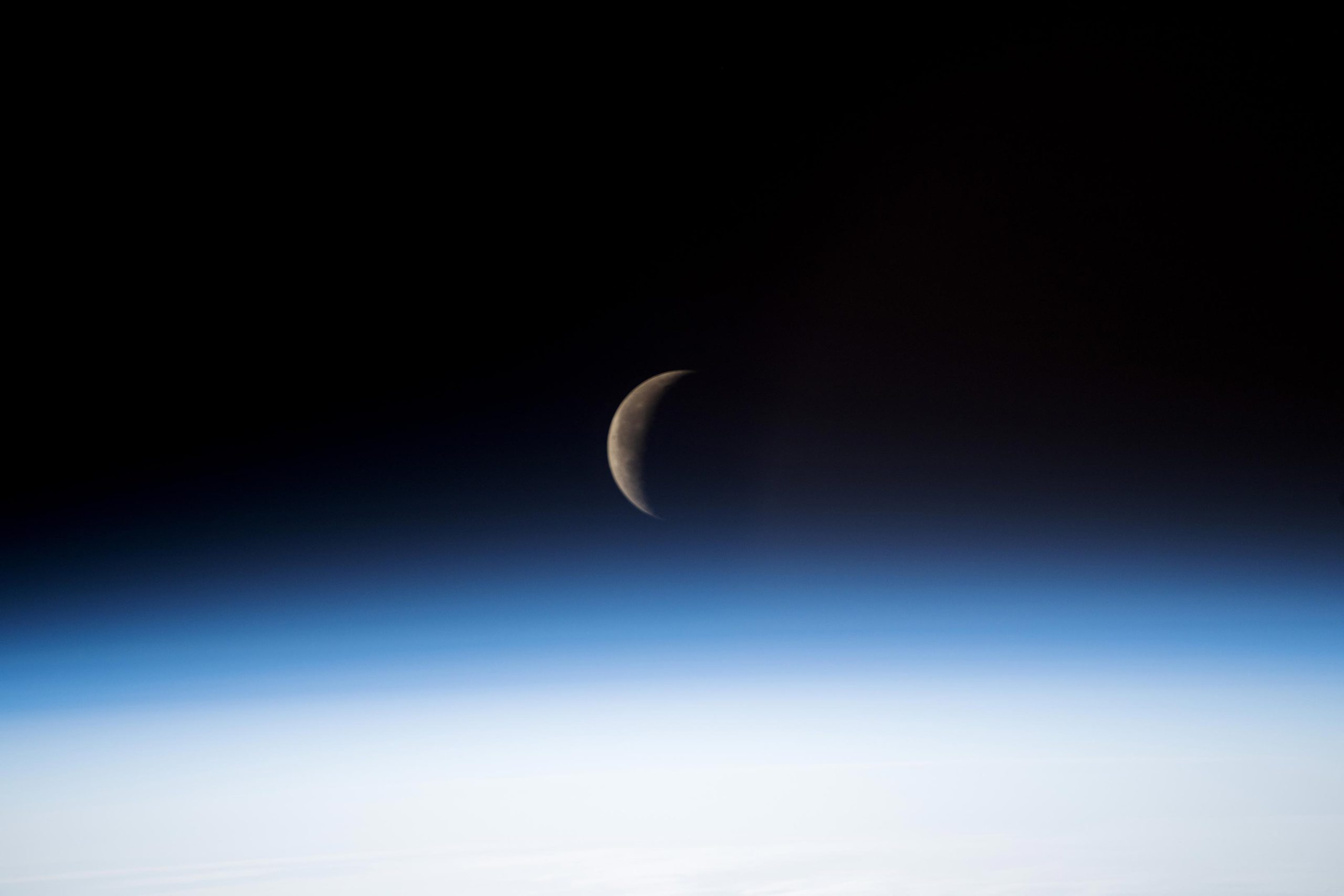
Captured from the ISS, a stunning image of the waning crescent Moon over Quebec showcases the distinct vantage point of space, free from atmospheric distortions, offering a clear view of the lunar surface and its phases.
On November 25, 2024, an astronaut aboard the International Space Station (ISS) captured this remarkable photograph while orbiting over Quebec, Canada. Rather than aiming the camera directly at the province below, the astronaut turned their lens toward the Moon.
At the time, sunlight illuminated 27% of the waning crescent Moon, a lunar phase visible that same day to observers on Earth. The similarity in perspectives arises because the ISS, despite orbiting Earth, is relatively close to our planet compared to the vast distance to the Moon.
Still, viewing the Moon from the ISS offers unique differences compared to observations from Earth. Traveling at a staggering speed of 28,200 kilometers (17,500 miles) per hour, the space station completes an orbit roughly every 90 minutes. This rapid movement allows astronauts to experience 16 moonrises and moonsets (along with 16 sunrises and sunsets) within a single 24-hour period—far more than anyone on Earth can witness.

Also, astronauts see the Moon without the apparent shape– and color-changing effects of Earth’s atmosphere and without clouds to potentially block the view. On the day that this photo was taken, clouds covered much of Quebec, including the ground directly below the station.
Since the time of this image, the Moon has completed an orbit around Earth and entered a waxing crescent phase by New Year’s Day 2025. Together, the Moon and Earth begin another journey around the Sun.
The astronaut photograph ISS072-E-277954 was taken on November 25, 2024, using a Nikon Z9 digital camera equipped with a 500-millimeter lens. Captured by a member of the Expedition 72 crew, this image is part of the ISS Crew Earth Observations Facility, supported by the Earth Science and Remote Sensing Unit at NASA’s Johnson Space Center.
To enhance the image’s clarity, it was cropped, its contrast adjusted, and lens artifacts were removed. This effort ensures the photograph is as visually accurate and impactful as possible.
The International Space Station Program, as part of the ISS National Laboratory, supports this initiative to enable astronauts to capture high-quality images of Earth. These photographs serve both scientific research and public interest and are made freely available online to maximize their value and accessibility.
Never miss a breakthrough: Join the SciTechDaily newsletter.
Follow us on Google and Google News.