
Close Menu
    Facebook X (Twitter) Instagram
    SciTechDaily
    • Biology
    • Chemistry
    • Earth
    • Health
    • Physics
    • Science
    • Space
    • Technology
    Facebook X (Twitter) Pinterest YouTube RSS
    SciTechDaily
    Home»Space»Astronomers Develop a New Method to Evaluate the Turbulence of the Hot Intracluster Gas
    Space

    Astronomers Develop a New Method to Evaluate the Turbulence of the Hot Intracluster Gas

    By Harvard-Smithsonian Center for AstrophysicsDecember 1, 2014No Comments3 Mins Read
    Facebook Twitter Pinterest Telegram LinkedIn WhatsApp Email Reddit
    Share
    Facebook Twitter LinkedIn Pinterest Telegram Email Reddit
    New Method to Evaluate the Turbulence of the Hot Intracluster Gas
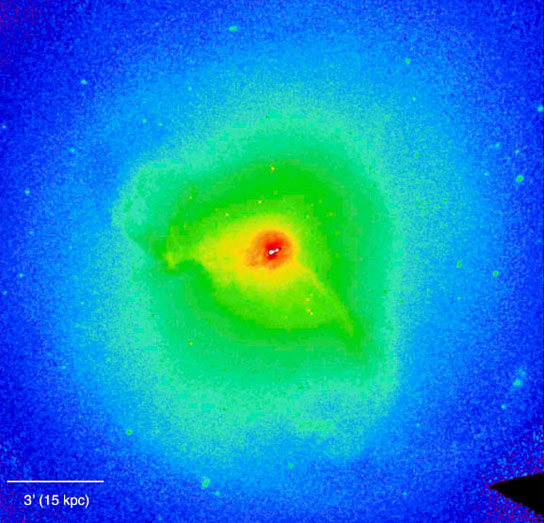
    A false-color X-ray image of the core of the Virgo cluster of galaxies. The emission comes from very hot gas between the galaxies. This gas should cool off, but doesn’t, and a new paper presents a very plausible solution to this long-time mystery. The scale mark corresponds to a physical scale of 50 light-years. Credit: NASA/Chandra X-ray Observatory

    Using data from the Chandra X-Ray Observatory, astronomers from the Harvard-Smithsonian Center for Astrophysics have pioneered a new method to evaluate the turbulence of the hot intracluster gas.

    Most galaxies lie in clusters, groupings of a few to many thousands of galaxies. Our Milky Way galaxy itself is a member of the “Local Group,” a band of about fifty galaxies whose other large member is the Andromeda Galaxy about 2.3 million light-years away. The closest large cluster of galaxies to us is the Virgo Cluster, about 50 million light-years away, with about 2000 members.

    The space between the galaxies in clusters is filled with very hot gas – its temperature is of order ten million kelvin, or even higher. Most of the matter in the so-called intracluster medium is in the form of this very hot gas. Hot gas should cool off, and one of the major puzzles about galaxy clusters is that the hot intracluster gas does not seem to cool.

    In fact, calculations based on the energy radiated indicate that the gas should cool about ten times faster than is observed. X-ray observations of the hot gas also suggest that it might be turbulent, perhaps driven by mechanical flows of matter pouring outward from the supermassive black holes at the centers of the clusters’ galaxies, perhaps creating inflating bubbles of fast-moving charged particles that stir and heat the gas. Unfortunately, current X-ray observatories do not have the ability to measure the supposed gas velocities to test this proposed solution.

    A team of astronomers including Harvard-Smithsonian Center for Astrophysics (CfA) scientists Bill Forman and Alexey Vikhlinin have pioneered a new method to evaluate the turbulence of the hot intracluster gas. They took advantage of the superb spatial resolution and sensitive images from the Chandra X-Ray Observatory to probe small clumps distributed through two clusters, Perseus and Virgo. They analyze the structures as resulting from turbulence, and then inferred the turbulent velocities needed, deriving values up to about 145 kilometers per second.

    These velocities are indeed adequate to heat the gas over all the scales observed over the cluster, and could readily be produced by black hole jets. The results are very encouraging, though not definitive, and imply that no mysterious mechanisms needed to be invoked to explain the enduring hot gas.

    Reference: “Turbulent heating in galaxy clusters brightest in X-rays” by I. Zhuravleva, E. Churazov, A. A. Schekochihin, S. W. Allen, P. Arévalo, A. C. Fabian, W. R. Forman, J. S. Sanders, A. Simionescu, R. Sunyaev, A. Vikhlinin and N. Werner, 26 October 2014, Nature.
    DOI: 10.1038/nature13830

    Never miss a breakthrough: Join the SciTechDaily newsletter.
    Follow us on Google and Google News.

    Astronomy Astrophysics Harvard-Smithsonian Center for Astrophysics
    Share. Facebook Twitter Pinterest LinkedIn Email Reddit

    Related Articles

    X-Ray Emission From Mysterious Dark Matter

    Analyzing Dust Storm Sequences on Mars

    Intriguing Remains of a Rare Stellar Explosion Discovered in Milky Way Center

    Puzzling Astrophysics of Quasars in the Early Universe

    Four Exoplanets – Including a Super-Earth Planet – Discovered by High School Students

    Massive Rotating Stars in the Pleiades Cluster

    Astronomers Discover First Cloudless, Jupiter-Like Planet – “Smoking Gun Evidence”

    Chandra X-ray Observatory Studies Extraordinary Magnetar [Video]

    Chandra Studies Extraordinary Magnetar: Fastest Spinning and Possibly the Youngest Magnetar Known

    Leave A Reply Cancel Reply

    • Facebook
    • Twitter
    • Pinterest
    • YouTube

    Don't Miss a Discovery

    Subscribe for the Latest in Science & Tech!

    Trending News

    Tea or Coffee? Your Daily Choice Could Affect Osteoporosis Risk

    Vitamin C May Fight Cancer in a Surprising Way

    Hidden Earthquake Threat: Oregon’s Fault May Be Closer to the Surface Than Scientists Thought

    Scientists Discover Hidden Sleep Switch That Boosts Brainpower, Builds Muscle, and Burns Fat

    Ancient Mega-Floods Once Ripped Across Mars and Left This Giant Scar

    Scientists Discover Cheap, Natural Remedy for High Blood Pressure

    Earth’s Upper Atmosphere Is Cooling Fast and Scientists Finally Know Why

    32,000 Olympic Pools of Magma Nearly Erupted Beneath Atlantic Island

    Follow SciTechDaily
    • Facebook
    • Twitter
    • YouTube
    • Pinterest
    • Newsletter
    • RSS
    SciTech News
    • Biology News
    • Chemistry News
    • Earth News
    • Health News
    • Physics News
    • Science News
    • Space News
    • Technology News
    Recent Posts
    • Ancient Roman Gold Mines Discovered in Spain’s Pyrenees
    • Ancient DNA Reveals How Farming Spread and Nearly Broke a Civilization
    • 146,000-Year-Old Discovery Rewrites the Story of Human Creativity
    • The Type of Alcohol You Drink Could Affect How Long You Live
    • 19-Year Study Reveals the Surprising Truth About Sitting and Dementia
    Copyright © 1998 - 2026 SciTechDaily. All Rights Reserved.
    • Science News
    • About
    • Contact
    • Editorial Board
    • Privacy Policy
    • Terms of Use

    Type above and press Enter to search. Press Esc to cancel.