
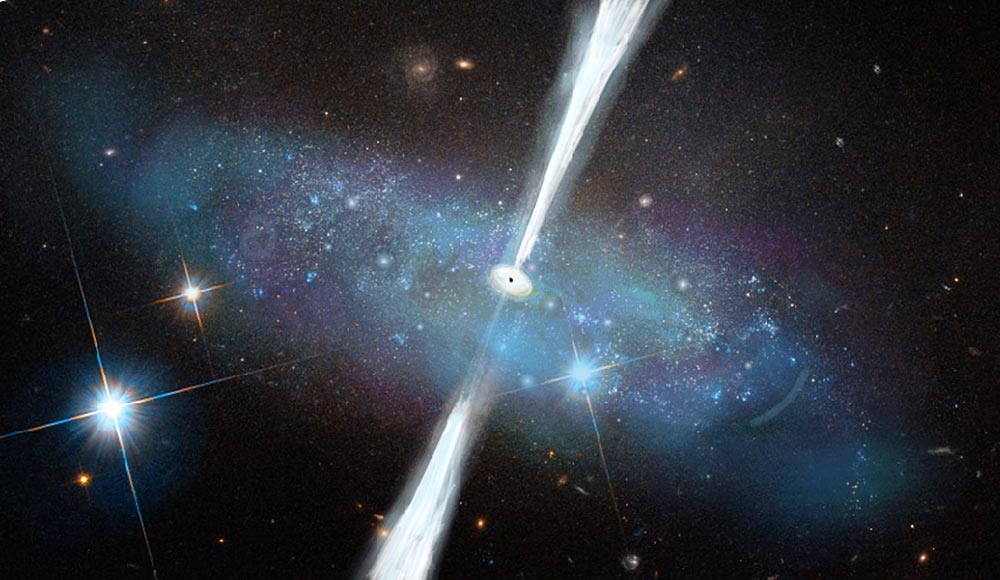
Newfound black holes in dwarf galaxies shed light on the origin of our galaxy’s supermassive black hole.
A team of researchers led by astronomers in the UNC-Chapel Hill Department of Physics & Astronomy has found a previously overlooked treasure trove of massive black holes in dwarf galaxies. The newly discovered black holes offer a glimpse into the life story of the supermassive black hole at the center of our own Milky Way galaxy.
Hiding in Plain Sight
As a giant spiral galaxy, the Milky Way is believed to have been built up from mergers of many smaller dwarf galaxies. For example, the Magellanic Clouds seen in the southern sky are dwarf galaxies that will merge into the Milky Way. Each dwarf that falls in may bring with it a central massive black hole, tens or hundreds of thousands of times the mass of our sun, potentially destined to be swallowed by the Milky Way’s central supermassive black hole.
But how often dwarf galaxies contain a massive black hole is unknown, leaving a key gap in our understanding of how black holes and galaxies grow together. New research published in the Astrophysical Journal on May 24, 2022, helps to fill in this gap by revealing that massive black holes are many times more common in dwarf galaxies than previously thought.
“This result really blew my mind because these black holes were previously hiding in plain sight,” said Mugdha Polimera, Ph.D. student in the Department of Physics & Astronomy and lead author of the study.
Sending Mixed Messages
Black holes are typically detected when they are actively growing by consuming gas and stardust swirling around them, which makes them glow intensely.
Professor Sheila Kannappan, Polimera’s Ph.D. advisor in the Department of Physics & Astronomy and coauthor of the study, compared black holes to fireflies. “Just like fireflies, we see black holes only when they’re lit up — when they’re growing — and the lit-up ones give us a clue to how many we can’t see.”
The problem is, while growing black holes glow with distinctive high-energy radiation, young newborn stars can too. Traditionally, astronomers have differentiated growing black holes from new star formation using diagnostic tests that rely on detailed features of each galaxy’s visible light when spread out into a spectrum like a rainbow.
“We all got nervous. The first question that came to my mind was: Have we missed a way that extreme star formation alone could explain these galaxies?” Mugdha Polimera
The path to discovery began when undergraduate students working with Kannappan tried to apply these traditional tests to galaxy survey data. The team realized that some of the galaxies were sending mixed messages — two tests would indicate growing black holes, but a third would indicate only star formation.
“Previous work had just rejected ambiguous cases like these from statistical analysis, but I had a hunch they might be undiscovered black holes in dwarf galaxies,” Kannappan said. She suspected that the third, sometimes contradictory, test was more sensitive than the other two to typical properties of dwarfs: their simple elemental composition (mainly primordial hydrogen and helium from the Big Bang) and their high rate of forming new stars.
Study coauthor Chris Richardson, an associate professor at Elon University, confirmed with theoretical simulations that the mixed-message test results exactly matched what theory would predict for a primordial-composition, highly star-forming dwarf galaxy containing a growing massive black hole. “The fact that my simulations lined up with what the Kannappan group found made me excited to explore the implications for how galaxies evolve,” Richardson said.
A Census of Growing Black Holes
Polimera took on the challenge of constructing a new census of growing black holes, with attention to both traditional and mixed-message types. She obtained published measurements of visible light spectral features to test for black holes in thousands of galaxies found in two surveys led by Kannappan, RESOLVE and ECO. These surveys include ultraviolet and radio data ideal for studying star formation, and they have an unusual design: Whereas most astronomical surveys select samples that favor big and bright galaxies, RESOLVE and ECO are complete inventories of huge volumes of the present-day universe, in which dwarf galaxies are abundant.
“It was important to me that we didn’t bias our black hole search toward dwarf galaxies,” Polimera said. “But in looking at the whole census, I found that the new type of growing black holes almost always showed up in dwarfs. I was taken aback by the numbers when I first saw them.”
More than 80 percent of all growing black holes she found in dwarf galaxies belonged to the new type.
The result seemed too good. “We all got nervous,” Polimera said. “The first question that came to my mind was: Have we missed a way that extreme star formation alone could explain these galaxies?” She led an exhaustive search for alternative explanations involving star formation, modeling uncertainties, or exotic astrophysics. In the end, the team was forced to conclude that the newly identified black holes were real.
“We’re still pinching ourselves,” Kannappan said. “We’re excited to pursue a zillion follow-up ideas. The black holes we’ve found are the basic building blocks of supermassive black holes like the one in our own Milky Way. There’s so much we want to learn about them.”
Reference: “RESOLVE and ECO: Finding Low-metallicity z ~ 0 Dwarf AGN Candidates Using Optimized Emission-line Diagnostics” by Mugdha S. Polimera, Sheila J. Kannappan, Chris T. Richardson, Ashley S. Bittner, Carlynn Ferguson, Amanda J. Moffett, Kathleen D. Eckert, Jillian M. Bellovary and Mark A. Norris, 24 May 2022, The Astrophysical Journal.
DOI: 10.3847/1538-4357/ac6595
This research was funded in part by the National Science Foundation.
Never miss a breakthrough: Join the SciTechDaily newsletter.
Follow us on Google and Google News.
4 Comments
The evolution of early galaxy after big bang has different process than dwarf galaxies’ growth.
The observations of growth òf dwarf galaxies,including super massive black holes(dwarf) and stars in two different sections are good.
The evolution process of early galaxy after big bang and growth of dwarf galaxies are different.Dwarf galaxy depends upon the nearest galaxy.
It is time for humans to understand our universe. Only a paradigm shift will solve the problems. Paradigm shifts are incredibly hard to come by because the big bang theory is currently a literal fact. That is what causes the endless confusion in astrophysics.
Each galaxy was born as a single black hole. The galaxies are shrapnel from our universe taking two objects, that contained the mass of the observable galaxies, and slamming them together at an astronomical speed. The pressure and friction from this event created quark plasma shrapnel just like what happens in particle colliders all the time. The characteristics of each galaxy were determined by the size, shape, and rotational rate of each piece of quark plasma shrapnel. All of this happened in an already existing, static universe. The first law of thermodynamics is happy now when it never has been before.
It is no surprise that so many black holes were found. Even our own planet was a black hole when it was eventually formed from our galaxy. Even our moon was a black hole. This because quark plasma uses the electron neutrinos of space to create every naturally occurring element all by itself from the outside of the mass inward. Neutrons are first, then hydrogen, helium, and on down the line. The beta minus decay reaction accomplishes all this element creating using the endless supply of quark plasma at the core. Our Moon is a rock simply because a smaller mass cools faster than a bigger one. That is why our moon is a rock and the black hole in the center of our galaxy is still a black hole.
Quark plasma is invisible and can make shapes. It uses the dark matter of space that causes gravity as its catalyst. That’s why it is the most efficient reaction in the universe. Once the quarks have been separated from a sufficient enough reaction, it is the sheer density and pressure of dark matter that keeps the quarks apart indefinitely. The energy is created as the strong force between quarks and the electron neutrinos of space throws the incoming dark matter out of the reaction as gamma rays. It is this energy, not fusion, that makes the energy in our universe basically timeless.
Our galaxy was a spinning mass of quark plasma. Centrifugal force spread the matter into a disk with a bulbous center. The center separated from the disk and our black hole was formed. The remaining quark plasma disk was left to create all the solar systems. Our solar system was spinning and spread itself into a disk with a bulbous center as well. The center separated from the disk and our Sun was born as quark plasma. The remaining quark plasma disk created all the planets and corresponding moons and rings. Even the planets were formed like our galaxy was. Even our moon was born as a black hole.
Science has gone at our universe all wrong for a century. Edwin Hubble discovered the galaxies expanding, not the universe. The collision that created what we see gave everything the energy it possesses, not gravity. That is why science has no idea how the force of gravity works.
This is the paradigm shift science has been looking for. If course, it sounds foreign. Why wouldn’t it? The most important thing is it follows all the laws. Does the Big Bang theory follow any laws?
Obegripligt är det första paradigmskiftet!