
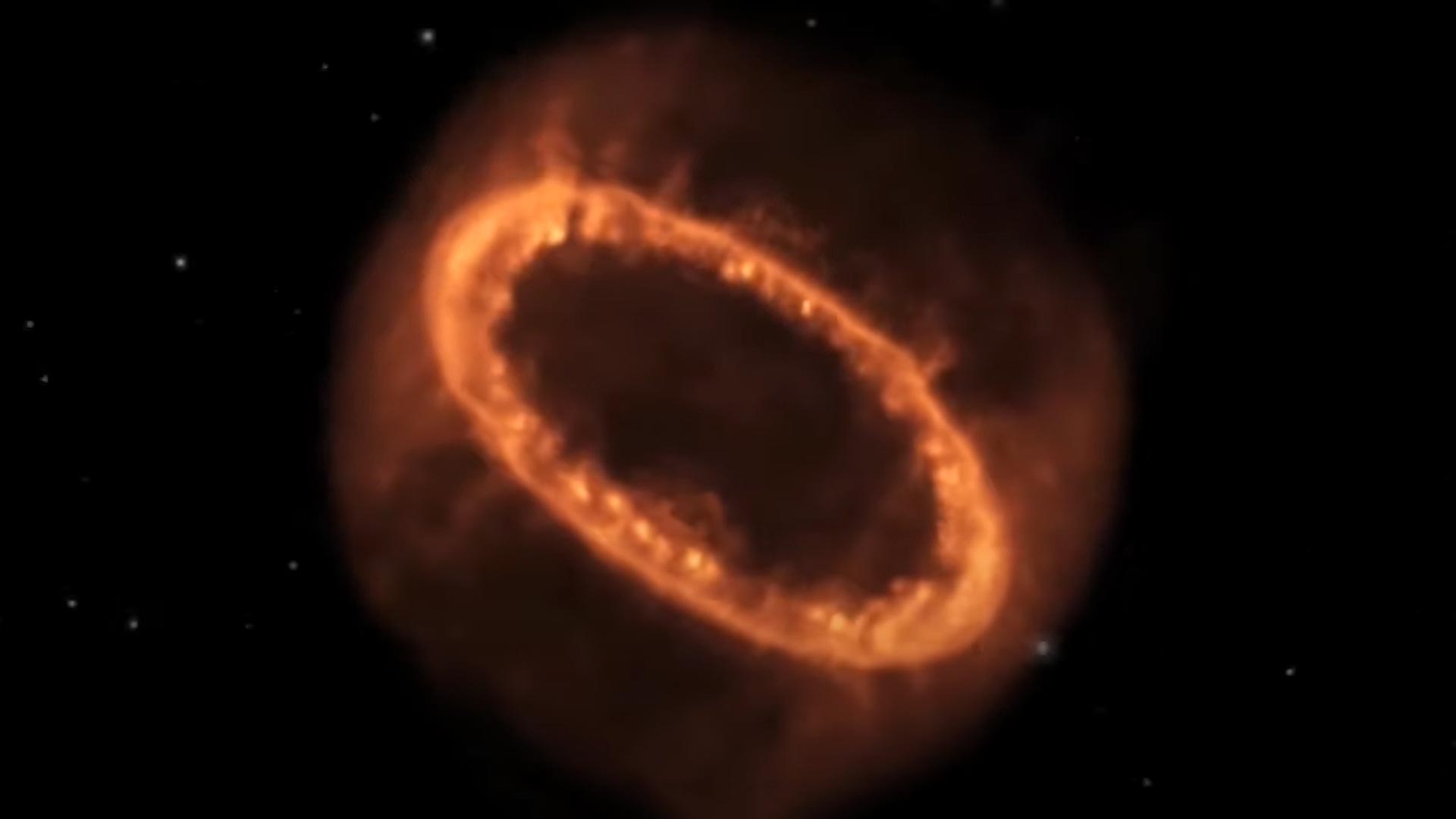
A newly discovered ring, J0624–6948, may be the first known intergalactic Supernova Remnant.
Western Sydney University researchers, together with an international team of experts, have discovered a mysterious circular ring near our neighboring galaxy that could be the first known case of an intergalactic Supernova Remnant – remains of an exploded star that could be up to 7,000 years old.
Dubbed a ‘rogue’ Supernova Remnant by the scientists and named J0624–6948, it is most likely located in the Large Magellanic Cloud (LMC) – a satellite galaxy of the Milky Way – and its position suggests a previously unobserved origin.
Published in the prestigious journal Monthly Notices of the Royal Astronomical Society, lead author Professor Miroslav Filipovic from the University’s School of Science said the discovery was exciting and raised many unanswered questions.
“When we originally discovered this almost perfectly circular radio object we thought it was yet another ORC (Odd Radio Circle) but after our additional observations, it became clear that this object is much more likely to be something else,” said Professor Filipovic.
The ring that was discovered has significant differences to the five other known ORCs — a flatter radio spectral index, lack of a prominent central galaxy as a possible host, and larger apparent size — that all suggest it may be a different type of object.
Theories Behind the Origin of J0624–6948
“The most plausible explanation is that the object is an intergalactic Supernova Remnant due to an exploded star that resided in the Large Magellanic Cloud outskirts that had undergone a single-degenerate type Ia supernova which involves the explosion of two stars orbiting each other,” said Professor Filipovic.
“However, we considered other scenarios such as that this object might represent a remnant of the super-flare activity from a nearby Milky Way star (at only 190 light years away from Sun) that happened only a few centuries ago, or the premise that it may in fact be a much larger ORC.
“What we’ve potentially then discovered is a unique remnant of supernova that has expanded into a rarefied, intergalactic environment — an environment that we didn’t expect to find in such an object. Our estimates point to the age of about 2200 to 7100 years old.”
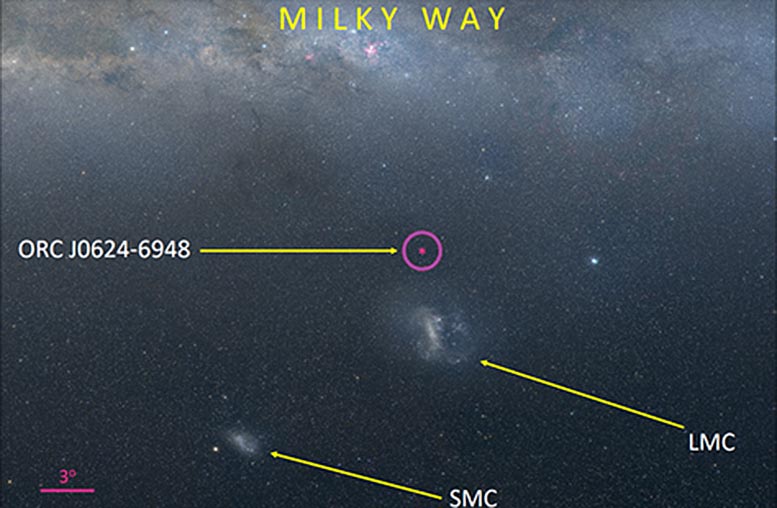
J0624–6948 was first detected with the Australian Square Kilometer Array Pathfinder (ASKAP) managed by CSIRO – one of several new generation radio telescopes that are revealing new features of the Universe.
“These new radio telescopes can pick up a range of spherical objects, and due to the combined effects of high-sensitivity, good spatial sampling, and wide area coverage, they are enriching our understanding of the Universe.”
Reference: “Mysterious odd radio circle near the large magellanic cloud – an intergalactic supernova remnant?” Miroslav D Filipović, J L Payne, R Z E Alsaberi, R P Norris, P J Macgregor, L Rudnick, B S Koribalski, D Leahy, L Ducci, R Kothes, H Andernach, L Barnes, I S Bojičić, L M Bozzetto, R Brose, J D Collier, E J Crawford, R M Crocker, S Dai, T J Galvin, F Haberl, U Heber, T Hill, A M Hopkins, N Hurley-Walker, A Ingallinera, T Jarrett, P J Kavanagh, E Lenc, K J Luken, D Mackey, P Manojlović, P Maggi, C Maitra, C M Pennock, S Points, S Riggi, G Rowell, S Safi-Harb, H Sano, M Sasaki, S Shabala, J Stevens, J Th van Loon, N F H Tothill, G Umana, D Urošević, V Velović, T Vernstrom, J L West, Z Wan, 4 February 2022, Monthly Notices of the Royal Astronomical Society.
DOI: 10.1093/mnras/stac210
Never miss a breakthrough: Join the SciTechDaily newsletter.
Follow us on Google and Google News.
5 Comments
It’s never aliens (until it’s aliens).
The doors open have we recieved the invitation.
Why would this intact ring be left after a Supernova? Unless a very strong coronal-like “gasket”. Definitely leaves one scratching one’s noggin.
Ringworld it is!
We’re you blinded by it’s majesty, paralyzed, dumbstruck?