

An international team led by Australian research center ASTRO 3D reports that age is the driving force in changing how stars move within galaxies.
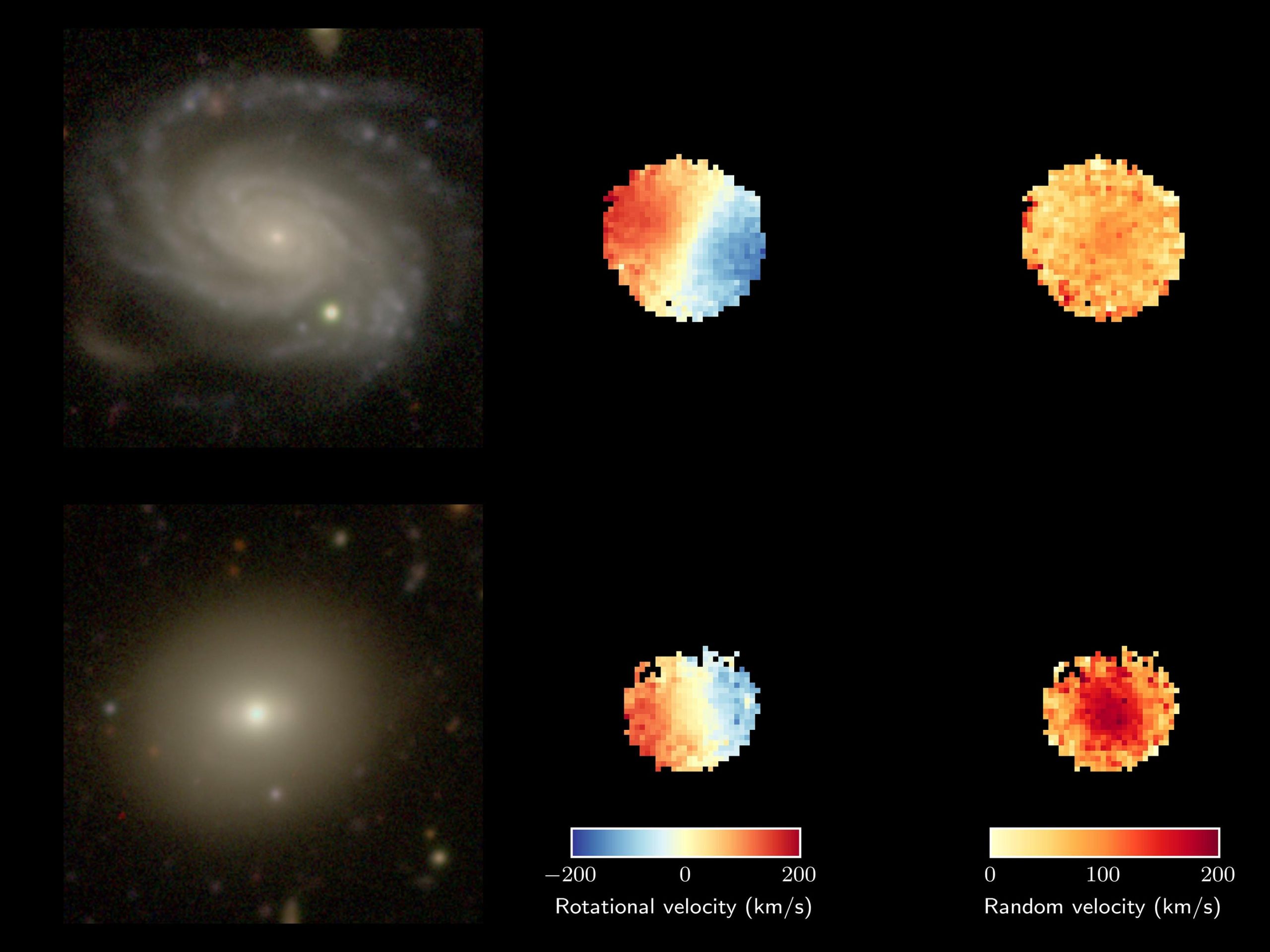
Galaxies start life with their stars rotating in an orderly pattern but in some the motion of stars in more random. Until now, scientists have been uncertain about what causes this – possibly the surrounding environment or the mass of the galaxy itself.
Key Findings on Galaxy Age
A new study, published in recently in MNRAS (Monthly Notices of the Royal Astronomical Society), has found that the most important factor is neither of these things. It shows the tendency of the stars to have random motion is driven mostly by the age of the galaxy – things just get messy over time.
“When we did the analysis, we found that age, consistently, whichever way we slice or dice it, is always the most important parameter,” says first author Prof Scott Croom, an ASTRO 3D researcher at the University of Sydney.
Environmental and Mass Factors
“Once you account for age, there is essentially no environmental trend, and it’s similar for mass.
“If you find a young galaxy it will be rotating, whatever environment it is in, and if you find an old galaxy, it will have more random orbits, whether it’s in a dense environment or a void.”
Research Team and Methodology
The research team also included scientists from Macquarie University, Swinburne University of Technology, the University of Western Australia, the Australian National University, the University of New South Wales, the University of Cambridge, the University of Queensland, and Yonsei University in the Republic of Korea.
The study updates our understanding from previous studies that have variously suggested environment or mass as more important factors. But the earlier work is not necessarily incorrect, says second author Dr. Jesse van de Sande.
Young galaxies are star-forming super-factories, while in older ones, star formation ceases.
“We do know that age is affected by environment. If a galaxy falls into a dense environment, it will tend to shut down the star formation. So galaxies in denser environments are, on average, older,” Dr. van de Sande says.
“The point of our analysis is that it’s not living in dense environments that reduces their spin, it’s the fact that they’re older.”
The Milky Way’s Dynamics
Our own galaxy, the Milky Way, still has a thin star-forming disk, so is still considered a high-spin rotational galaxy.
“But when we look at the Milky Way in detail, we do see something called the Milky Way thick disk. It’s not dominant, in terms of light, but it is there and those look to be older stars, which may well have been heated from the thin disk at earlier times, or born with more turbulent motion in the early Universe,” Prof Croom says.
Contributions of the SAMI Galaxy Survey
The research used data from observations made under the SAMI Galaxy Survey. The SAMI instrument was built in 2012 by the University of Sydney and the Anglo-Australian Observatory (now Astralis). SAMI uses the Anglo-Australian Telescope, at Siding Spring Observatory, near Coonabarabran, New South Wales. It has surveyed 3000 galaxies across a large range of environments.
The study allows astronomers to rule out many processes when trying to understand galaxy formation and so fine-tune models of how the Universe has developed.
Future Directions in Galaxy Research
The next steps will be to develop simulations of galaxy evolution with more granular detail.
“One of the challenges of getting simulations right is the high resolution you need in to predict what’s going on. Typical current simulations are based on particles which have the mass of maybe 100,000 stars and you can’t resolve small-scale structures in galaxy disks,” Prof. Croom says.
The Hector Galaxy Survey will help Prof Croom and his team expand this work using a new instrument on the Anglo-Australian Telescope.
“Hector is observing 15,000 galaxies but with higher spectral resolution, allowing the age and spin of galaxies to be measured even in much lower mass galaxies and with more detailed environmental information,” says Professor Julia Bryant, lead of the Hector Galaxy Survey, University of Sydney.
Conclusion and Impact on Universal Understanding
Professor Emma Ryan-Weber, Director of ASTRO 3D, says, “These findings answer one of the key questions posed by ASTRO 3D: how does mass and angular momentum evolve in the Universe? This careful work by the SAMI team reveals that the age of a galaxy determines how the stars orbit. This critical piece of information contributes to a clearer big-picture view of the Universe.”
Reference: “The SAMI Galaxy Survey: galaxy spin is more strongly correlated with stellar population age than mass or environment” by Scott M Croom, Jesse van de Sande, Sam P Vaughan, Tomas H Rutherford, Claudia del P Lagos, Stefania Barsanti, Joss Bland-Hawthorn, Sarah Brough, Julia J Bryant, Matthew Colless, Luca Cortese, Francesco D’Eugenio, Amelia Fraser-McKelvie, Michael Goodwin, Nuria P F Lorente, Samuel N Richards, Andrei Ristea, Sarah M Sweet, Sukyoung K Yi and Tayyaba Zafar, 3 April 2024, Monthly Notices of the Royal Astronomical Society.
DOI: 10.1093/mnras/stae458
ABOUT ASTRO 3D
The ARC Centre of Excellence for All Sky Astrophysics in 3 Dimensions (ASTRO 3D) is a $40m Research Centre of Excellence funded by the Australian Research Council (ARC) and nine collaborating Australian universities – The Australian National University, The University of Sydney, The University of Melbourne, Swinburne University of Technology, The University of Western Australia, Curtin University, Macquarie University, The University of New South Wales, and Monash University.
ABOUT the SAMI Galaxy Survey
The SAMI Galaxy Survey began in March 2013, with the intention of creating a large survey of 3000 galaxies across a large range of environment. The data for the SAMI Galaxy Survey was collected using SAMI, the Sydney-Australian-Astronomical-Observatory Multi-object Integral-Field Spectrograph. SAMI is an instrument on the 4-meter Anglo-Australian Telescope at Siding Spring Observatory. Integral-field spectroscopy (IFS) allows a unique view of how stars and gas zoom around inside distant galaxies because we collect dozens of spectra across the entire face of each galaxy.
Never miss a breakthrough: Join the SciTechDaily newsletter.
Follow us on Google and Google News.