
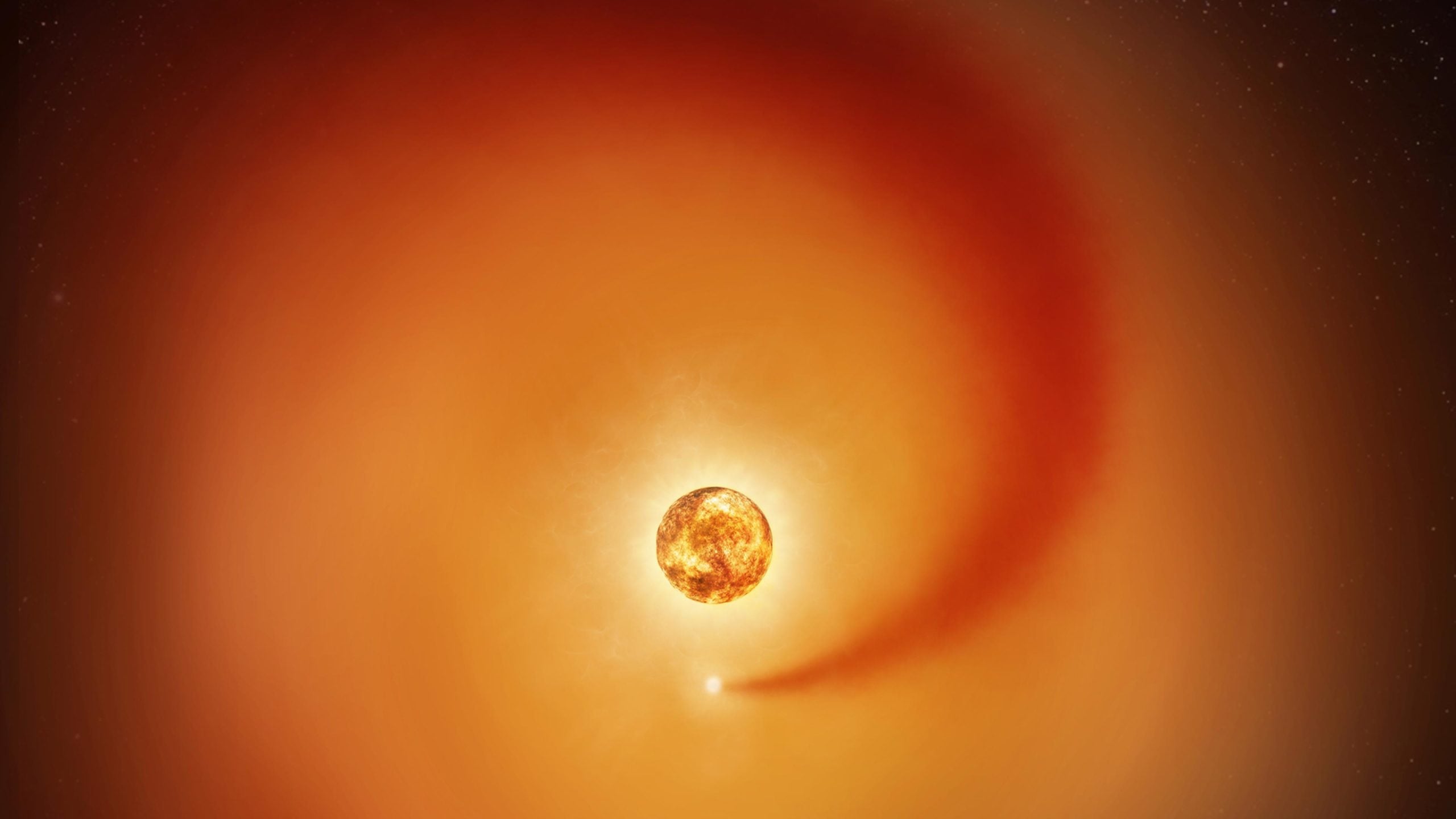
Betelgeuse’s long-standing mystery has been cracked: a hidden companion star is literally reshaping the giant from the inside out.
Astronomers using new data from NASA’s Hubble Space Telescope along with observations from ground-based telescopes have uncovered fresh evidence of a companion star shaping the environment around Betelgeuse. The study, led by researchers at the Center for Astrophysics | Harvard & Smithsonian (CfA), shows that the companion star, known as Siwarha, is stirring up dense streams of gas within Betelgeuse’s enormous outer atmosphere. These findings help explain the unusual changes scientists have observed in the star’s brightness and behavior.
The research was presented on January 5 during a news conference at the 247th meeting of the American Astronomical Society in Phoenix and has been accepted for publication in The Astrophysical Journal.
Tracking a Stellar Wake Over Eight Years
The research team identified the influence of Siwarha by closely monitoring subtle shifts in Betelgeuse’s light over nearly eight years. These long-term observations revealed signs of a once-theoretical companion star moving through the red supergiant’s extended atmosphere. As the companion travels through the gas surrounding Betelgeuse, it creates a trail of denser material, similar to a wake.
This detection resolves a major question that has puzzled astronomers for decades. By confirming the presence of a companion star, scientists can now better explain how Betelgeuse behaves and how massive stars evolve during the final stages of their lives.
Why Betelgeuse Is a Stellar Laboratory
Betelgeuse lies about 650 light-years from Earth in the constellation Orion. It is a red supergiant so vast that more than 400 million Suns could fit inside it. Its immense size and relative closeness make it one of the few stars whose surface and surrounding atmosphere can be directly studied, offering astronomers a rare opportunity to observe how giant stars age, lose mass, and eventually explode as supernovae.
Evidence from Space and Ground Observatories
Using Hubble along with telescopes at the Fred Lawrence Whipple Observatory and the Roque de Los Muchachos Observatory, the researchers detected repeating patterns in Betelgeuse’s behavior. These patterns pointed to the presence of a long-suspected companion and revealed how it affects the star’s outer layers.
The data showed changes in Betelgeuse’s spectrum, which is the range of colors emitted by different elements, as well as shifts in the speed and direction of gas in its atmosphere. These changes are linked to a trail of denser material left behind by the companion star. This wake appears shortly after the companion passes in front of Betelgeuse roughly every six years, or about 2,100 days, matching predictions from earlier theoretical models.
A Visible Ripple Through a Giant Star
“It’s a bit like a boat moving through water. The companion star creates a ripple effect in Betelgeuse’s atmosphere that we can actually see in the data,” said Andrea Dupree, an astronomer at the CfA and lead author of the study. “For the first time, we’re seeing direct signs of this wake, or trail of gas, confirming that Betelgeuse really does have a hidden companion shaping its appearance and behavior.”
Decades of Puzzling Variations
Astronomers have been monitoring Betelgeuse for years, trying to understand why its brightness and surface features change over time. Interest surged in 2020 when the star unexpectedly dimmed, an event often described as a stellar “sneeze.” Scientists identified two main cycles in its variability: a shorter 400-day cycle linked to pulsations within the star, and a longer secondary cycle lasting about 2,100 days.
From Theory to Direct Evidence
Over the years, researchers explored many possible explanations for Betelgeuse’s long-term changes, including massive convection cells, dust clouds, magnetic effects, and the idea of an unseen companion. Recent studies suggested that the longer cycle was best explained by a low-mass star orbiting deep within Betelgeuse’s atmosphere. While one team reported a possible detection, there had been no direct proof until now.
The newly observed wake provides the first clear evidence that a companion star is actively disrupting the atmosphere of this red supergiant.
“The idea that Betelgeuse had an undetected companion has been gaining in popularity for the past several years, but without direct evidence, it was an unproven theory,” Dupree said. “With this new direct evidence, Betelgeuse gives us a front-row seat to watch how a giant star changes over time. Finding the wake from its companion means we can now understand how stars like this evolve, shed material, and eventually explode as supernovae.”
What Comes Next for Betelgeuse Studies
From Earth, Betelgeuse is currently eclipsing its companion star, but astronomers are already planning new observations when the companion emerges again in 2027. Researchers believe this discovery may also help solve similar mysteries surrounding other giant and supergiant stars.
Hubble’s Ongoing Legacy
The Hubble Space Telescope has been operating for more than 30 years and continues to deliver discoveries that deepen our understanding of the universe. Hubble is a joint project between NASA and ESA (European Space Agency). NASA’s Goddard Space Flight Center in Greenbelt, Maryland, oversees the mission and telescope operations, with additional support from Lockheed Martin Space in Denver. The Space Telescope Science Institute in Baltimore, operated by the Association of Universities for Research in Astronomy, manages Hubble’s scientific programs for NASA.
Never miss a breakthrough: Join the SciTechDaily newsletter.
Follow us on Google and Google News.
1 Comment
B Memo 2601080136 Source 1. Reinterpretation []
Source 1.
https://scitechdaily.com/astronomers-finally-solve-betelgeuses-biggest-mystery/
1.
_Astronomers Finally Solve Betelgeuse’s Biggest Mystery
_This artist’s concept shows the red supergiant star Betelgeuse and its orbiting companion star. At this point, the clockwise orbiting companion creates a dense gas trail expanding outward.
_The companion star is very close to Betelgeuse, passing through the supergiant’s extensive exosphere. The companion star is not proportional to its actual size and appears as a tiny dot compared to Betelgeuse. The distance between the companion star and Betelgeuse is expressed as a ratio relative to Betelgeuse’s diameter.
_The long-standing mystery of Betelgeuse has been solved. The hidden companion star is literally reshaping the massive star from within.
ㅡC[[[ Betelgeuse is a massive red supergiant.
(_Betelgeuse is a red supergiant located in the constellation Orion, about 650 light-years from Earth. This star is so massive that it could fit more than 400 million suns inside.)
>>The star will soon meet its supernova end. Will the aftermath endanger the solar system? That’s a startling question. My guess is no. 0140.
>>>>Attention, everyone.
This evidence suggests that the nearly dead companion star vixxa absorbed most of the explosive energy of vixxb and was reincarnated. Wow. 0144. What a remarkable discovery.
>> This phenomenon demonstrates that the shape of vix.vixx_bar resembles a fan, as if the fan-shaped size of the center point and the chord of the circle were a fan-shaped companion of life and death.
>>> So, the explosive energy of the supernova is absorbed by the dead companion neutron star, Vixxb, minimizing or eliminating the damage to its neighbor. Wow. 0149.
>>> So, the final death of Betelgeuse as a supergiant will not destroy our galaxy or cause a sudden catastrophe for Earth in our solar system.
>> This suggests that Vixa and Vixb of the black hole Vixer are living companion stars of a young couple,
and when one dies, they are reincarnated into each other, representing their bond of childbearing. Wow. Amazing deduction. 0155.
(((Related Article
.Hubble Telescope Discovers the Cause of Betelgeuse’s Mysterious Dimming – Is an Aging Red Supergiant Star About to Go Supernova?
.Quasar Tsunamis Sweep Interstellar Space, Wreaking Massive Damage on the Galaxy.)))
>>>The related article’s question can be answered by interpreting it as a (vixa,vixb).(vixxa,vixxb).bar.circular sector companion star. Betelgeuse’s dimming is due to its companion star being revitalized, and the supergiant explosion absorbs most of its energy, reviving it, leaving no damage to its surroundings.)
>>>Based on this reasoning, I wonder if I should win the Nobel Prize in Astronomy in 2027. Hehe.
People are very worried about what would happen to Earth if a black hole exploded, but it turns out that most of Vixa’s explosive energy is absorbed by Vixb, like its partner. 0206.
So, without harming anyone else, I think their partner, their companion, might be having a tumultuous love affair and have a baby. Hmm. 0212.
]]]
1-1.
_Using new data from NASA’s Hubble Space Telescope and observations from ground-based telescopes, astronomers have found new evidence of a companion star influencing the environment surrounding Betelgeuse.
_The study, led by researchers at the Harvard-Smithsonian Center for Astrophysics (CfA), shows that the companion star, named Siwarha, is stirring up dense gas flows within Betelgeuse’s vast exosphere.
_This discovery resolves a crucial question that has puzzled astronomers for decades. By confirming the companion star’s existence, scientists can now better explain Betelgeuse’s behavior and how massive stars evolve in the final stages of their lives.
2-2. Visible Ripples Across a Massive Star
_”It’s like a boat moving across water. The companion star creates a ripple effect in Betelgeuse’s atmosphere, and we can actually see that effect in our data,” said Andrea Dupree, a CfA astronomer and lead author of the study.
_”With this study, we have, for the first time, direct evidence of these ripples, or gas signatures, confirming that Betelgeuse actually has a hidden companion star that influences its appearance and behavior.”
3. From Theory to Direct Evidence
_The newly observed signatures provide the first clear evidence that the companion star is actively disrupting the red supergiant’s atmosphere.
3-1.
_”The hypothesis that Betelgeuse has an undiscovered companion star has gained increasing support in recent years, but it remained unproven due to the lack of direct evidence,” Dupree said.
—B[[ There’s a reason binaries form in the universe. It could be because reincarnation involves pendulum motion. Uh-huh. 2601080105.
((1.
NASA’s stunning X-ray image reveals a “dead” star coming back to life.
2-1. A binary system powered by stolen gas
Source 1.
https://scitechdaily.com/a-dead-star-comes-alive-in-a-stunning-nasa-x-ray-view/
_EX Hydrae is part of a binary system containing a typical main sequence star. Gas from the companion star constantly flows into the white dwarf. The process of accretion and the location of this material on the white dwarf are determined by the strength of the white dwarf’s magnetic field.))
>>>There’s a reason why vixers and vixxas are binary stars.
>>>Because the pair reincarnate each other. I think the hypothesis that Betelgeuse has an undiscovered companion star is correct. Hmm. A companion star is necessary for life, maintaining balance between the two, and when one dies, the companion star survives. A life in which the companion star divides and only one dies is a true companion. Companion stars demonstrate the enduring bond between parents and children. Oh, my. 0123
]]
_”This new direct evidence provides the closest possible observation of how the massive star Betelgeuse changes over time. By discovering the traces of its companion star, we can now understand how such stars evolve, expel matter, and ultimately explode as supernovae.”