
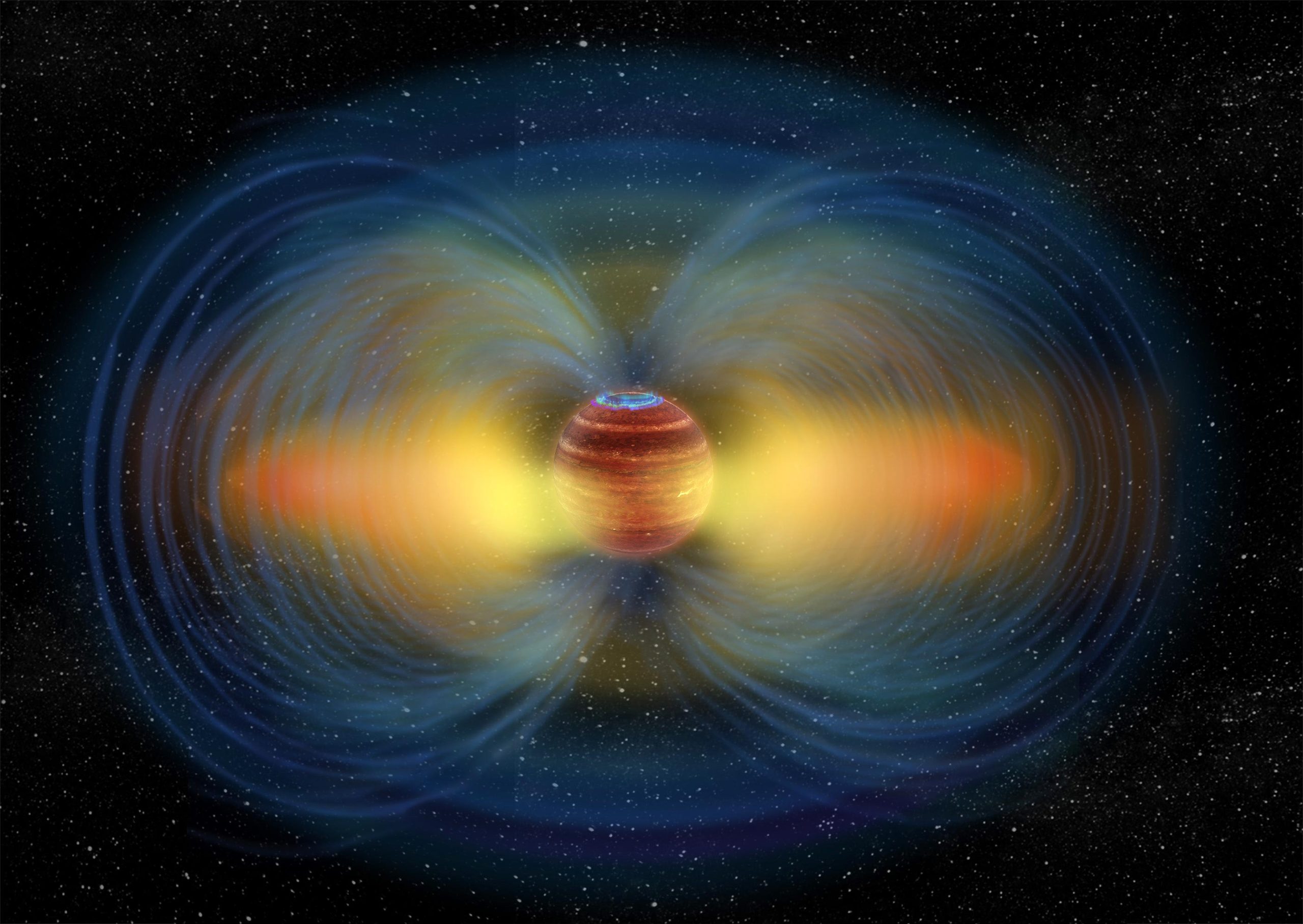
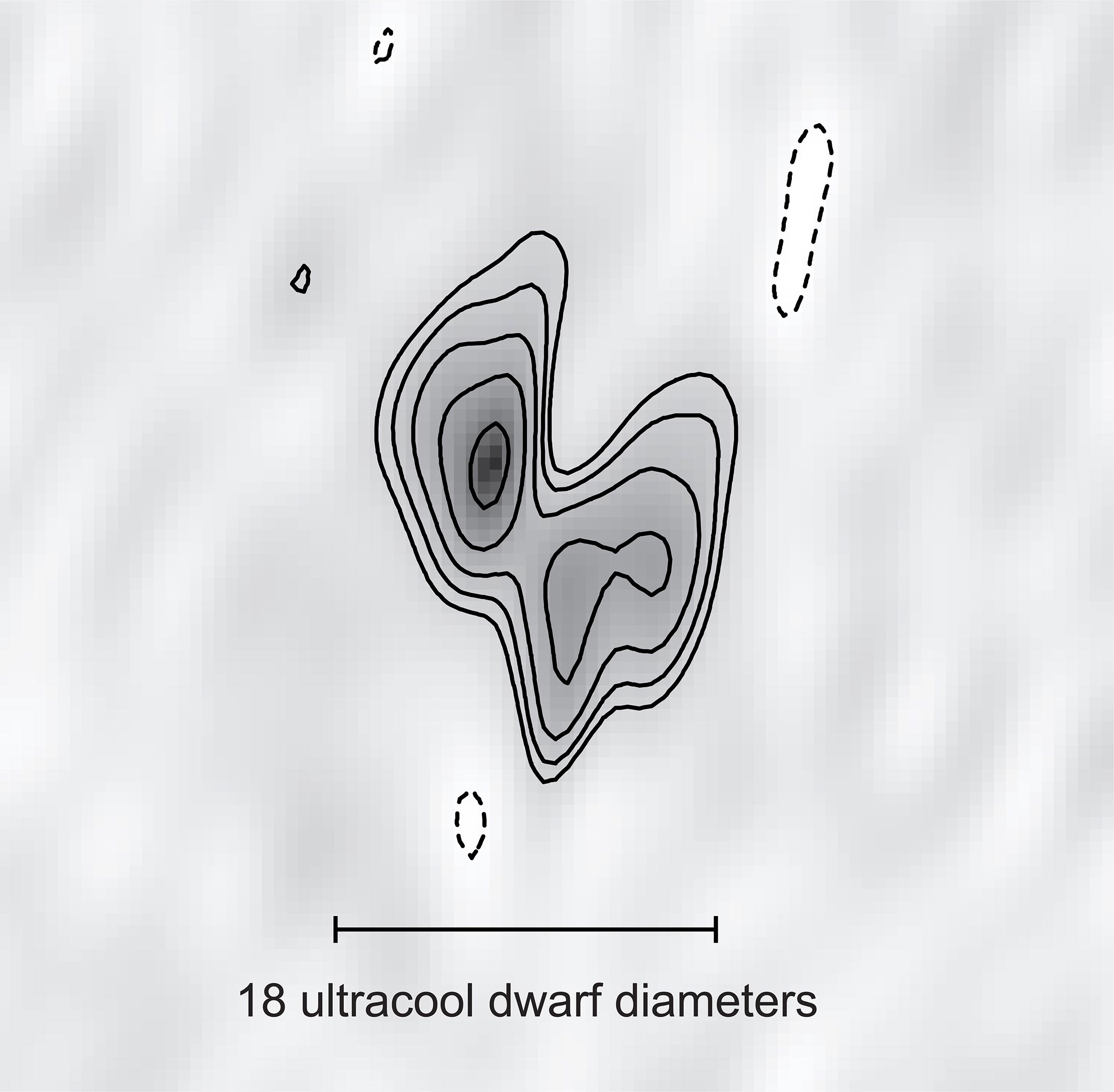
High-resolution imaging of radio emissions from an ultracool dwarf shows a double-lobed structure like the radiation belts of Jupiter.
A team of astronomers has successfully observed the first radiation belt outside our solar system, using an array of 39 radio dishes. The radiation belt, found around an ultracool dwarf, is similar to Jupiter’s but 10 million times brighter. This breakthrough in the study of magnetic fields of celestial bodies may contribute to the understanding of the habitability of exoplanets.
Astronomers have described the first radiation belt observed outside our solar system, using a coordinated array of 39 radio dishes from Hawaii to Germany to obtain high-resolution images. The images of persistent, intense radio emissions from an ultracool dwarf reveal the presence of a cloud of high-energy electrons trapped in the object’s powerful magnetic field, forming a double-lobed structure analogous to radio images of Jupiter’s radiation belts.
“We are actually imaging the magnetosphere of our target by observing the radio-emitting plasma—its radiation belt—in the magnetosphere. That has never been done before for something the size of a gas giant planet outside of our solar system,” said Melodie Kao, a postdoctoral fellow at the University of California, Santa Cruz and first author of a paper on the new findings published on May 15 in Nature.
Strong magnetic fields form a “magnetic bubble” around a planet called a magnetosphere, which can trap and accelerate particles to near the speed of light. All the planets in our solar system that have such magnetic fields, including Earth, as well as Jupiter and the other giant planets, have radiation belts consisting of these high-energy charged particles trapped by the planet’s magnetic field.
Earth’s radiation belts, known as the Van Allen belts, are large donut-shaped zones of high-energy particles captured from solar winds by the magnetic field. Most of the particles in Jupiter’s belts are from volcanoes on its moon Io. If you could put them side by side, the radiation belt that Kao and her team have imaged would be 10 million times brighter than Jupiter’s.
Differentiating Auroras and Radiation Belts
Particles deflected by the magnetic field toward the poles generate auroras (“northern lights”) when they interact with the atmosphere, and Kao’s team also obtained the first image capable of differentiating between the location of an object’s aurora and its radiation belts outside our solar system.
The ultracool dwarf imaged in this study straddles the boundary between low-mass stars and massive brown dwarfs. “While the formation of stars and planets can be different, the physics inside of them can be very similar in that mushy part of the mass continuum connecting low-mass stars to brown dwarfs and gas giant planets,” Kao explained.
Characterizing the strength and shape of the magnetic fields of this class of objects is largely uncharted terrain, she said. Using their theoretical understanding of these systems and numerical models, planetary scientists can predict the strength and shape of a planet’s magnetic field, but they haven’t had a good way to easily test those predictions.
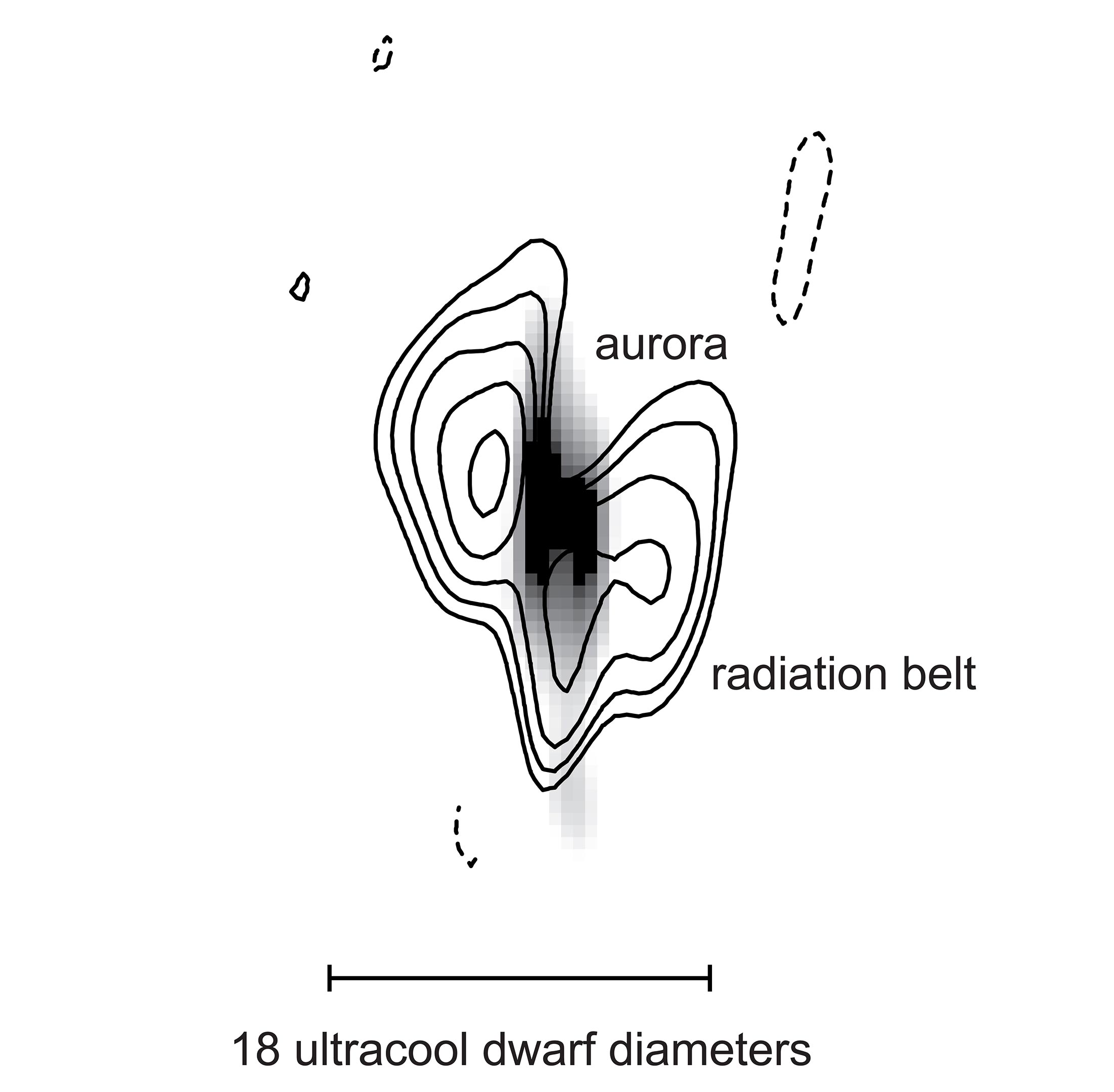
“Auroras can be used to measure the strength of the magnetic field, but not the shape. We designed this experiment to showcase a method for assessing the shapes of magnetic fields on brown dwarfs and eventually exoplanets,” Kao said.
Magnetic Fields and Planetary Habitability
The strength and shape of the magnetic field can be an important factor in determining a planet’s habitability. “When we’re thinking about the habitability of exoplanets, the role of their magnetic fields in maintaining a stable environment is something to consider in addition to things like the atmosphere and climate,” Kao said.
To generate a magnetic field, a planet’s interior must be hot enough to have electrically conducting fluids, which in the case of Earth is the molten iron in its core. In Jupiter, the conducting fluid is hydrogen under so much pressure it becomes metallic. Metallic hydrogen probably also generates magnetic fields in brown dwarfs, Kao said, while in the interiors of stars the conducting fluid is ionized hydrogen.
The ultracool dwarf known as LSR J1835+3259 was the only object Kao felt confident would yield the high-quality data needed to resolve its radiation belts.
Future Prospects for Extrasolar Radiation Belt Studies
“Now that we’ve established that this particular kind of steady-state, low-level radio emission traces radiation belts in the large-scale magnetic fields of these objects, when we see that kind of emission from brown dwarfs—and eventually from gas giant exoplanets—we can more confidently say they probably have a big magnetic field, even if our telescope isn’t big enough to see the shape of it,” Kao said, adding that she is looking forward to when the Next Generation Very Large Array, currently being planned by the National Radio Astronomy Observatory (NRAO), can image many more extrasolar radiation belts.
“This is a critical first step in finding many more such objects and honing our skills to search for smaller and smaller magnetospheres, eventually enabling us to study those of potentially habitable, Earth-size planets,” said coauthor Evgenya Shkolnik at Arizona State University, who has been studying the magnetic fields and habitability of planets for many years.
The team used the High Sensitivity Array, consisting of 39 radio dishes coordinated by the NRAO in the United States and the Effelsberg radio telescope operated by the Max Planck Institute for Radio Astronomy in Germany.
“By combining radio dishes from across the world, we can make incredibly high-resolution images to see things no one has ever seen before. Our image is comparable to reading the top row of an eye chart in California while standing in Washington, D.C.,” said coauthor Jackie Villadsen at Bucknell University.
For more on this discovery, see Astronomers Find First Radiation Belt Beyond Our Solar System.
Reference: “Resolved imaging confirms a radiation belt around an ultracool dwarf” by Melodie M. Kao, Amy J. Mioduszewski, Jackie Villadsen and Evgenya L. Shkolnik, 15 May 2023, Nature.
DOI: 10.1038/s41586-023-06138-w
Kao emphasized that this discovery was a true team effort, relying heavily on the observational expertise of co-first author Amy Mioduszewski at NRAO in planning the study and analyzing the data, as well as the multiwavelength stellar flare expertise of Villadsen and Shkolnik. This work was supported by NASA and the Heising-Simons Foundation.
Never miss a breakthrough: Join the SciTechDaily newsletter.
Follow us on Google and Google News.