
Close Menu
    Facebook X (Twitter) Instagram
    SciTechDaily
    • Biology
    • Chemistry
    • Earth
    • Health
    • Physics
    • Science
    • Space
    • Technology
    Facebook X (Twitter) Pinterest YouTube RSS
    SciTechDaily
    Home»Space»Astronomers Map the Movement of White Dwarfs of the Milky Way
    Space

    Astronomers Map the Movement of White Dwarfs of the Milky Way

    By Lund UniversityMay 12, 2022No Comments4 Mins Read
    Facebook Twitter Pinterest Telegram LinkedIn WhatsApp Email Reddit
    Share
    Facebook Twitter LinkedIn Pinterest Telegram Email Reddit
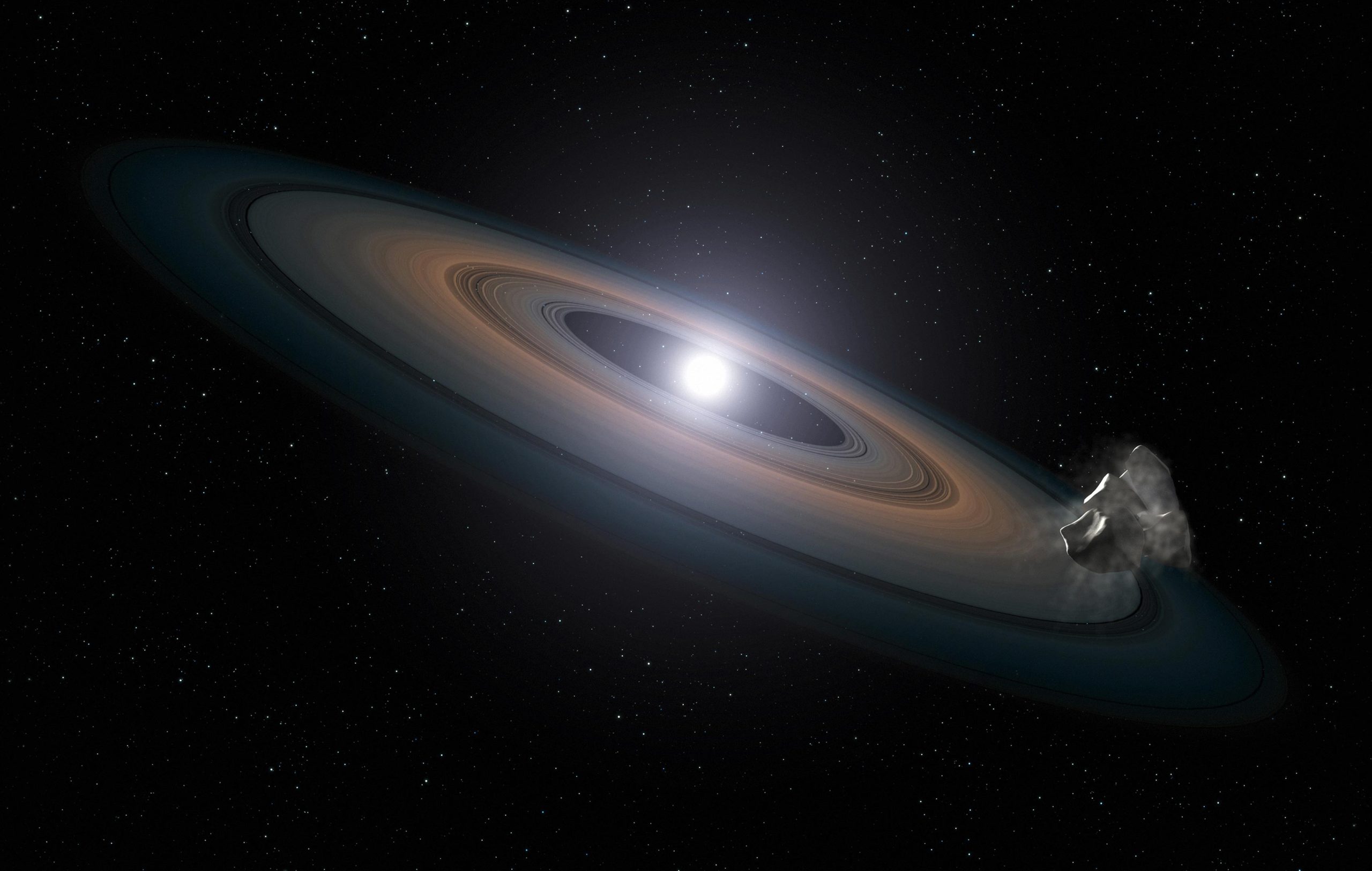
    Debris Around a White Dwarf Star
    This illustration is an artist’s impression of the thin, rocky debris disc discovered around the two Hyades white dwarfs. Rocky asteroids are thought to have been perturbed by planets within the system and diverted inwards towards the star, where they broke up, circled into a debris ring, and were then dragged onto the star itself. Credit: NASA, ESA, STScI, and G. Bacon (STScI)

    Researchers from Lund University used Gaia data to map white dwarf movements, discovering two distinct sequences that reveal new details about their evolution.

    White dwarfs were once normal stars similar to the Sun but then collapsed after exhausting all their fuel. Historically, these interstellar remnants have been difficult to study. A recent study from astronomers at Sweden’s Lund University, however, reveals new information about the movement patterns of these perplexing stars.

    White dwarfs have a radius of about 1 percent that of the Sun’s. They have roughly the same mass, which means they have an astonishing density of about 1,000 kg (2,200 pounds) per cubic centimeter. After billions of years, white dwarfs will cool down to a point where they no longer emit visible light, and transform into so-called black dwarfs.

    The First White Dwarf and New Findings on Movement Patterns

    40 Eridani A was the first white dwarf discovered. It is a bright celestial body 16.2 light-years away from Earth, surrounded by a binary system consisting of the white dwarf 40 Eridani B and the red dwarf 40 Eridani C. Ever since it was discovered in 1783, astronomers have tried to learn more about white dwarfs in order to gain a deeper understanding of the evolutionary history of our home galaxy.

    In a study published in the journal Monthly Notices of the Royal Astronomical Society, a research team can present new findings of how the collapsed stars move.
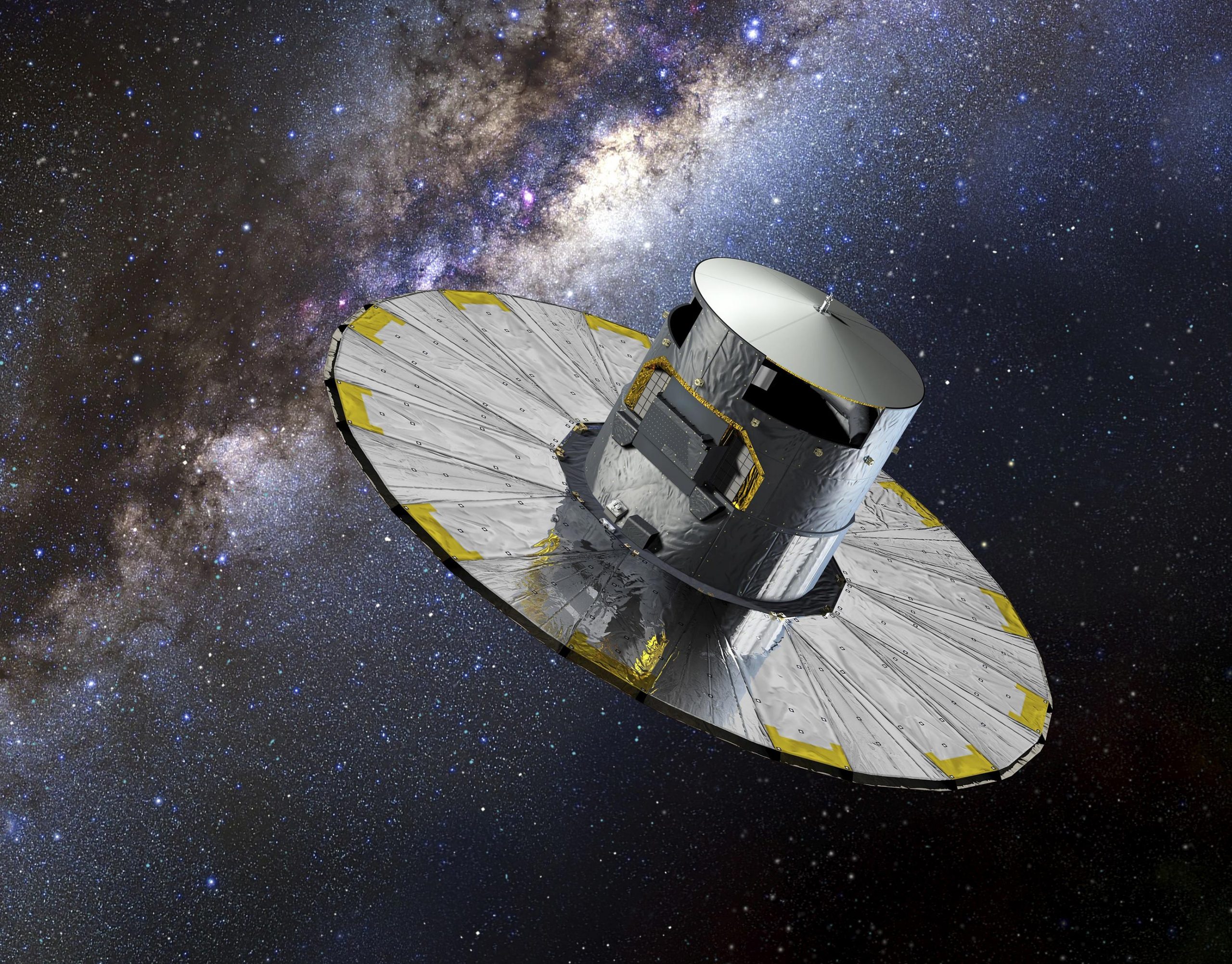
    Gaia Spacecraft Artist's Impression
    Illustration of Gaia with the Milky Way in the background. Gaia is an ambitious mission to chart a three-dimensional map of our Galaxy, the Milky Way, in the process revealing the composition, formation and evolution of the Galaxy. Credit: ESA–D. Ducros, 2013

    Mapping White Dwarf Movements with the Gaia Space Telescope

    “Thanks to observations from the Gaia space telescope, we have for the first time managed to reveal the three-dimensional velocity distribution for the largest catalog of white dwarfs to date. This gives us a detailed picture of their velocity structure with unparalleled detail,” says Daniel Mikkola, doctoral student in astronomy at Lund University.

    Thanks to Gaia, researchers have measured positions and velocities for about 1.5 billion stars. But only recently have they been able to completely focus on the white dwarfs in the Solar neighborhood.

    “We have managed to map the white dwarfs’ velocities and movement patterns. Gaia revealed that there are two parallel sequences of white dwarfs when looking at their temperature and brightness. If we study these separately, we can see that they move in different ways, probably as a consequence of them having different masses and lifetimes,” says Daniel Mikkola.

    The results can be used to develop new simulations and models to continue to map the history and development of the Milky Way. Through an increased knowledge of the white dwarfs, the researchers hope to be able to straighten out a number of question marks surrounding the birth of the Milky Way.

    “This study is important because we learned more about the closest regions in our galaxy. The results are also interesting because our own star, the Sun, will one day turn into a white dwarf just like 97 percent of all stars in the Milky Way,” concludes Daniel Mikkola.

    Reference: “The velocity distribution of white dwarfs in Gaia EDR3″ by Daniel Mikkola, Paul J McMillan, David Hobbs and John Wimarsson, 22 February 2022, Monthly Notices of the Royal Astronomical Society.
    DOI: 10.1093/mnras/stac434

    Never miss a breakthrough: Join the SciTechDaily newsletter.
    Follow us on Google and Google News.

    Astronomy Astrophysics ESA Gaia Spacecraft Lund University White Dwarf
    Share. Facebook Twitter Pinterest LinkedIn Email Reddit

    Related Articles

    Floating Crystal Phenomenon Challenges Textbook Definition of White Dwarf Stars

    Astronomers Use Planet-Hunting Satellite To See White Dwarf “Switch On and Off” for First Time

    Planet Discovered That Survived Its Star’s Death: A Crystal Ball Into Our Solar System’s Future

    Astronomers Discover a “Break” in One of the Milky Way’s Spiral Arms

    A Smoldering Stellar Corpse on the Edge: Astronomers Spot a White Dwarf So Massive It Might Collapse

    Solution Proposed to Mystery of Incredibly Strong White Dwarf Magnetic Fields

    Tantalizing Evidence: Is the Nearest Star Cluster to the Sun Being Destroyed?

    Vaporized Crusts of Earth-Like Planets Discovered in Dying Stars

    Unexpected Discovery: Hubble Space Telescope Uncovers Concentration of Small Black Holes

    Leave A Reply Cancel Reply

    • Facebook
    • Twitter
    • Pinterest
    • YouTube

    Don't Miss a Discovery

    Subscribe for the Latest in Science & Tech!

    Trending News

    Bone-Strengthening Discovery Could Reverse Osteoporosis

    Scientists Uncover Hidden Trigger Behind Stem Cell Aging

    Scientists Find Way to Reverse Fatty Liver Disease Without Changing Diet

    Could Humans Regrow Limbs? New Study Reveals Promising Genetic Pathway

    Scientists Reveal Eating Fruits and Vegetables May Increase Your Risk of Lung Cancer

    Scientists Reverse Brain Aging With Simple Nasal Spray

    Scientists Uncover Potential Brain Risks of Popular Fish Oil Supplements

    Scientists Discover a Surprising Way To Make Bread Healthier and More Nutritious

    Follow SciTechDaily
    • Facebook
    • Twitter
    • YouTube
    • Pinterest
    • Newsletter
    • RSS
    SciTech News
    • Biology News
    • Chemistry News
    • Earth News
    • Health News
    • Physics News
    • Science News
    • Space News
    • Technology News
    Recent Posts
    • Men vs. Women: Scientists Uncover Dramatic Differences in How the Immune System Ages
    • Eating Chili Peppers Linked to Longer Life
    • Bread Might Be Making You Gain Weight Even Without Eating More
    • 4,000-Year-Old Tablets Reveal Lost Magic, Medicine, and Ancient Kings
    • AI Meets Quantum Computing and the Predictions Get Scary Accurate
    Copyright © 1998 - 2026 SciTechDaily. All Rights Reserved.
    • Science News
    • About
    • Contact
    • Editorial Board
    • Privacy Policy
    • Terms of Use

    Type above and press Enter to search. Press Esc to cancel.