
Close Menu
    Facebook X (Twitter) Instagram
    SciTechDaily
    • Biology
    • Chemistry
    • Earth
    • Health
    • Physics
    • Science
    • Space
    • Technology
    Facebook X (Twitter) Pinterest YouTube RSS
    SciTechDaily
    Home»Space»Astronomers Observe Star Formation in the Outskirts of Galaxies
    Space

    Astronomers Observe Star Formation in the Outskirts of Galaxies

    By Harvard-Smithsonian Center for AstrophysicsFebruary 5, 2016No Comments3 Mins Read
    Facebook Twitter Pinterest Telegram LinkedIn WhatsApp Email Reddit
    Share
    Facebook Twitter LinkedIn Pinterest Telegram Email Reddit
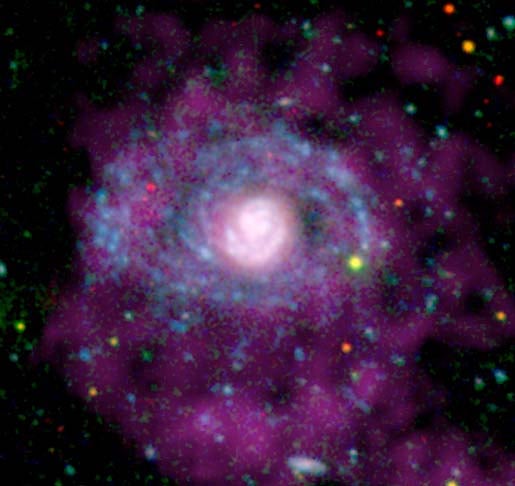
    Star Formation in the Outer Spiral Regions of Galaxy NGC 4625
    Star formation in the outer spiral regions of the galaxy NGC 4625 is seen in ultraviolet light (blue); these arms are nearly invisible in optical light, but have hot, newborn stars that radiate in the UV. The atomic gas is traced in the radio (purple); optical starlight is red. NASA/JPL-Caltech/Carnegie Observatories/WSRT

    A newly published study from the Harvard-Smithsonian Center for Astrophysics finds that the star formation processes in the outer spiral regions of the galaxy NGC 4625 generally resemble the processes at work in more normal, denser regions where molecular gas abounds.

    Star formation environments can be roughly grouped into three types, categorized by the density of their gas (or more precisely, the projected “surface” density of the gas, which is easier to determine than the conventional volume density). In moderately high-density regions, where the gas is primarily molecular in form rather than atomic, there is a strong correlation between the amount of star formation taking place and the density. This result is the basis for concluding that stars form from molecular material. In very high-density regions like those found in merging and starbursting galaxies, the star-formation rates compared to the total mass of available material are even larger. In low-density regions there is little known about correlations between the total gas and star-formation activity.

    Low-density regions, however, are important: they can cover very large spatial extents in the outer domains of galaxies, going well beyond the sizes defined by starlight in the optical. Recently, sensitive searches for molecular gas in these outer regions have been able to map that component, while ultraviolet surveys have spotted UV emission from up to four times farther out in galaxies than the nominal, optical radius. Since the UV is produced by hot young stars, the presumption is that there are new stars forming there. Does star formation in these outer regions correlate with the gas density in the same way as higher density regions, or might perhaps the star formation process proceed differently?

    CfA astronomer Linda Watson led a team of five colleagues to address these questions. They analyzed published observations of carbon monoxide gas (a bright tracer of molecular material) in fifteen outer regions of the galaxy NGC 4625 where UV was spotted but which are faint in the optical, and derived the relationship between star formation and gas density. They found that in general the activity is consistent with the same physical processes at work in the brighter, inner regions of the galaxies, a finding that is somewhat reassuring for theorists. But they also spotted a few outer locations where something different was happening: much higher rates of stars were being formed. Molecular gas is a crude tracer for age (because it takes time to convert atomic material into molecular), and most of the regions in this study are estimated to be between about one-to-seven million years old. The scientists raise the possibility that evolutionary effects between these regions could be at work, and urge deeper carbon monoxide observations to facilitate a broader analysis.

    Reference: “Testing the molecular-hydrogen Kennicutt–Schmidt law in the low-density environments of extended ultraviolet disc galaxies” by Linda C. Watson, Paul Martini, Ute Lisenfeld, Torsten Boker, and Eva Schinnerer, 18 November 2015, MNRAS.
    DOI:  10.1093/mnras/stv2412

    Never miss a breakthrough: Join the SciTechDaily newsletter.
    Follow us on Google and Google News.

    Astronomy Astrophysics Cosmology Harvard-Smithsonian Center for Astrophysics Star Formation
    Share. Facebook Twitter Pinterest LinkedIn Email Reddit

    Related Articles

    Harvard Astronomers Estimate the Lifetimes of Massive Star-Forming Regions

    No Change in Global Star Formation Process

    Harvard Astrophysicists Examine the Properties of Pre-Stellar Cores

    Astronomers Study the Star Formation Rates of Galaxies

    Astronomers Study the Interstellar Medium a Billion Years After the Big Bang

    The Formation of a Quadruple Star System

    CfA Astronomers Examine the Dynamics of Collapsing Cores and Star Formation

    New Study Challenges Planck Results

    Calculations Show the Ideal Time to Study the Cosmos

    Leave A Reply Cancel Reply

    • Facebook
    • Twitter
    • Pinterest
    • YouTube

    Don't Miss a Discovery

    Subscribe for the Latest in Science & Tech!

    Trending News

    Millions Take These IBS Drugs, But a New Study Finds Serious Risks

    Scientists Unlock Hidden Secrets of 2,300-Year-Old Mummies Using Cutting-Edge CT Scanner

    Bread Might Be Making You Gain Weight Even Without Eating More Calories

    Scientists Discover Massive Magma Reservoir Beneath Tuscany

    Europe’s Most Active Volcano Just Got Stranger – Here’s Why Scientists Are Rethinking It

    Alzheimer’s Symptoms May Start Outside the Brain, Study Finds

    Millions Take This Popular Supplement – Scientists Discover a Concerning Link to Heart Failure

    The Universe Is Expanding Too Fast and Scientists Can’t Explain Why

    Follow SciTechDaily
    • Facebook
    • Twitter
    • YouTube
    • Pinterest
    • Newsletter
    • RSS
    SciTech News
    • Biology News
    • Chemistry News
    • Earth News
    • Health News
    • Physics News
    • Science News
    • Space News
    • Technology News
    Recent Posts
    • Doctors Surprised by the Power of a Simple Drug Against Colon Cancer
    • Why Popular Diabetes Drugs Like Ozempic Don’t Work for Everyone: The “Genetic Glitch”
    • Scientists Create Improved Insulin Cells That Reverse Diabetes in Mice
    • Scientists Stunned After Finding Plant Thought Extinct for 60 Years
    • A Common Diabetes Drug May Hold the Key to Stopping HIV From Coming Back
    Copyright © 1998 - 2026 SciTechDaily. All Rights Reserved.
    • Science News
    • About
    • Contact
    • Editorial Board
    • Privacy Policy
    • Terms of Use

    Type above and press Enter to search. Press Esc to cancel.