
Close Menu
    Facebook X (Twitter) Instagram
    SciTechDaily
    • Biology
    • Chemistry
    • Earth
    • Health
    • Physics
    • Science
    • Space
    • Technology
    Facebook X (Twitter) Pinterest YouTube RSS
    SciTechDaily
    Home»Space»Astronomers Reveal a Warped and Twisted Milky Way
    Space

    Astronomers Reveal a Warped and Twisted Milky Way

    By Xu Ang, Chinese Academy of SciencesFebruary 4, 2019No Comments4 Mins Read
    Facebook Twitter Pinterest Telegram LinkedIn WhatsApp Email Reddit
    Share
    Facebook Twitter LinkedIn Pinterest Telegram Email Reddit
    The Milky Way in a Twist
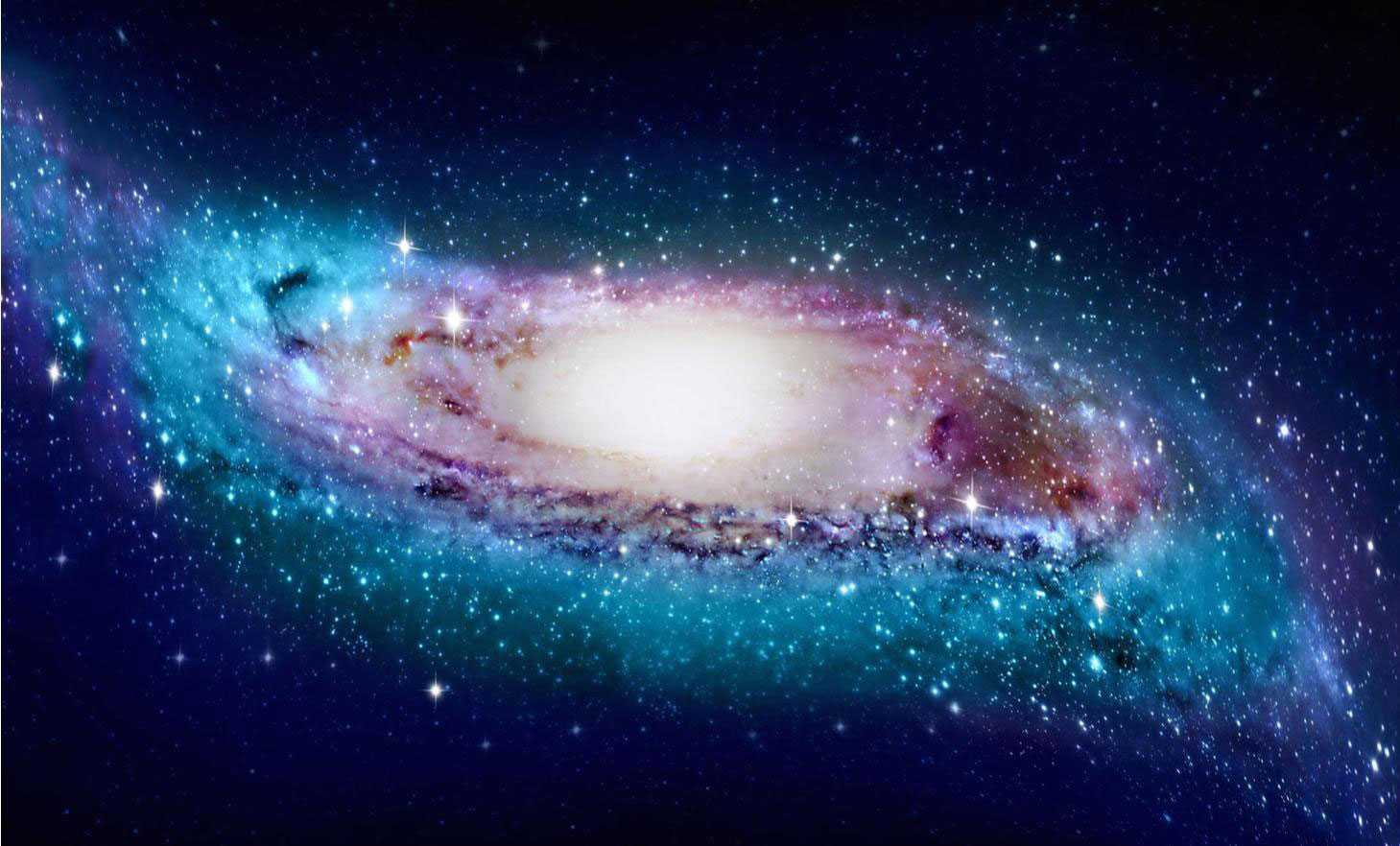
    Artist’s impression of the warped and twisted Milky Way disk. (Image by CHEN Xiaodian)

    Our Milky Way galaxy’s disk of stars is anything but stable and flat. Instead, it becomes increasingly ‘warped’ and twisted far away from the Milky Way’s center, according to astronomers from National Astronomical Observatories of Chinese Academy of Sciences (NAOC).

    From a great distance, our galaxy would look like a thin disk of stars that orbit once every few hundred million years around its central region, where hundreds of billions of stars, together with a huge mass of dark matter, provide the gravitational ‘glue’ to hold it all together.

    But the pull of gravity becomes weaker far away from the Milky Way’s inner regions. In the galaxy’s far outer disk, the hydrogen atoms making up most of the Milky Way’s gas disk are no longer confined to a thin plane, but they give the disk an S-like warped appearance.

    “It is notoriously difficult to determine distances from the Sun to parts of the Milky Way’s outer gas disk without having a clear idea of what that disk actually looks like,” says Dr. Chen Xiaodian, a researcher at NAOC and lead author of the article published in Nature Astronomy.
    Twisted Milky Way
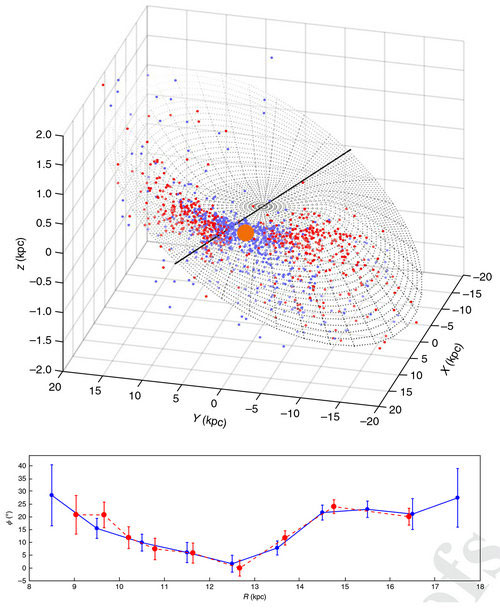
    Top: Three-dimensional distribution of the classical Cepheid variable stars in the Milky Way’s warped disk (red and blue points) centered on the location of the Sun ( large orange symbol). The units ‘kpc’ (kiloparsecs) along the image’s three axes are used by astronomers to indicate distances on galaxy-wide scales. One kiloparsec is equivalent to about 3,262 light years. Lower: Precession of the warp’s line of nodes with Galactocentric radius. (Image by CHEN Xiaodian)

    “However, we recently published a new catalog of well-behaved variable stars known as classical Cepheids, for which distances as accurate as 3 to 5% can be determined.” That database allowed the team to develop the first accurate three-dimensional picture of our Milky Way out to its far outer regions.

    Classical Cepheids are young stars that are some four to 20 times as massive as our Sun and up to 100,000 times as bright. Such high stellar masses imply that they live fast and die young, burning through their nuclear fuel very quickly, sometimes in only a few million years. They show day- to month-long pulsations, which are observed as changes in their brightness. Combined with a Cepheid’s observed brightness, its pulsation period can be used to obtain a highly reliable distance.

    “Somewhat to our surprise, we found that in 3D our collection of 1339 Cepheid stars and the Milky Way’s gas disk follow each other closely. This offers new insights into the formation of our home galaxy,” says Prof. Richard de Grijs from Macquarie University in Sydney, Australia, and senior co-author of the paper. “Perhaps more importantly, in the Milky Way’s outer regions, we found that the S-like stellar disk is warped in a progressively twisted spiral pattern.”

    This reminded the team of earlier observations of a dozen other galaxies which also showed such progressively twisted spiral patterns. “Combining our results with those other observations, we concluded that the Milky Way’s warped spiral pattern is most likely caused by ‘torques’ – or rotational forcing – by the massive inner disk.” Says Dr. LIU Chao, senior researcher and co-author of the paper.

    “This new morphology provides a crucial updated map for studies of our galaxy’s stellar motions and the origins of the Milky Way’s disk,” says Dr. DENG Licai, senior researcher at NAOC and co-author of the paper.

    Reference: “An intuitive 3D map of the Galactic warp’s precession traced by classical Cepheids” by Xiaodian Chen, Shu Wang, Licai Deng, Richard de Grijs, Chao Liu and Hao Tian, 4 Feburary 2019, Nature Astronomy.
    DOI: 10.1038/s41550-018-0686-7

    Never miss a breakthrough: Join the SciTechDaily newsletter.
    Follow us on Google and Google News.

    Astronomy Astrophysics Chinese Academy of Sciences Cosmology
    Share. Facebook Twitter Pinterest LinkedIn Email Reddit

    Related Articles

    Evidence of How a Dwarf Galaxy Contributes to Growth of the Milky Way

    The Brightest Flare Ever Observed From Sagittarius A*

    12 Billion-Year Old Supernova Discovered by Astronomers

    Dark Matter Filament in Galaxy Supercluster Directly Measured

    Calculations Show the Ideal Time to Study the Cosmos

    Lyman-Alpha Blobs are Some of the Largest Individual Objects in the Observable Universe

    Links Between Core Collapse Supernovae and Star Formation Established

    The Bolshoi Simulation: Boxing the Universe

    Baryon Oscillation Spectroscopic Survey Measures the Universe’s Expansion and Dark Energy

    Leave A Reply Cancel Reply

    • Facebook
    • Twitter
    • Pinterest
    • YouTube

    Don't Miss a Discovery

    Subscribe for the Latest in Science & Tech!

    Trending News

    Millions Take These IBS Drugs, But a New Study Finds Serious Risks

    Scientists Unlock Hidden Secrets of 2,300-Year-Old Mummies Using Cutting-Edge CT Scanner

    Bread Might Be Making You Gain Weight Even Without Eating More Calories

    Scientists Discover Massive Magma Reservoir Beneath Tuscany

    Europe’s Most Active Volcano Just Got Stranger – Here’s Why Scientists Are Rethinking It

    Alzheimer’s Symptoms May Start Outside the Brain, Study Finds

    Millions Take This Popular Supplement – Scientists Discover a Concerning Link to Heart Failure

    The Universe Is Expanding Too Fast and Scientists Can’t Explain Why

    Follow SciTechDaily
    • Facebook
    • Twitter
    • YouTube
    • Pinterest
    • Newsletter
    • RSS
    SciTech News
    • Biology News
    • Chemistry News
    • Earth News
    • Health News
    • Physics News
    • Science News
    • Space News
    • Technology News
    Recent Posts
    • Simple Blood Test May Predict Alzheimer’s Years Before Brain Scans Show Signs
    • Scientists Say Adding This Unusual Seafood to Your Diet Could Reverse Signs of Aging
    • U.S. Waste Holds $5.7 Billion Worth of Crop Nutrients
    • Scientists Say a Hidden Structure May Exist Inside Earth’s Core
    • Doctors Surprised by the Power of a Simple Drug Against Colon Cancer
    Copyright © 1998 - 2026 SciTechDaily. All Rights Reserved.
    • Science News
    • About
    • Contact
    • Editorial Board
    • Privacy Policy
    • Terms of Use

    Type above and press Enter to search. Press Esc to cancel.