
Close Menu
    Facebook X (Twitter) Instagram
    SciTechDaily
    • Biology
    • Chemistry
    • Earth
    • Health
    • Physics
    • Science
    • Space
    • Technology
    Facebook X (Twitter) Pinterest YouTube RSS
    SciTechDaily
    Home»Space»Astronomers Spot “Indigestion” in Supermassive Black Hole
    Space

    Astronomers Spot “Indigestion” in Supermassive Black Hole

    By Royal Astronomical SocietyJuly 4, 2017No Comments3 Mins Read
    Facebook Twitter Pinterest Telegram LinkedIn WhatsApp Email Reddit
    Share
    Facebook Twitter LinkedIn Pinterest Telegram Email Reddit
    Astronomers Reveal Indigestion in Supermassive Black Hole
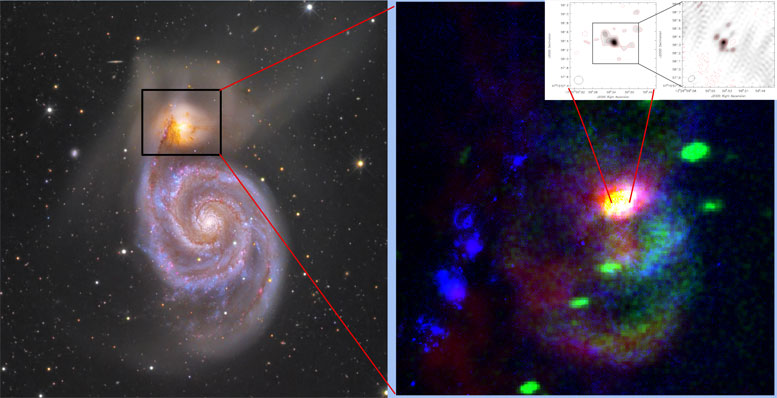
    Left: Image of the Whirlpool galaxy and NGC 5195. Credit: Jon Christensen. Right: False color image of NGC 5195 created by combining the VLA 20 cm radio image (red), the Chandra X-ray image (green), and the Hubble Space telescope H-alpha image (blue). The image shows the X-ray and H-alpha arcs, as well as the radio outflows from the supermassive black hole at the center of NGC 5195. Credit: NRAO / AUI / NSF / NASA / CXC / NASA / ESA / STScI / U. Manchester / Rampadarath et al. Right inset: e-MERLIN maps of the nuclear region of NGC 5195 at 1.4 GHz (left) and 5 GHz (right). The images display a partially resolved source with possible parsec-scale outflows. Credit: e-MERLIN / U. Manchester / Rampadarath et al.

    A new multi-wavelength study of a pair of colliding galaxies has revealed the cause of a supermassive black hole’s case of “indigestion.” The new research will be presented by Dr. Hayden Rampadarath at the National Astronomy Meeting at the University of Hull.

    Once every couple of hundred million years, the small galaxy NGC 5195 falls into the outer arms of its larger companion, NGC 5194, also known as the Whirlpool galaxy. Both galaxies are locked in a gravitational dance that will result – billions of years in the future – in the formation of a single galaxy.

    As NGC 5195 plunges into the Whirlpool, matter streams onto the supermassive black hole at NGC 5195’s center and forms an accretion disc. The disc grows to a point where the supermassive black hole can no longer accrete or ‘digest’ efficiently and matter is blasted out into the surrounding interstellar medium. Last year, NASA’s Chandra X-Ray observatory spotted arcs of X-ray emission that appeared to result from this ‘force-feeding’.

    Now, new high-resolution images of the core of NGC 5195, taken with the e-MERLIN radio array, and archive images of the surrounding area from the Very Large Array (VLA), Chandra and the Hubble Space Telescope, reveal in detail how these blasts occur and spread. The study was led by astronomers at the University of Manchester’s Jodrell Bank Center for Astrophysics.

    The supermassive black hole at the center of NGC 5195 has a mass equivalent to 19 million Suns. When the accretion process breaks down, immense forces and pressures create a shock wave that pushes matter out into the interstellar medium. Electrons, accelerated close to the speed of light, interact with the magnetic field of the interstellar medium and emit energy at radio wavelengths. The shock wave then inflates and heats up the interstellar medium, which emits in the X-ray, and strips the electrons from surrounding neutral hydrogen atoms to make ionized hydrogen gas. This inflated bubble creates the arcs detected by Chandra and Hubble.

    Rampadarath explains: “Comparing the VLA images at radio wavelengths to Chandra’s X-ray observations and the hydrogen-emission detected by Hubble, shows that features are not only connected, but that the radio outflows are in fact the progenitors of the structures seen by Chandra and Hubble. This is an event of galactic proportions that we can see right across the electromagnetic spectrum.”

    He adds: “The age of the arcs in NGC 5195 is 1-2 million years. To put that into context, the first traces of matter were being forced out of the black hole in this system at about the time that our ancestors were learning to make fire. That we are able to observe this event now through such a range of astronomical facilities is quite remarkable.”

    Never miss a breakthrough: Join the SciTechDaily newsletter.
    Follow us on Google and Google News.

    Astronomy Black Hole Chandra X-ray Observatory Hubble Space Telescope Popular Royal Astronomical Society
    Share. Facebook Twitter Pinterest LinkedIn Email Reddit

    Related Articles

    Astronomers Discover Clues For How Giant Black Holes Formed So Quickly

    5,000 Light Year Long Jet of Superheated Gas Ejected From a Supermassive Black Hole

    New Method for Measuring Black Hole Spin Could Provide a Greater Understanding of Galaxy Growth

    NASA Data Suggests Black Holes Abundant Among the Earliest Stars

    Hubble Views Spiral Galaxy NGC 1097

    Survey Reveals “Ultramassive” Black Holes Weighing 40 billion Times the Mass of the Sun

    Hubble and VLA View Elliptical Galaxy Hercules A

    Evidence Suggests Black Holes Can “Change Gears”

    Spacecraft to Explore Supermassive Black Holes at Center of Galaxies

    Leave A Reply Cancel Reply

    • Facebook
    • Twitter
    • Pinterest
    • YouTube

    Don't Miss a Discovery

    Subscribe for the Latest in Science & Tech!

    Trending News

    Millions Take These IBS Drugs, But a New Study Finds Serious Risks

    Scientists Unlock Hidden Secrets of 2,300-Year-Old Mummies Using Cutting-Edge CT Scanner

    Bread Might Be Making You Gain Weight Even Without Eating More Calories

    Scientists Discover Massive Magma Reservoir Beneath Tuscany

    Europe’s Most Active Volcano Just Got Stranger – Here’s Why Scientists Are Rethinking It

    Alzheimer’s Symptoms May Start Outside the Brain, Study Finds

    Millions Take This Popular Supplement – Scientists Discover a Concerning Link to Heart Failure

    The Universe Is Expanding Too Fast and Scientists Can’t Explain Why

    Follow SciTechDaily
    • Facebook
    • Twitter
    • YouTube
    • Pinterest
    • Newsletter
    • RSS
    SciTech News
    • Biology News
    • Chemistry News
    • Earth News
    • Health News
    • Physics News
    • Science News
    • Space News
    • Technology News
    Recent Posts
    • Doctors Surprised by the Power of a Simple Drug Against Colon Cancer
    • Why Popular Diabetes Drugs Like Ozempic Don’t Work for Everyone: The “Genetic Glitch”
    • Scientists Create Improved Insulin Cells That Reverse Diabetes in Mice
    • Scientists Stunned After Finding Plant Thought Extinct for 60 Years
    • A Common Diabetes Drug May Hold the Key to Stopping HIV From Coming Back
    Copyright © 1998 - 2026 SciTechDaily. All Rights Reserved.
    • Science News
    • About
    • Contact
    • Editorial Board
    • Privacy Policy
    • Terms of Use

    Type above and press Enter to search. Press Esc to cancel.