
Close Menu
    Facebook X (Twitter) Instagram
    SciTechDaily
    • Biology
    • Chemistry
    • Earth
    • Health
    • Physics
    • Science
    • Space
    • Technology
    Facebook X (Twitter) Pinterest YouTube RSS
    SciTechDaily
    Home»Space»Astronomers View Pulsar Encased in Supernova Bubble
    Space

    Astronomers View Pulsar Encased in Supernova Bubble

    By European Space AgencyJune 2, 2014No Comments3 Mins Read
    Facebook Twitter Pinterest Telegram LinkedIn WhatsApp Email Reddit
    Share
    Facebook Twitter LinkedIn Pinterest Telegram Email Reddit
    Astronomers View Pulsar Encased in Supernova Bubble
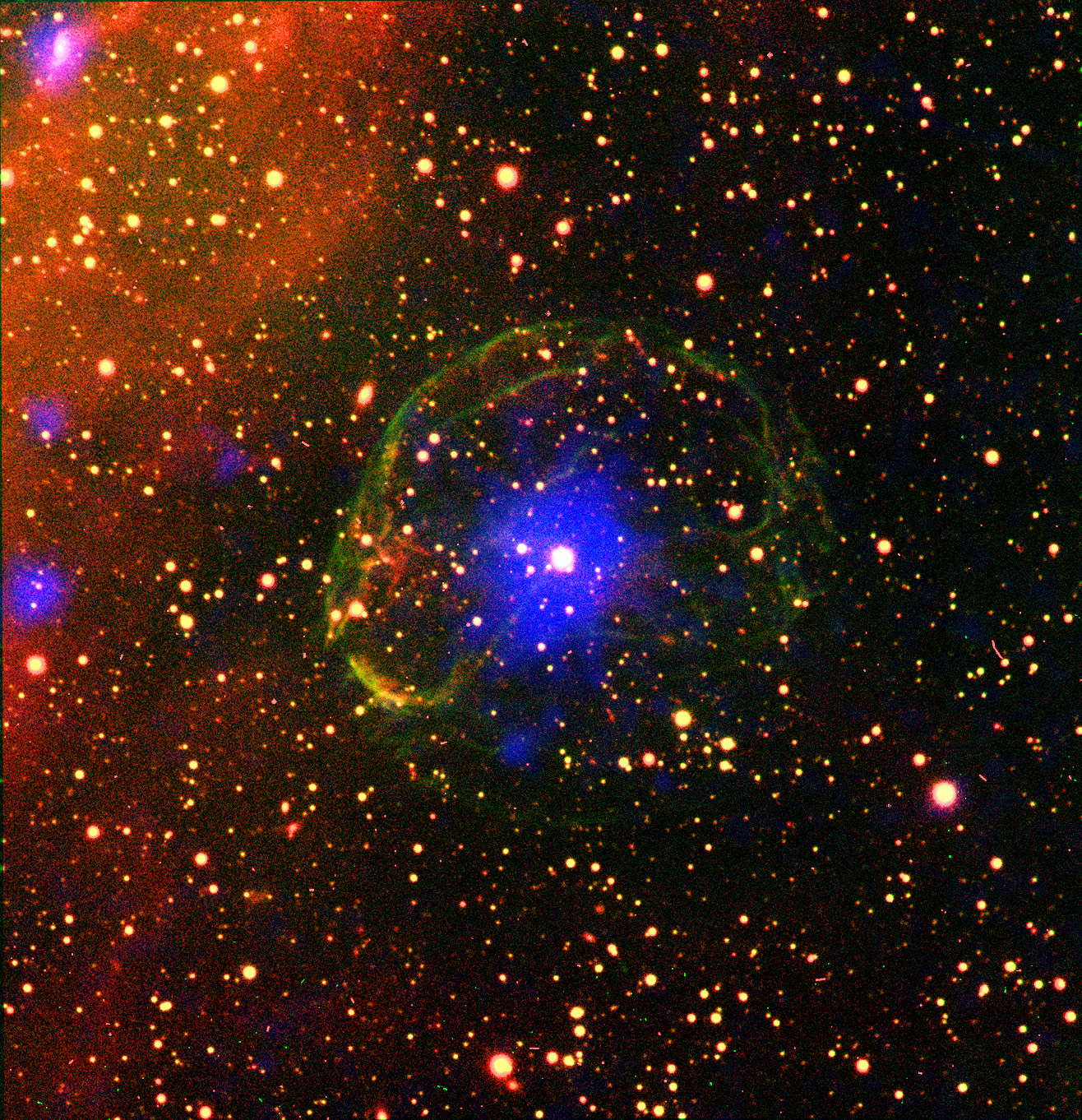
    This image captures a unique scene: a pulsar, a rotating neutron star, enclosed within the remnants of its supernova shell, a rare sight due to the shell’s short lifespan. This pulsar, named SXP 1062, lies in the outskirts of the Small Magellanic Cloud, one of the satellite galaxies of our Milky Way galaxy. Credit: ESA/XMM-Newton/ L. Oskinova/M. Guerrero; CTIO/R. Gruendl/Y.H. Chu

    This XMM-Newton image reveals a strongly magnetized, rotating neutron star and the remains of the explosion that generated it.

    Massive stars end their lives with a bang: exploding as spectacular supernovas, they release huge amounts of mass and energy into space. These explosions sweep up any surrounding material, creating bubble remnants that expand into interstellar space. At the heart of bubbles like these are small, dense neutron stars or black holes, the remains of what once shone brightly as a star.

    Since supernova-carved bubbles shine for only a few tens of thousands of years before dissolving, it is rare to come across neutron stars or black holes that are still enclosed within their expanding shell. This image captures such an unusual scene, featuring both a strongly magnetized, rotating neutron star – known as a pulsar – and its cosmic cloak, the remains of the explosion that generated it.

    This pulsar, named SXP 1062, lies in the outskirts of the Small Magellanic Cloud, one of the satellite galaxies of our Milky Way galaxy. It is an object known as an X-ray pulsar: it hungrily gobbles up material from a nearby companion star and burps off X-rays as it does so. In the future, this scene may become even more dramatic, as SXP 1062 has a massive companion star that has not yet exploded as a supernova.

    Most pulsars whirl around incredibly quickly, spinning many times per second. However, by exploring the expanding bubble around this pulsar and estimating its age, astronomers have noticed something intriguing: SXP 1062 seems to be rotating far too slowly for its age. It is actually one of the slowest pulsars known.

    While the cause of this weird sluggishness is still a mystery, one explanation may be that the pulsar has an unusually strong magnetic field, which would slow the rotation.

    The diffuse blue glow at the center of the bubble in this image represents X-ray emission from both the pulsar and the hot gas that fills the expanding bubble. The other fuzzy blue objects visible in the background are extragalactic X-ray sources.

    This image combines X-ray data from ESA’s XMM-Newton (shown in blue) with optical observations from the Cerro Tololo Inter-American Observatory in Chile. The optical data were obtained using two special filters that reveal the glow of oxygen (shown in green) and hydrogen (shown in red). The size of the image is equivalent to a distance of 457 light-years on a side.

    This image was first published on ESA’s Science and Technology website in 2011. It is based on data from the paper “Discovery of a Be/X-ray pulsar binary and associated supernova remnant in the Wing of the Small Magellanic Cloud” by V. Hénault-Brunet, et al. 2012.

    Reference: “Discovery of a Be/X-ray pulsar binary and associated supernova remnant in the Wing of the Small Magellanic Cloud” by V. Hénault-Brunet, L.M. Oskinova, M.A. Guerrero, W. Sun, Y.-H. Chu, C.J. Evans, J.S. Gallagher III, R.A. Gruendl and J. Reyes-Iturbide, 1 February 2012, Monthly Notices of the Royal Astronomical Society: Letters.
    DOI: 10.1111/j.1745-3933.2011.01183.x
    arXiv: 1110.6404 

    Never miss a breakthrough: Join the SciTechDaily newsletter.
    Follow us on Google and Google News.

    Astronomy European Space Agency Neutron Star Pulsars Supernova
    Share. Facebook Twitter Pinterest LinkedIn Email Reddit

    Related Articles

    Cosmic Flash: Earth Struck by Historic Gamma-Ray Burst From Exploding Star

    Why Have Pulsars “Gone Missing” – A New Finding Offers Some Answers

    Heaviest Neutron Star Ever Discovered Is a “Black Widow” Devouring Its Mate

    Astronomers Discover a Mysterious “Black Widow” Binary – With the Shortest Orbit Yet

    Astronomers May Use Pulsars To Detect Merging Supermassive Black Holes

    Searching for Elusive Continuous Gravitational Waves From the Densest Objects in the Universe

    Super-Bright Extragalactic Stellar Explosion – “The Cow” – Is Likely a Dying Star Giving Birth to a Black Hole or Neutron Star

    Stellar Collision Triggers Supernova Explosion – “This Is the First Time We’ve Actually Seen Such an Event”

    Evidence of “Pulsar Wind Nebula” May Solve 34-Year-Old Astronomical Mystery

    Leave A Reply Cancel Reply

    • Facebook
    • Twitter
    • Pinterest
    • YouTube

    Don't Miss a Discovery

    Subscribe for the Latest in Science & Tech!

    Trending News

    Millions of People Have Osteopenia Without Realizing It – Here’s What You Need To Know

    Researchers Discover Boosting a Single Protein Helps the Brain Fight Alzheimer’s

    World-First Study Reveals Human Hearts Can Regenerate After a Heart Attack

    Why Your Dreams Feel So Real Sometimes and So Strange Other Times

    This Simple Home Device May Boost Brain Power in Adults Over 40

    Enormous Prehistoric Insects Puzzle Scientists

    Scientists Develop Bioengineered Chewing Gum That Could Help Fight Oral Cancer

    After 37 Years, the World’s Longest-Running Soil Warming Experiment Uncovers a Startling Climate Secret

    Follow SciTechDaily
    • Facebook
    • Twitter
    • YouTube
    • Pinterest
    • Newsletter
    • RSS
    SciTech News
    • Biology News
    • Chemistry News
    • Earth News
    • Health News
    • Physics News
    • Science News
    • Space News
    • Technology News
    Recent Posts
    • After 100 Years, Scientists Uncover Hidden Rule Governing Cosmic Rays
    • The Milky Way Has a Hidden Edge and Scientists Finally Mapped It
    • Scientists Stunned by New Organic Molecules Found on Mars
    • Scientists Discover Evolution’s 120-Million-Year-Old “Cheat Sheet”
    • This New “Sound Laser” Could Measure Gravity With Stunning Precision
    Copyright © 1998 - 2026 SciTechDaily. All Rights Reserved.
    • Science News
    • About
    • Contact
    • Editorial Board
    • Privacy Policy
    • Terms of Use

    Type above and press Enter to search. Press Esc to cancel.