

This newly released image of the Prawn Nebula was taken by ESO’s VLT Survey Telescope in Chile.
The glowing jumble of gas clouds visible in this new image make up a huge stellar nursery nicknamed the Prawn Nebula. Taken using the VLT Survey Telescope at ESO’s Paranal Observatory in Chile, this may well be the sharpest picture ever taken of this object. It shows clumps of hot new-born stars nestled in among the clouds that make up the nebula.
Located around 6,000 light-years from Earth in the constellation of Scorpius (The Scorpion), the nebula formally known as IC 4628 is a huge region filled with gas and clumps of dark dust. These gas clouds are star-forming regions, producing brilliant hot young stars. In visible light, these stars appear as a blue-white color, but they also emit intense radiation in other parts of the spectrum — most notably in the ultraviolet [1].
This pan video takes a closer look at some of the strange and spectacular features in the glowing jumble of gas clouds making up a huge stellar nursery nicknamed the Prawn Nebula. Taken using the VLT Survey Telescope at ESO’s Paranal Observatory in Chile, this may well be the sharpest picture ever taken of this object. Credit: ESO. Music: movetwo. Acknowledgement: Martin Pugh
It is this ultraviolet light from the stars that causes the gas clouds to glow. This radiation strips electrons from hydrogen atoms, which then later recombine and release energy in the form of light. Each chemical element emits light at characteristic colors when this process occurs, and for hydrogen the predominant color is red. IC 4628 is an example of an HII region [2].
The Prawn Nebula is around 250 light-years across, covering an area of sky equivalent to four times that of the full Moon. Despite this huge size it has been often overlooked by observers due to its faintness and because most of its light is emitted at wavelengths where the human eye is not sensitive. The nebula is also known as Gum 56, after the Australian astronomer Colin Gum, who published a catalog of HII regions in 1955.
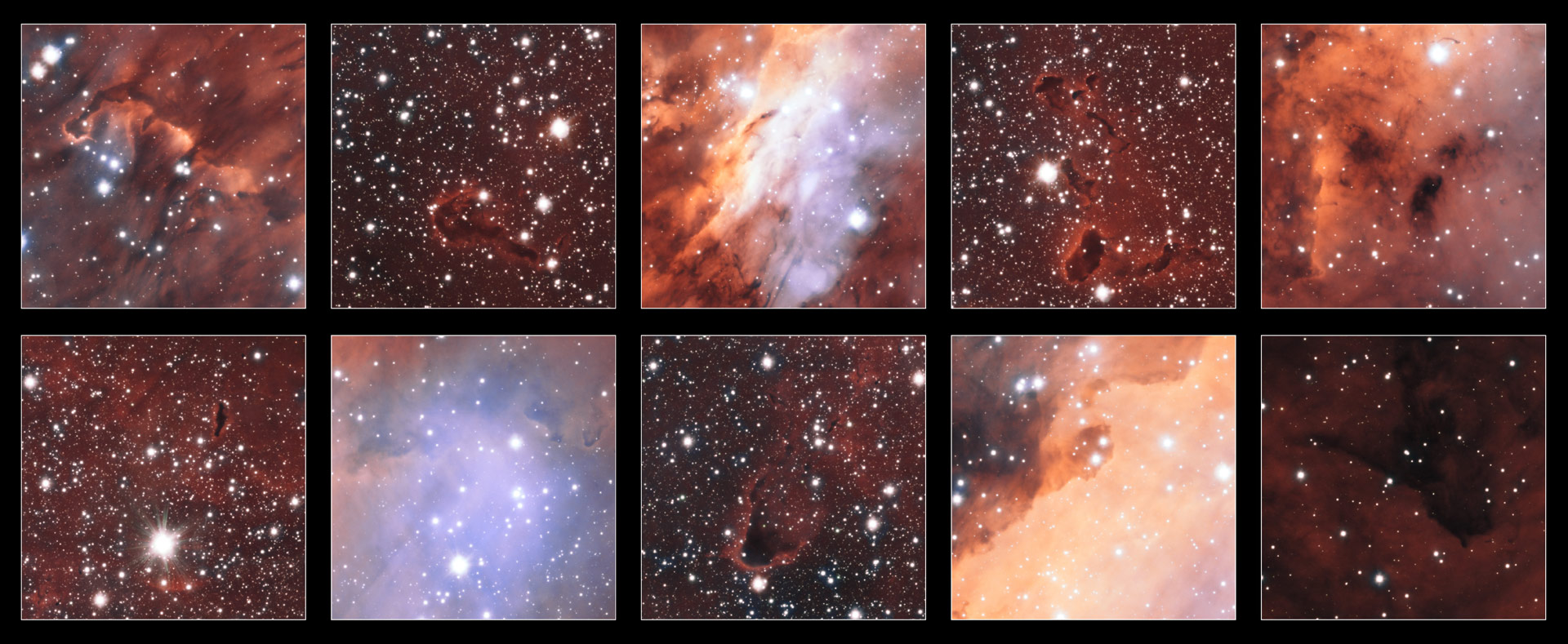
Over the last few million years this region of sky has formed many stars, both individually and in clusters. There is a large scattered star cluster named Collinder 316 which extends over most of this image. This cluster is a part of a much larger gathering of very hot and luminous stars. Also visible are many dark structures or cavities, where interstellar matter has been blown away by the powerful winds generated by the nearby hot stars.
This image was taken by the VLT Survey Telescope (VST) at ESO’s Paranal Observatory in Chile. The VST is the largest telescope in the world designed for surveying the sky in visible light. It is a state-of-the-art 2.6-meter telescope built around the OmegaCAM camera that contains 32 CCD detectors that together create 268-megapixel images. This new 24,000-pixel-broad image is a mosaic of two such images and is one of the largest single images released by ESO so far.
The picture forms part of a detailed public survey of a large part of the Milky Way called VPHAS+ that is using the power of the VST to search for new objects such as young stars and planetary nebulae. The survey will also provide the best images yet taken of many huge glowing star formation regions, such as the one pictured here.
The very sharp VST images were further enhanced to bring out the color by including additional high quality imaging through other filters taken by Martin Pugh, a very skilled amateur astronomer observing from Australia using 32-centimeter and 13-centimeter telescopes [3].
This press release represents a milestone — it is the 1000th press release issued by ESO. The first one appeared in late 1985 and featured a picture of Halley’s Comet. They are all available online.
Notes
- This is the same kind of radiation that causes unprotected human skin to burn when exposed to too much direct sunlight. But the Earth’s atmosphere shields life on the surface from most ultraviolet radiation and only longer wavelengths (between about 300 and 400 nanometers) reach the ground and cause tanning and burning of human skin. Some of the ultraviolet radiation emitted by very hot stars in HII regions is at the much shorter wavelengths (shorter than 91.2 nanometers) that can ionize hydrogen.
- Astronomers use the term “HII” (pronounced “aitch-two”) to refer to ionized hydrogen, and “HI” (aitch-one) for atomic hydrogen. A hydrogen atom consists of an electron bound to a proton; in an ionized gas, atoms are split into freely-moving electrons and positive ions — in this case the positive ions are just single protons.
- More details of his observations can be found at Martin Pugh’s information page on this object.
Never miss a breakthrough: Join the SciTechDaily newsletter.
Follow us on Google and Google News.