
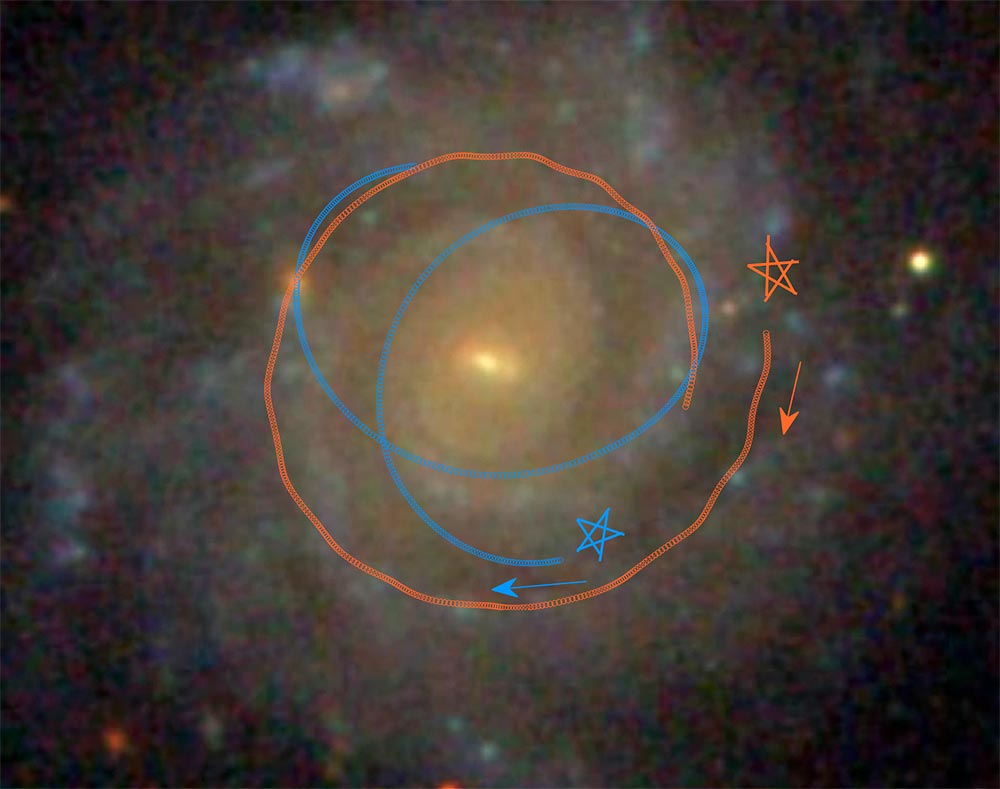
Computer simulations are showing astrophysicists how massive clumps of gas within galaxies scatter some stars from their orbits, eventually creating the smooth, exponential fade in the brightness of many galaxy disks.
Researchers from Iowa State University, the University of Wisconsin-Madison and IBM Research have advanced studies they started nearly 10 years ago. They originally focused on how massive clumps in young galaxies affect star orbits and create galaxy disks featuring bright centers fading to dark edges.
(As Curtis Struck, an Iowa State professor of physics and astronomy, wrote in a 2013 research summary: “In galaxy disks, the scars of a rough childhood, and adolescent blemishes, all smooth away with time.”)
Now, the group has co-authored a new paper that says their ideas about the formation of exponential disks apply to more than young galaxies. It’s also a process that is robust and universal in all kinds of galaxies. The exponential disks, after all, are common in spiral galaxies, dwarf elliptical galaxies and some irregular galaxies.
How can astrophysicists explain that?
By using realistic models to track star scattering within galaxies, “We feel we have a much deeper understanding of the physical processes that resolve this almost-50-year-old key problem,” Struck said.
Gravitational impulses from massive clumps alter the orbits of stars, the researchers found. As a result, the overall star distribution of the disk changes, and the exponential brightness profile is a reflection of that new stellar distribution.
The astrophysicists’ findings are reported in a paper just published online by the Monthly Notices of the Royal Astronomical Society. Co-authors are Struck; Jian Wu, an Iowa State doctoral student in physics and astronomy; Elena D’Onghia, an associate professor of astronomy at Wisconsin; and Bruce Elmegreen, a research scientist at IBM’s Thomas J. Watson Research Center in Yorktown Heights, New York.
Stars are scattered, disks are smoothed
The latest computer modeling – led by Wu – is a capstone topping years of model improvements, Struck said. Previous models treated the gravitational forces of galaxy components more approximately, and researchers studied fewer cases.
The latest models show how star clusters and clumps of interstellar gases within galaxies can change the orbits of nearby stars. Some star-scattering events significantly change star orbits, even catching some stars in loops around massive clumps before they can escape to the general flow of a galaxy disk. Many other scattering events are less powerful, with fewer stars scattered and orbits remaining more circular.
“The nature of the scattering is far more complex than we previously understood,” Struck said. “Despite all this complexity on small scales, it still averages out to the smooth light distribution on large scales.”
The models also say something about the time it takes for these exponential galaxy disks to form, according to the researchers’ paper. The types of clumps and initial densities of the disks affect the speed of the evolution, but not the final smoothness in brightness.
Speed in this case is a relative term because the timescales for these processes are billions of years.
Over all those years, and even with model galaxies where stars are initially distributed in a variety of ways, Wu said the models show the ubiquity of the star-scattering-to-exponential-falloff process.
“Stellar scattering is very general and universal,” he said. “It works to explain the formation of exponential disks in so many cases.”
Reference: “Stellar scattering and the formation of exponential discs in self-gravitating systems” by Jian Wu, Curtis Struck, Elena D’Onghia and Bruce G Elmegreen, 15 September 2020, Monthly Notices of the Royal Astronomical Society.
DOI: 10.1093/mnras/staa2750
Never miss a breakthrough: Join the SciTechDaily newsletter.
Follow us on Google and Google News.
1 Comment
… not sure to understand, but where is the dark matter in this one?