
Close Menu
    Facebook X (Twitter) Instagram
    SciTechDaily
    • Biology
    • Chemistry
    • Earth
    • Health
    • Physics
    • Science
    • Space
    • Technology
    Facebook X (Twitter) Pinterest YouTube RSS
    SciTechDaily
    Home»Space»Computer Models Help Explain Why Disk Galaxies Eventually Look Alike
    Space

    Computer Models Help Explain Why Disk Galaxies Eventually Look Alike

    By Iowa State UniversitySeptember 12, 2013No Comments3 Mins Read
    Facebook Twitter Pinterest Telegram LinkedIn WhatsApp Email Reddit
    Share
    Facebook Twitter LinkedIn Pinterest Telegram Email Reddit
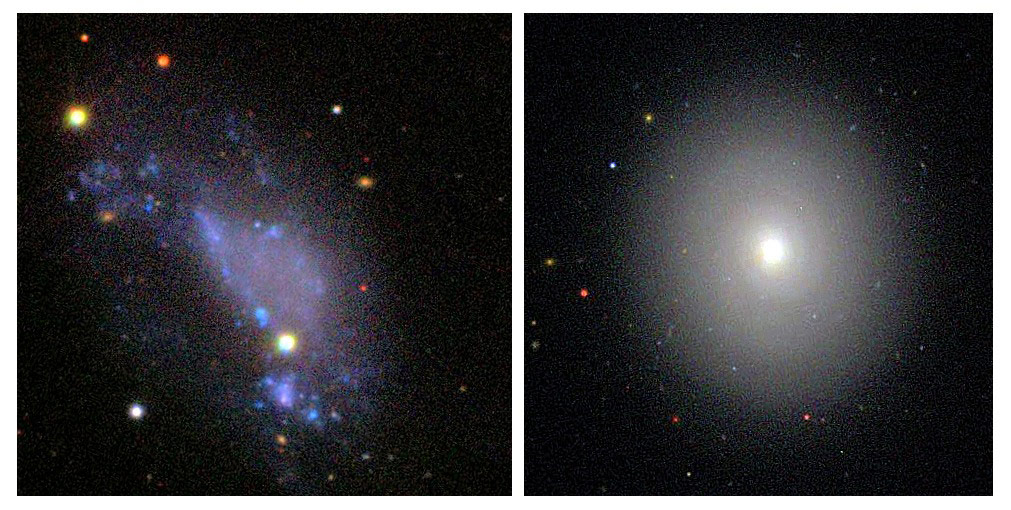
    Astronomers Explain Why Disk Galaxies Look Alike
    Iowa State’s Curtis Struck and IBM’s Bruce Elmegreen are studying how galaxies evolve from the clumpy example on the left to the smooth example on the right. Credit: Sloan Digital Sky Survey.

    In a newly published study, researchers detail how they developed and used computer models simulating galaxy evolution to help explain why all disk galaxies eventually look the same.

    Ames, Iowa – It happens to all kinds of flat, disk galaxies – whether they’re big, little, isolated, or crowded in a cluster. They all grow out of their irregular, clumped appearance and their older stars take on the same smooth look, predictably fading from a bright center to a dim edge.

    Or, as Curtis Struck, an Iowa State University astronomer, wrote in a research summary: “In galaxy disks, the scars of a rough childhood, and adolescent blemishes, all smooth away with time.”

    But how does that happen?

    Struck, a professor of physics and astronomy who studies galaxy evolution and wrote the 2011 book “Galaxy Collisions,” said a few explanations have been proposed, but most of those only covered certain types of galaxies. There hasn’t been an explanation for the nearly universal and exponential fade in the brightness of the lookalike disk galaxies.

    To try to find an explanation, Struck and Bruce Elmegreen, a research scientist at IBM’s Thomas J. Watson Research Center in Yorktown Heights, New York, built computer models simulating galaxy evolution. And they think they’ve found a fundamental answer in the gravitational pull of the irregular, clumped structure of younger galaxies.

    They report their findings in a paper, “Exponential Galaxy Disks from Stellar Scattering,” just published online by The Astrophysical Journal Letters.

    Struck and Elmegreen based their paper on the simplest possible galaxy model that still includes all the essential ingredients: a razor-thin disk and orbiting stars subject to the gravity of the massive clumps.

    “We focused on the clumps,” Struck said. “We thought the clumpy structure of young galaxy disks may be responsible for both its own erasure and the smooth universal brightness profile.”

    Struck said the models showed that’s the case. The gravity of those clumps of interstellar gases and new stars alter the orbits of nearby stars. In some cases, the changes are significant, scattering stars well away from their original and nearly circular orbits.

    Over time, that scattering from circular to slightly elliptical orbits produces the smooth fade in brightness from the center of a galaxy to its edge.

    We’re talking a lot of time: “This process takes a few hundred million years to a few billion years,” Struck said.

    Do those findings match the data coming from the Hubble Space Telescope and large ground-based telescopes, tools that allow astronomers to see distant galaxies in their young and clumpy structure?

    “Yes, they do fit the observed data coming back,” Struck said.

    Struck also said there’s more work to be done to explain the mystery of the smooth, steady fade of older disk galaxies. Struck and Elmegreen will gradually add more physical processes to their models to see how additional complexities affect what they’ve discovered about the fundamental process of star scattering.

    Even so, Struck said the current models have provided a good explanation for the universal appearance of older disk galaxies.

    “If there is some disturbance, some clumpiness in the galaxy,” he said, “you eventually get this smooth profile.”

    Reference: “Exponential Galaxy Disks from Stellar Scattering” by Bruce G. Elmegreen and Curtis Struck, 11 September 2013, The Astrophysical Journal Letters.
    DOI: 10.1088/2041-8205/775/2/L35
    arXiv:1308.5236

    Never miss a breakthrough: Join the SciTechDaily newsletter.
    Follow us on Google and Google News.

    Astronomy Astrophysics Galaxy Evolution Iowa State University
    Share. Facebook Twitter Pinterest LinkedIn Email Reddit

    Related Articles

    Ancient Dusty Galaxies Discovered at the Edge of the Universe Rewrite Cosmic History

    Scientists Find Cosmic “Fingerprints” of Mysterious Dark Matter

    NASA’s Webb Telescope Discovers 300 Mysterious Objects That Shouldn’t Exist

    Dwarf Galaxies’ Big Secret: New Study Reveals How They Transform Into Ultra-Compact Dwarfs

    Data Reveals Swift J1644+57’s QPO Cycle

    3D Models Confirm Supernova’s Role in the Formation of Our Solar System

    Trajectory Models of Refractory Particles Help Solve Two Solar System Puzzles

    Discovery Solves Decades Old Discrepancies

    Using Infrared Images from Hubble & Spitzer, Scientists Discover 25 Distant Galaxies

    Leave A Reply Cancel Reply

    • Facebook
    • Twitter
    • Pinterest
    • YouTube

    Don't Miss a Discovery

    Subscribe for the Latest in Science & Tech!

    Trending News

    Popular Supplement Ingredient Linked to Shorter Lifespan in Men

    Scientists May Have Found a Way To Repair Nerve Damage in Multiple Sclerosis

    “Totally Unexpected” – Scientists Discover Pancreatic Cancer’s Fatal Addiction

    A Strange Quantum Effect May Explain One of Biology’s Greatest Mysteries

    James Webb Telescope Reveals the Universe’s Hidden Cosmic Web in Stunning Detail

    Scientists Identify Simple Supplement That Greatly Reduces Alzheimer’s Damage

    You May Have a Dangerous Type of Cholesterol Even if Your Tests Look Normal

    Your Blood Pressure Reading Could Be Wrong Because of One Simple Mistake

    Follow SciTechDaily
    • Facebook
    • Twitter
    • YouTube
    • Pinterest
    • Newsletter
    • RSS
    SciTech News
    • Biology News
    • Chemistry News
    • Earth News
    • Health News
    • Physics News
    • Science News
    • Space News
    • Technology News
    Recent Posts
    • Scientists Say a 40-Year-Old Childhood Obesity Warning May Be Completely Wrong
    • Marijuana Use May Raise Lung Cancer Risk, Researchers Warn
    • This Common Type of Food May Be Raising Your Risk of Heart Disease
    • Fur Seals’ Hearts Suddenly Spike Hours After Returning to Land
    • Scientists Say Cognitive Decline Isn’t Inevitable — Your Brain Can Improve at Any Age
    Copyright © 1998 - 2026 SciTechDaily. All Rights Reserved.
    • Science News
    • About
    • Contact
    • Editorial Board
    • Privacy Policy
    • Terms of Use

    Type above and press Enter to search. Press Esc to cancel.