
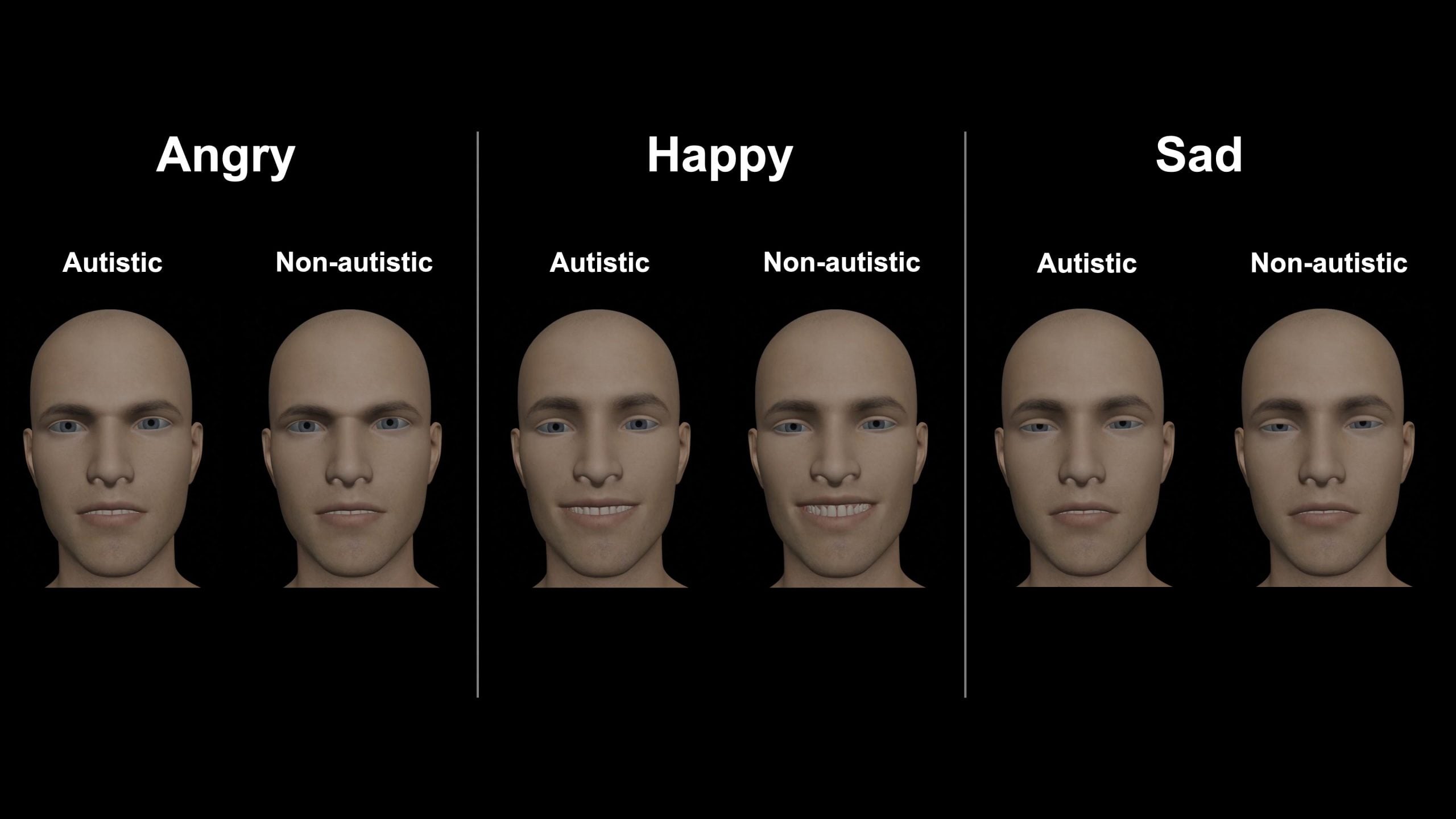
Autistic and non-autistic faces express emotion differently, and misunderstanding can go both ways.
A new study suggests that autistic and non-autistic people use facial movements to express emotions in different ways. These differences may help explain why emotional signals are sometimes misunderstood between the two groups.
Mapping Facial Movements Linked to Emotion
Researchers at the University of Birmingham carried out an in-depth investigation of facial expressions in autistic and non-autistic individuals. Using advanced facial motion tracking, they built a large reference library of expressions connected to core emotions such as anger, happiness, and sadness. The project analyzed more than 265 million data points, offering an unusually detailed look at how facial movements vary across individuals.
How the Study Was Conducted
The research, published in Autism Research, included 25 autistic adults and 26 non-autistic adults. Together, participants produced nearly 5000 facial expressions. Each person was asked to show anger, happiness, and sadness in two different situations: while matching their expressions to sounds and while speaking.
Clear differences emerged between the two groups. Autistic participants also produced a wider range of distinct expressions. The researchers observed several consistent patterns:
- For anger, autistic participants depended more on movements of the mouth and less on eyebrow movements than non-autistic participants;
- For happiness, autistic participants displayed a more subtle smile that did not “reach the eyes”; and
- For sadness, autistic participants formed a downturned expression by lifting the upper lip more than their non-autistic peers.
The Influence of Alexithymia on Expression
The researchers also examined the role of alexithymia – a ‘sub-clinical’ condition commonly found in autism that involves difficulties identifying and describing one’s own emotions. Higher levels of alexithymia were linked to facial expressions of anger and happiness that were less clearly defined, making those emotions more likely to appear unclear or mixed.
Why Emotional Signals Are Often Misread
Dr. Connor Keating, who led the research at the University of Birmingham and is now based in the Department of Experimental Psychology at the University of Oxford, said the differences go beyond appearance alone. “Our findings suggest autistic and non-autistic people differ not only in the appearance of facial expressions, but also in how smoothly these expressions are formed. These mismatches in facial expressions may help to explain why autistic people struggle to recognize non-autistic expressions and vice versa.”
A Two-Way Challenge in Understanding Emotion
Professor Jennifer Cook, senior author of the study from the University of Birmingham, emphasized that these differences should not be seen as a shortcoming. “Autistic and non-autistic people may express emotions in ways that are different but equally meaningful – almost like speaking different languages. What has sometimes been interpreted as difficulties for autistic people might instead reflect a two-way challenge in understanding each other’s expressions. We are currently investigating this idea, so watch this space for updates.”
Reference: “Mismatching Expressions: Spatiotemporal and Kinematic Differences in Autistic and Non-Autistic Facial Expressions” by Connor T. Keating, Sophie Sowden-Carvalho, Holly O′Donoghue and Jennifer L. Cook, 18 January 2026, Autism Research.
DOI: 10.1002/aur.70157
The project was funded by the Medical Research Council (MRC, United Kingdom) and the European Union’s Horizon 2020 Research and Innovation Programme.
Never miss a breakthrough: Join the SciTechDaily newsletter.
Follow us on Google and Google News.
1 Comment
Although the key takeaways from the results seem correct, I don’t think asking autistic people to make the face they would make when intentionally trying to communicate an emotion is going to accurately reflect the expressions that naturally happen when genuinely experiencing these emotions.