
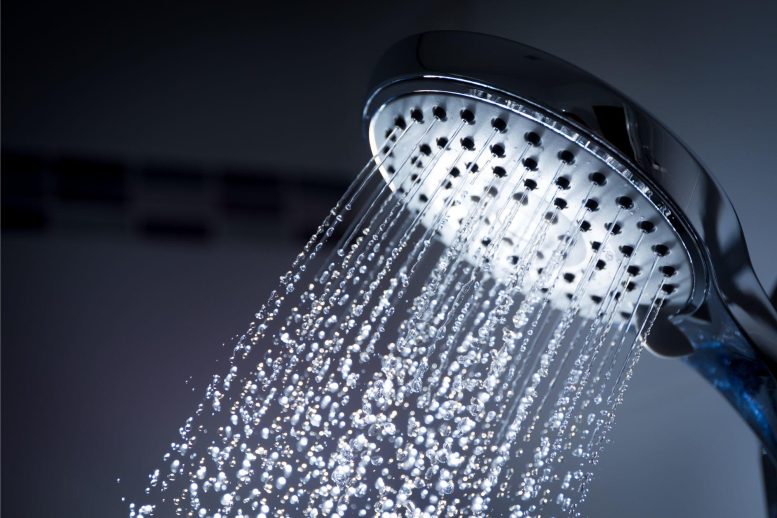
The Hidden Risks in Your Showerhead
Stepping into a shower, we often seek the comforting embrace of warm water after a taxing day — but there may be something dangerous lurking in the showerhead.
While most bacteria found in showers are benign, certain ones, referred to as drinking water-associated pathogens of the immunocompromised (DWPIs) – can pose a serious risk to our health, especially for individuals with weakened immune systems.
Sarah Haig, Assistant Professor of Civil and Environmental Engineering at the University of Pittsburgh Swanson School of Engineering, received $420,000 from the National Science Foundation (NSF) to lead a three-year study to test different showerhead features to compare concentrations of DWPIs present in shower water and the aerosols it produces.
“There are many types of showerheads on the market, leaving consumers to make choices on the type of spray pattern, material, flow rate, and additives like bacteria-killing chemicals they want,” Haig explained. “But, it’s unknown how these decisions impact the risk of DWPIs exposure.”
In This Shower, It’s Not Norman Bates You Need To Worry About
DWPIs are a high cost not just to our health, but to the United States economy, costing $2.93 billion annually.
They’re also incredibly hard to kill. Despite the wide range of physical and chemical processes used to treat drinking water, DWPIs can survive and continue to grow and thrive in plumbing systems.
Although there are many DWPIs of concern, Legionella pneumophila, Pseudomonas aeruginosa, and nontuberculous mycobacteria (NTM) cause the most respiratory infections. However, as NTM causes 57 percent of all US waterborne disease deaths, it will be the primary focus for Haig and her team.
“The goal for those of us who work in public health and prevention is to have ways to limit exposure to these bacteria either physically or chemically so that we control the exposure and thereby control the risk of illness,” said Janet Stout, a frequent collaborator of Haig’s and executive vice president and founder of the Special Pathogens Laboratory. “Professor Haig’s research in testing these materials is aligning with those goals.”
Exposure to DWPIs can come from a variety of sources, but inhalation of water-associated aerosols are most commonly related to infection. However, DWPI aerosolization and their relationship to showerhead features are poorly understood.
To bridge this knowledge gap, Haig and her team will test showerheads with different features and compare the concentration of DWPIs present in shower water and shower water-produced aerosols.
Dr. Janet Lee, Chief, division of pulmonary and critical care medicine, Selma and Herman Seldin Distinguished Professor in Medicine, professor of pathology and immunology at Washington University in St. Louis and co-principal investigator of this project, said this project will bring valuable insights for society to minimize its risk of DWPI exposure.
“This knowledge will empower individuals to select showerheads that prioritize their health while enhancing our overall understanding of how our choices in the built environment impact our well-being,” Lee said.
Haig leads Pitt’s Investigating Home Water and Aerosols’ Links to Opportunistic Pathogen Exposure (INHALE) Lab. The 250-square-foot (23-square-meter) lab, which has 3 full-size shower cubicles each supplied by its own water heaters, will be utilized in this project.
The study was funded by the National Science Foundation.
Never miss a breakthrough: Join the SciTechDaily newsletter.
Follow us on Google and Google News.
3 Comments
$420,000 for this ridiculous study? This is welfare for PhD’s. No wonder we’re $32 billion in debt!
It was once said that HIV couldn’t be caught from a toilet seat, but of course now we know that flushing a public toilet produces significant aerosols, so maybe flushing someone else’s business can be hazardous to one’s health after all.
And it’s still said you can’t get HIV from a toilet seat, because it’s true. And aerosols from flushing toilets have been known since before HIV was discovered.