
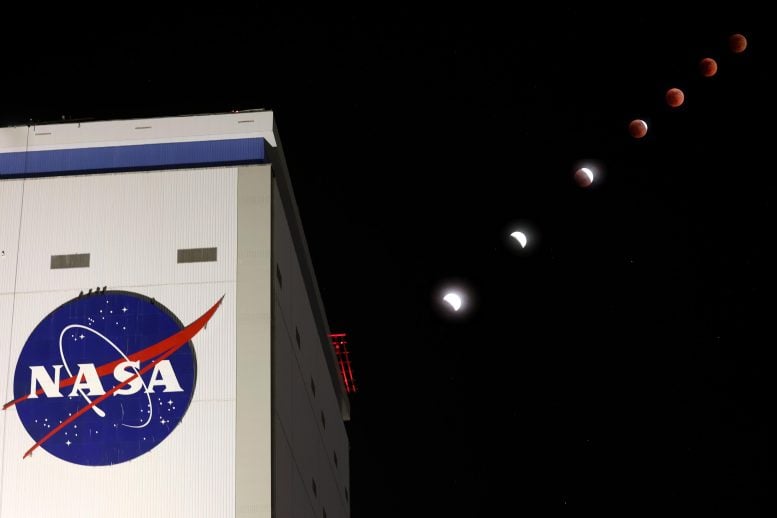
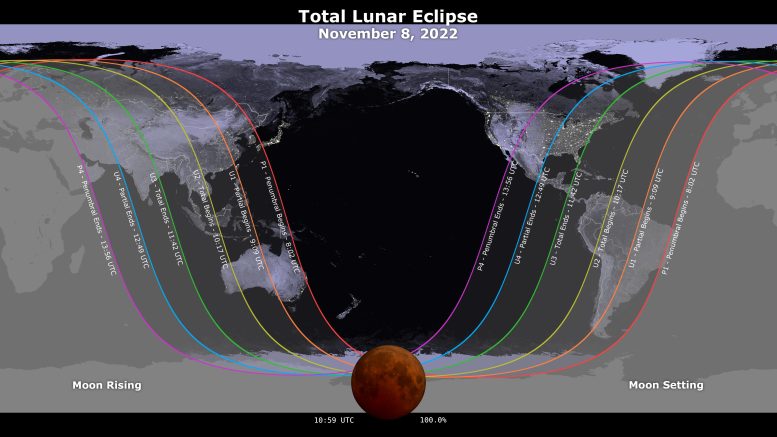
On November 8, stargazers will have the opportunity to view a total lunar eclipse for the second time in 2022. At least a portion of the phenomenon will be visible throughout eastern Asia, Australia, the Pacific, and North America. The most recent total lunar eclipse took place in May.
Total lunar eclipses occur approximately once every 1.5 years on average, according to Alphonse Sterling, an astrophysicist from NASA’s Marshall Space Flight Center in Huntsville, Alabama. While the Moon has been providing generous eclipse viewing opportunities this year, viewers should take advantage of November’s eclipse because the next total lunar eclipse will not occur until 2025.
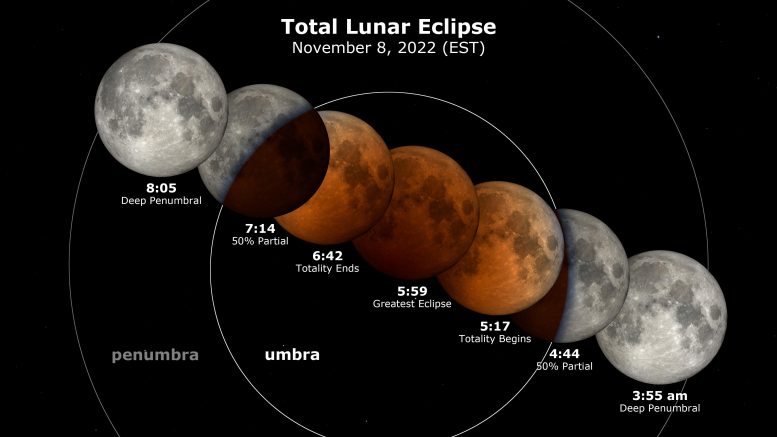
A total lunar eclipse occurs when Earth casts a complete shadow – called an umbra – over the Moon. Earth’s shadow is categorized into two parts: the umbra, the innermost part of the shadow where direct light from the Sun is completely blocked, and the penumbra, the outermost part of the shadow where the light is partially blocked.
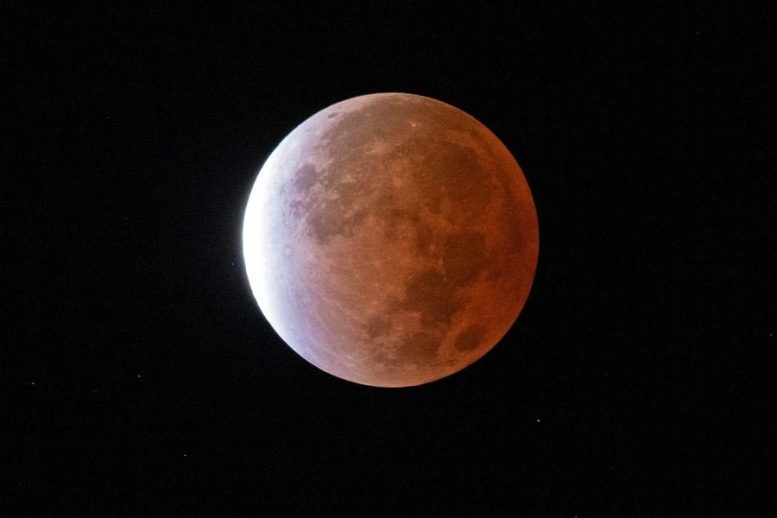
When the Moon is within the umbra, it will turn a reddish hue. Lunar eclipses are sometimes called “Blood Moons” because of this phenomenon. The full moon in November is known as the Beaver Moon (also called the Frost or Frosty Moon, or the Snow Moon), making this a “Beaver Blood Moon.”
During a total lunar eclipse, the Moon and the Sun are on opposite sides of Earth. Many people wonder why lunar eclipses don’t happen every month given the Moon completes an orbit around Earth every 27 days. The reason is that the Moon’s orbit around Earth is tilted relative to Earth’s orbit around the Sun, so the Moon often passes above or below Earth’s shadow. Lunar eclipses are only possible when the orbits align so that the Moon is directly behind Earth relative to the Sun.
For North America, the action will start in the early hours of the morning on November 8. The partial eclipse will begin at 3:09 a.m. CST, with totality beginning at 4:16 a.m. and ending at 5:42 a.m. Then, the partial phase will resume, lasting until 6:49 a.m. Those in the eastern part of the United States will miss most or all of the last partial phase because the Moon will set during totality or shortly after totality ends.
Another feature of a total lunar eclipse is the Moon’s red hue during totality. The red color occurs because of the refraction, filtering, and scattering of light by Earth’s atmosphere. The scattering is a phenomenon called Rayleigh scattering – named after the 19th-century British Physicist Lord Rayleigh.
Rayleigh scattering is also the reason for red sunrises and sunsets. Light from the Sun collides into the gases of Earth’s atmosphere and because of its shorter wavelength, blue light is filtered out, but red light is not easily scattered because of its longer wavelength. Some of that red light is refracted, or bent, as it passes through Earth’s atmosphere and ends up shining on the Moon with a ghostly red light. The degree of redness of a fully eclipsed Moon can be influenced by atmospheric conditions resulting from volcanic eruptions, fires, and dust storms.
But what does Earth look like from the Moon’s perspective during a lunar eclipse? According to Mitzi Adams, astrophysicist at Marshall, astronauts on the Moon during a total lunar eclipse would see a red ring around a silhouetted Earth. As NASA works to establish a permanent human presence on the Moon through the Artemis program, it’s fascinating to consider how Earthlings will experience astronomical events away from their home planet.
No special eye protection is needed for viewing a lunar eclipse, unlike solar eclipses (which occur during the daytime). While the lunar eclipse can be observed with the unaided eye, a pair of binoculars or a telescope can enhance the view.
Sterling says a fun activity for those who stargaze with family or friends is to discuss who notices the reddish hue of totality first and how it progresses throughout the eclipse.
Gain more understanding of lunar eclipses, learn about NASA’s observations of eclipses, and inspire young stargazers with activities and information.
Finally, if you want to know what else is happening as you watch the skies in November, check out Jet Propulsion Laboratory’s latest “What’s Up” video:
A total lunar eclipse brings some magic to the morning sky on November 8th, and the Leonid meteors peak after midnight on November 18th, with some glare from a 35% full moon. In addition, enjoy pretty views on other days in November when the Moon visits planets Mars and Saturn, and bright star Spica. Credit: NASA/JPL
Happy skywatching!
Never miss a breakthrough: Join the SciTechDaily newsletter.
Follow us on Google and Google News.
2 Comments
YAY Give me the Beaver!! Last time for another two years? I might as well be married.
“… making this a ‘Beaver Blood Moon.’”
Because a “Beaver Moon” occurs every year, but this is a special type, it should more properly be called a “Blood Beaver Moon.”