
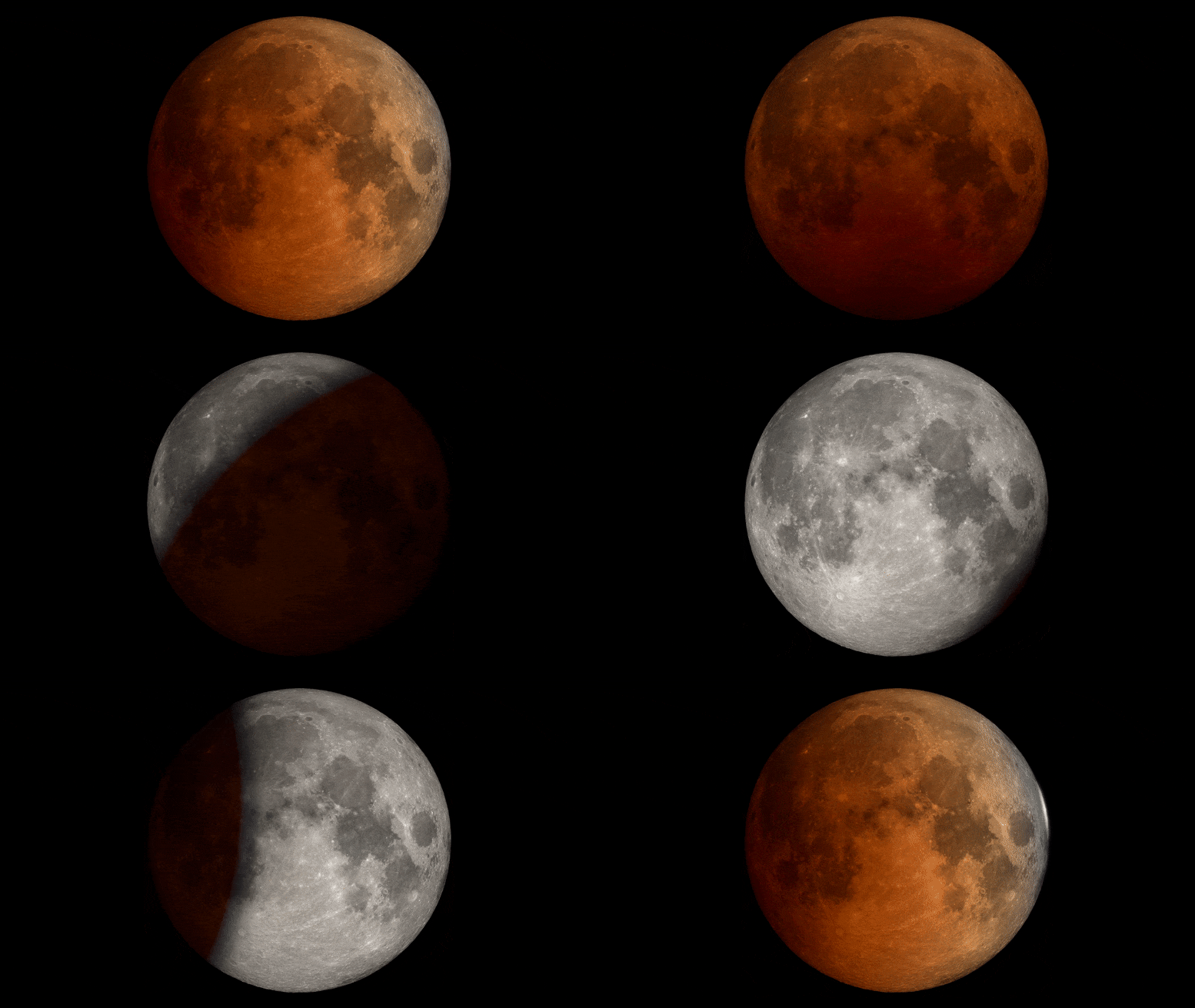
The Moon goes all red, plus Leonid meteors!
The Leonids will battle against moonlight this year, but anyone with a view of the Moon in the morning on November 8 can enjoy a lunar eclipse.
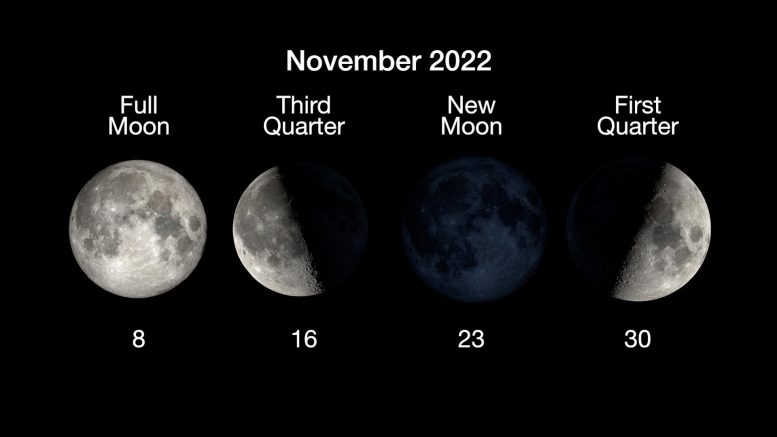
- November 8 – Full moon
- November 8 – Total lunar eclipse in the hours before sunrise
- November 11 – The Moon appears directly between Mars and bright blue-white star Elnath in the west before sunrise
- November 20 – In the hour before sunrise, find the crescent Moon above bright star Spica in the southeast
- November 18 – Look straight overhead for Leonid meteors after midnight. The Moon is about 35% full, and will diminish the fainter meteors.
- November 23 – New moon
- November 28 – The crescent Moon hangs beneath Saturn in the southwest after sunset
- All month – The Leonid meteor shower is active throughout November, and peaks between midnight and dawn on the 18th.
What’s Up for November? A lunar eclipse, the moon and planets, and the Leonid meteors.
A total lunar eclipse is on the way, to provide a little celestial magic, early on the morning of November 8th. The eclipse will be visible to viewers in North America, the Pacific region, Australia, and Eastern Asia – anywhere the Moon is above the horizon while the eclipse is happening.
The Moon moves right to left, passing through the penumbra and umbra, leaving in its wake an eclipse diagram with the times at various stages of the eclipse. The penumbra is the part of the Earth’s shadow where the Sun is only partially covered by the Earth. The umbra is where the Sun is completely hidden. The planet Uranus is about 3 degrees (six Moon widths) north of the Moon during totality. It’s normally a bit too dim to see with the naked eye, but binoculars and small telescopes reveal it as a small, mint-green dot. Credit: NASA’s Scientific Visualization Studio
For observers in the Eastern time zone of the U.S. and Canada, the partial eclipse begins a little after 4 a.m. It reaches full eclipse at about 5:15 a.m. local time, and the Moon then sets while still in eclipse for you. For observers on the West Coast of North America, that translates to the partial eclipse beginning just after 1 a.m., and reaching full eclipse by about 2:15 a.m. You’ll be able to see the entire eclipse unfold before sunrise, weather permitting, as the Moon exits the dark part of Earth’s shadow (called the umbra) a few minutes before 5 a.m.
During a lunar eclipse, you’ll likely notice that you can see a lot more faint stars, as the usually brilliant full moon dims to a dull red.
During a lunar eclipse, you’ll likely notice that you can see a lot more faint stars, as the usually brilliant full moon dims to a dull red. And during this eclipse, viewers with binoculars can spy an extra treat – the ice giant planet Uranus will be visible just a finger’s width away from the eclipsed Moon.
Check the video map below to find out if the eclipse is visible from your area, and find lots more eclipse info from NASA at moon.nasa.gov.
This animated map shows where the November 8, 2022, lunar eclipse is visible. Contours mark the edge of the visibility region at eclipse contact times. The map is centered on 168°57’W, the sublunar longitude at mid-eclipse. On November 8, 2022, the Moon enters the Earth’s shadow, creating a total lunar eclipse, the first since May. This animation shows the region of the Earth where this eclipse is visible. This region shifts to the west during the eclipse. Observers near the edge of the visibility region may see only part of the eclipse because for them, the Moon sets (on the eastern or right-hand edge) or rises (on the western or left-hand edge) while the eclipse is happening. Contour lines mark the edge of the visibility region at the contact times. These are the times when the Moon enters or leaves the umbra (the part of the Earth’s shadow where the Sun is completely hidden) and penumbra (the part where the Sun is only partially blocked). For observers located on a contour line, the contact occurs at moonrise (west) or moonset (east). Credit: NASA’s Scientific Visualization Studio
In the pre-dawn hours of November 11th, you’ll find the Moon directly between Mars and the bright bluish-white star Elnath. Elnath is the second brightest star in the constellation Taurus, after reddish Aldebaran, and it forms the northern horn of the bull. You’ll find that Elnath is about the same brightness as the star Bellatrix in nearby Orion, where it forms one of the hunter’s shoulders.
On November 20th, in the hour before sunrise, look toward the southeast to find a slim, crescent Moon hanging right above the bright bluish star Spica. It’s a giant star, 10 times the mass of our Sun, and 12,000 times more luminous. Fortunately for us, it’s located 260 light-years away from Earth.
And in the evening sky, on November 28th, a beautiful crescent Moon hangs beneath Saturn in the south after sunset.
The Leonid meteor shower is active throughout November. It peaks after midnight on the 18th, with something like 15 to 20 meteors per hour under clear, dark skies.
On the peak night for the Leonids this year, the Moon will be about 35% full, meaning it will interfere with your ability to see the fainter meteors.
The shower’s name comes from the constellation Leo, the lion, from which its meteors appear to radiate. The meteors are dusty bits of debris left behind by comet Tempel-Tuttle as it orbits the Sun. This comet was actually discovered twice, independently.
On the peak night for the Leonids this year, the Moon will be about 35% full, meaning it will interfere with your ability to see the fainter meteors. However, Leonid meteors are often bright, with trails (also called trains) that persist for a couple of seconds after they streak across the sky.
And while the Moon will be rising in the east with Leo around midnight local time, it’s actually better to view the sky away from the meteors’ apparent point of origin, by lying back and looking straight upward, as any meteor trails you see will appear longer and more spectacular.
Here are the phases of the Moon for November.
Stay up to date with all of NASA’s missions to explore the solar system and beyond at nasa.gov. I’m Preston Dyches from NASA’s Jet Propulsion Laboratory, and that’s What’s Up for this month.
Never miss a breakthrough: Join the SciTechDaily newsletter.
Follow us on Google and Google News.
11 Comments
Great article! Thank you!
Tanks
Interesting and informative article. Thanks!
THIS IS A ARMY AIR DEFENSE POST.
On January 5, 1995 at 2105hr a carrier aircraft landed in woods near the town of Sumner, Washington.
The next 25 days many people saw small ships craft left ALL IS WELL.
RECOMMENDATIONS:
APPOINTMENT OF A AMBASSADOR TO THEM.
THE AMBASSADOR WILL DO PUBLIC RELATIONS FOR THE PEOPLE AND TELL THEM TO KEEP THEIR WEAPONS NOT LOADED.
One of them UFO experts that is on the government payroll would make a good Ambassador.
These are changing times the people have every right to know!
Call our Agents names to make this not true will not work!
The need to know order was lifted on June 12, 2011.
Very Awesome NASA
Definitely very interesting all the time for me. Amazing night sky..
I love all the planets, like Uranus you show me.
Altho the clouds were thick with some rain I. Menifee, Can. Tonight. We just finished watching the eclipse we actually saw the very end of it due to cloud cover at about 2:13-2:15AM. Always awesome. Lots of meteors only seen on our phone app of the sky not by naked eye. Altogether very cool.
Hey now, that sure does sound like a hole lotta fun! I think I wanna see Uranus too!
Also, Patrick, if that happened way back in ’95…why are u just now wanting to start a party to check it out? Don’t u think they might’ve prolly bailed by now bubba?? 🤪
Thanks for your guidance between lust n love…. Some people can’t find their true love forever but your motivational blogs help them to live happily forever…
May God bless u n your family… Ameeen
I would like to thnkx for the efforts you’ve put in writing this website. I’m hoping the same high-grade website post from you in the upcoming as well. Actually your creative writing abilities has encouraged me to get my own web site now. Really the blogging is spreading its wings quickly. Your write up is a great example of it.