
This April, the skies put on a dazzling show – watch planets like Jupiter, Venus, and Mars glide across morning and evening skies, catch the Lyrid meteor shower lighting up the night, and explore a stunning “city of stars” with the ancient globular cluster M3. Whether you’re a casual stargazer or a telescope pro, there’s something for everyone to enjoy.
Following a planet-free morning sky in March, April brings planets back to your mornings, as well as the evening sky. Also look for Lyrid meteors, and hunt for the “faint fuzzy” wonder that is the distant and ancient city of stars known as globular cluster M3.
April (Meteor) Showers and See a City of Stars!
Enjoy a month full of skywatching opportunities! Look for bright planets in both the morning and evening skies, catch the Lyrid meteor shower mid-month, and search for a distant, ancient “faint fuzzy” known as M3 – a spectacular globular cluster sometimes called a “city of stars.”
Skywatching Highlights
All Month – Planet Visibility:
- Mercury: Briefly visible in the second half of April, extremely low in the eastern sky just before sunrise.
- Venus: Now a morning object, rising low in the east during the hour before dawn.
- Mars: Easy to spot after dark all month, glowing reddish and high overhead. Sets a couple of hours after midnight.
- Jupiter: Bright in the western sky after sunset, setting a few hours later.
- Saturn: Visible before sunrise in the last half of April, low in the east just below Venus.
Daily Highlights:
April 1 & 30 – Jupiter & Crescent Moon: Find the charming pair in the west as the sky darkens, setting about 3 hours after sunset.
April 4 & 5 – Mars & Moon: The Moon, around its first quarter phase, appears near Mars in the sky for two nights.
April 24-25 – Grouping of the Moon & Three Planets: Find Venus, Saturn, and the crescent moon gathered low in the east as dawn warms the morning sky. Mercury is also visible below them for those with a clear view to the horizon.
All month – Venus: Earth’s hothouse twin planet has made the shift from an evening object to a morning sight. You’ll notice it rising low in the east before dawn, looking a little higher each morning through the month.
All month – Mars: Looking bright and reddish in color, Mars is visible high overhead after dark all month. At the start of the month it lies along a line with bright stars Procyon and Pollux, but you’ll notice it moves noticeably over the course of April (~12 degrees or the width of your outstretched fist at arm’s length).
Video Transcript
What’s Up for April? Planets at dusk and dawn, April showers, and observing a distant city of stars.

First up, in the evening sky, we begin and end the month with Jupiter and the crescent Moon shining brightly together in the western sky as sunset fades. On both April 1st and 30th, you can find the charming pair about half an hour after sunset, setting about 3 hours later.
Mars is high overhead in the south on April evenings. At the start of the month, it’s directly in between bright stars Procyon and Pollux, but it moves noticeably during the month. You’ll find the first-quarter moon right next to Mars on April 4th and 5th.
Moving to the morning sky, Venus has now made the switch from an evening object to a morning one. You may start to notice it rising low in the east before dawn, looking a little higher each morning through the month.

Around April 24th and 25th, you’ll find Venus, Saturn, and the crescent moon gathered low in the east as dawn warms up the morning sky. Those with a clear view to the horizon might also pick out Mercury looking bright, but very low in the sky.
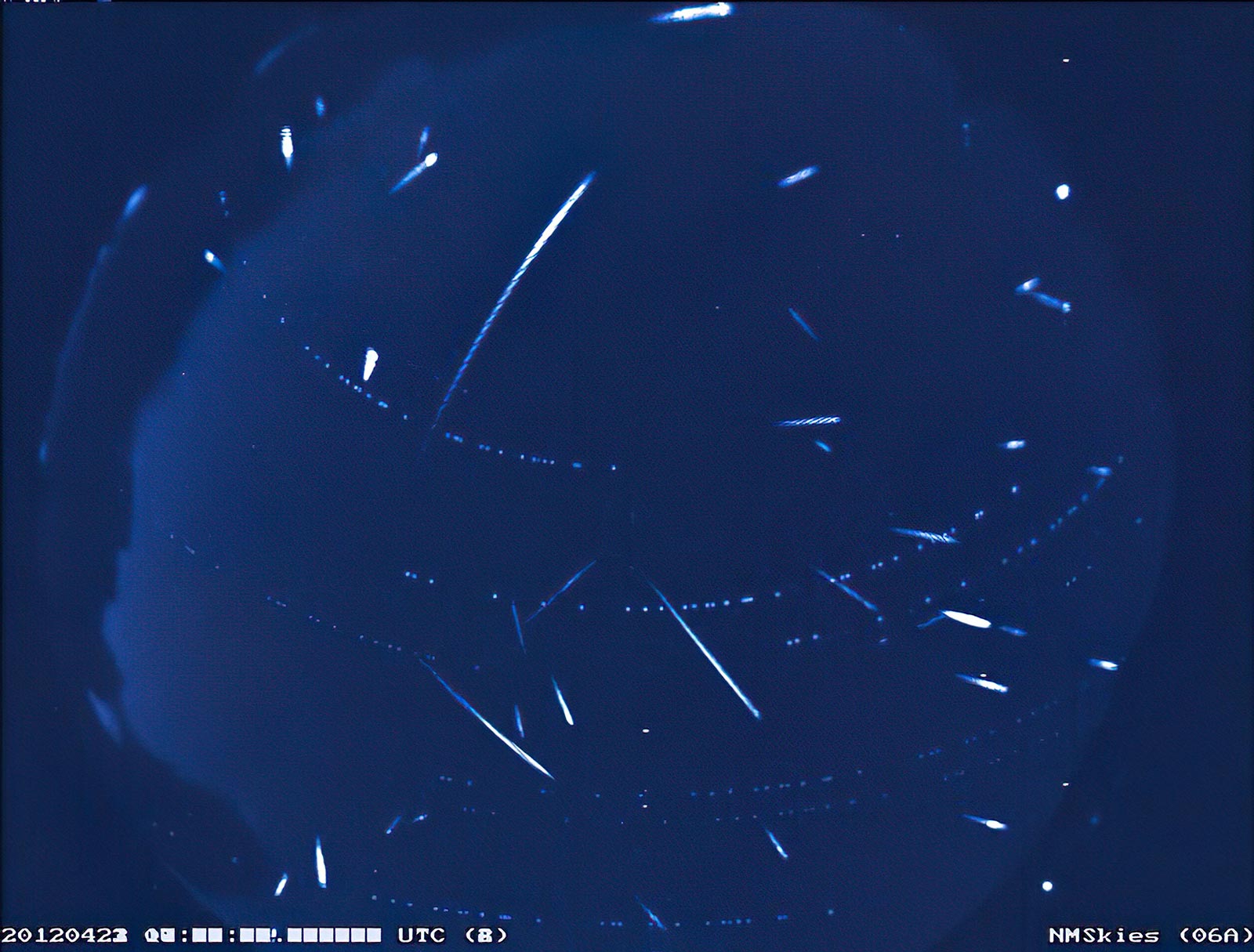
April brings shooting stars as Earth passes through one the streams of comet dust that create our annual meteor showers. The Lyrids are a modest meteor shower that peaks overnight on April 21st and into the morning of the 22nd. You can expect up to 15 meteors per hour near the peak under dark skies.
The Lyrids are best observed from the Northern Hemisphere, but can be seen from south of the equator as well. View them after about 10:30 p.m. local time until dawn, with the best viewing around 5 a.m. The waning crescent moon will rise around 3:30 a.m., but at only 27% full, it shouldn’t interfere too much with your meteor watching. For the best experience, face roughly toward the east, lie down in a safe, dark place away from bright lights, and look straight overhead. Meteors can appear anywhere in the sky, and some Lyrids can leave bright trails that last for a few seconds after they’ve passed.
NASA studies meteors from the ground, in the air, and from orbit to forecast meteor activity and protect spacecraft, and to understand the composition of comets and asteroids throughout our solar system.

April offers a chance to observe a truly distant wonder – a globular cluster known as “M3.” It’s a vast collection of stars that lies 34,000 light-years from Earth in our galaxy’s outer reaches. Astronomer Charles Messier discovered this object in 1764, while searching for new comets. Realizing it wasn’t one, he added it to his list of interesting objects that were not comets, which today we know as Messier’s catalog.
Through binoculars, Messier 3, or M3, appears as a small, fuzzy, star-like patch of light. With a small telescope, you’ll see a more defined glow with a slightly grainy texture. And with telescopes 8 inches or larger, the cluster begins to resolve into hundreds of individual stars.
Now, globular clusters contain some of the oldest stars in the universe, often over 10 billion years old. Unlike open clusters like the Pleiades, which sit within the Milky Way’s spiral arms, globular clusters are found in the galaxy’s halo, orbiting far above and below the Milky Way’s disk. Our galaxy has around 150 confirmed globular clusters. M3 itself is probably 11 to 13 billion years old and contains around half a million stars. And it’s relatively easy to spot in April under dark skies with binoculars or a small telescope.
Finding M3 starts with the Big Dipper. Facing east, use the Dipper’s handle to “arc to Arcturus,” the fourth-brightest star in the night sky. From there, look higher in the sky to find the star Cor Caroli located here to the west of the Dipper’s handle. It’s about as bright as this star in the Dipper’s cup. M3 is located roughly a third of the way from Arcturus to Cor Caroli. With binoculars or a finder scope, sweep within this area until you spot a faint, round glow.
M3 is an excellent target for beginners and seasoned observers alike. Whether using binoculars or a telescope, you’ll be rewarded with a view of one of the oldest objects in our galaxy.

Above are the phases of the Moon for April.
Never miss a breakthrough: Join the SciTechDaily newsletter.
Follow us on Google and Google News.
3 Comments
Great
Thanks for the update!
I’m located in Andalucia Spain.
Intressant artikel.
Peace. Odd on march 31st with venus setting behind and north of the sun 7hrs later it rose south and way in front of the sun. Venus rose early October wY south while the sun was marching towards the winter solstice. Then back north while Venus marched north then west the entire Time. Who ever taught you Demon AI’s Decieving to rule masses waS Good? Oh never mind I just answered my own question Freemason wannabe’s. 💩✌️