
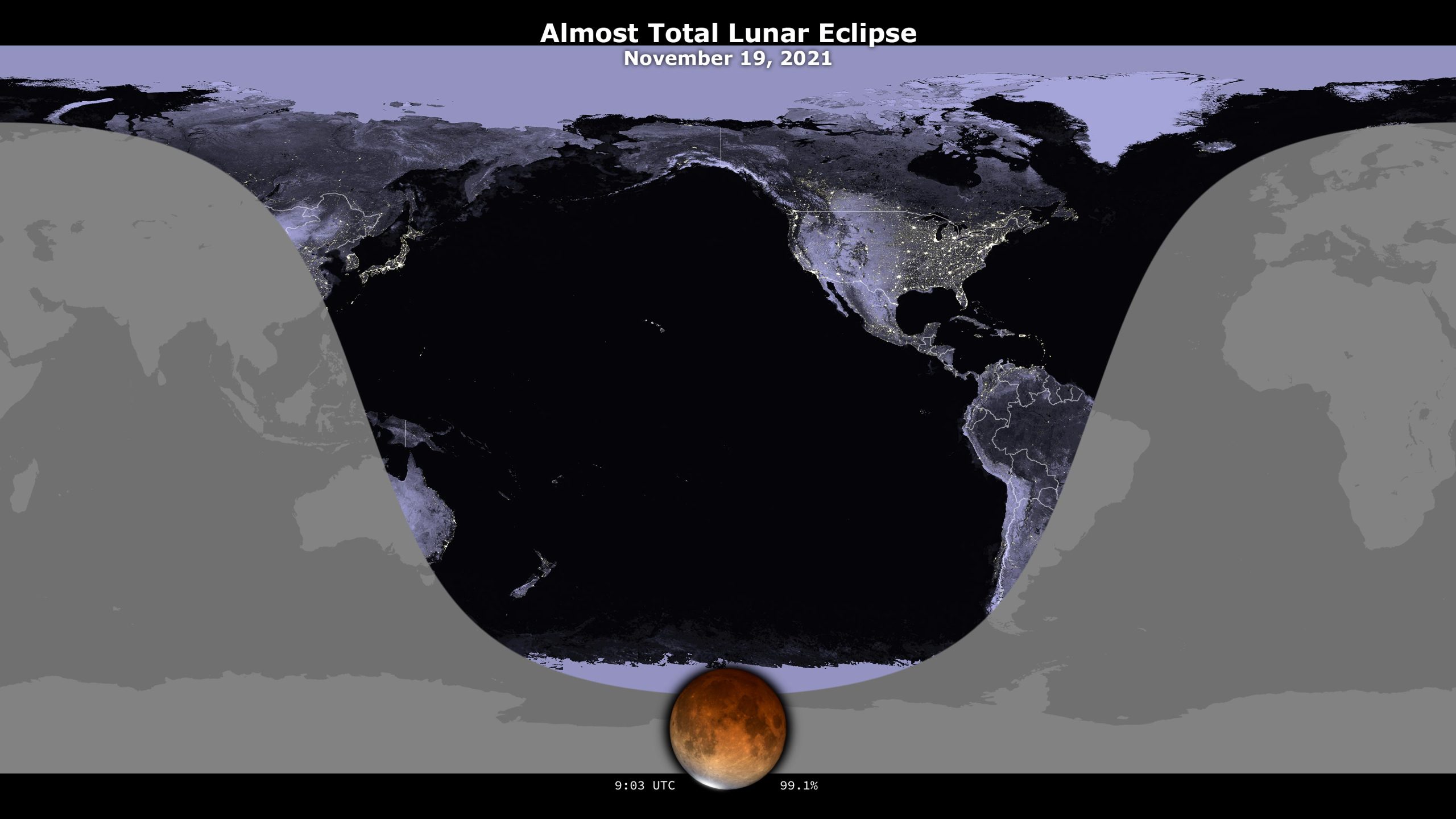
On November 19, 2021 (late evening of the 18th in some time zones), the Moon passes into the shadow of the Earth, creating a partial lunar eclipse so deep that it can reasonably be called almost total. Credit: NASA’s Scientific Visualization Studio
What is an “almost total” lunar eclipse?
A lunar eclipse occurs when the Sun, Earth, and Moon align so that the Moon passes into Earth’s shadow. In a total lunar eclipse, the entire Moon falls within the darkest part of Earth’s shadow, called the umbra. In this eclipse, up to 99.1% of the Moon’s disk will be within Earth’s umbra.
How can I observe the eclipse?
The best viewing will be right around the peak of the eclipse, on November 19th at 9:03 UTC/4:03 AM EDT/1:03 AM PDT. This part of the eclipse is visible in all of North America, as well as large parts of South America, Polynesia, eastern Australia, and northeastern Asia.
What can I expect to observe?
All times are in UTC on November 19, 2021.
| 6:02 | Penumbral eclipse begins | The Moon enters the Earth’s penumbra, the outer part of the shadow. The Moon begins to dim, but the effect is quite subtle. |
| 7:19 | Partial eclipse begins | The Moon begins to enter Earth’s umbra and the partial eclipse begins. To the naked eye, as the Moon moves into the umbra, it looks like a bite is being taken out of the lunar disk. The part of the Moon inside the umbra will appear very dark. |
| 8:45 | Red color becomes visible | More than 95% of the Moon’s disk is in the umbra and the Moon will appear red. The color might be easier to see in binoculars or a telescope. Using a camera on a tripod with exposures of several seconds will bring out the color, at the expense of overexposing the lit part of the Moon. |
| 9:03 | Eclipse peak | The peak of the eclipse occurs at 9:03 UTC. This is the best time to see the red color. |
| 9:20 | Red color no longer visible | The redness fades as less than 95% of the Moon is in the Earth’s umbra. It appears that a bite is taken out of the opposite side of the Moon from earlier. |
| 10:47 | Partial eclipse ends | The whole Moon is in Earth’s penumbra, but again, the dimming is subtle. |
| 12:04 | Penumbral eclipse ends | The eclipse is over. |
What else can I see tonight?
During the eclipse, the Moon moves through the western part of the constellation Taurus. The Pleiades star cluster is to the upper right, and the Hyades cluster ― including the bright star Aldebaran, eye of the bull ― is in the lower left. Here are some more skywatching tips for the month of November.
Why does the Moon turn red during a lunar eclipse?
The same phenomenon that makes our sky blue and our sunsets red causes the Moon to turn red during a lunar eclipse. It’s called Rayleigh scattering. Light travels in waves, and different colors of light have different physical properties. Blue light has a shorter wavelength and is scattered more easily by particles in Earth’s atmosphere than red light, which has a longer wavelength. Red light, on the other hand, travels more directly through the atmosphere. When the Sun is overhead, we see blue light throughout the sky. But when the Sun is setting, sunlight must pass through more atmosphere and travel farther before reaching our eyes. The blue light from the Sun scatters away, and longer-wavelength red, orange, and yellow light passes through.

During a lunar eclipse, the Moon turns red because the only sunlight reaching the Moon passes through Earth’s atmosphere. The more dust or clouds in Earth’s atmosphere during the eclipse, the redder the Moon will appear. It’s as if all the world’s sunrises and sunsets are projected onto the Moon.
Never miss a breakthrough: Join the SciTechDaily newsletter.
Follow us on Google and Google News.
21 Comments
UTC = No one knows what the hell you’re talking about without Googling it.
Wow.
Let me guess. GED?
What a wonderful time to be alive. Just Google it!
We aren’t in daylight time in November
Your times are wrong. Should be standard time.
It also listed PDT and EDT. You want them to list every time zones?
Just curious what times should we see it down here in texas??
Headline should have indicated this applied to USA only if not visible from UK the information is of limited use.
An almost total eclipse that will be clearly visible to almost nobody awake at that time.
November 19 is standard time! I’m in central standard time. When will I see it????? If you give me any standard time I can figure out when I can see it. I’m too old to try to figure it out of a daylight time.
Great article. Correction for the penultimate sentence: clouds have big (water) particles and scatter all wavelengths nearly equally, hence they are white — this is Mie scattering. The light reaching the moon during the eclipse will pass thru the clear atmosphere (small particles, ie molecules) and the blue end of the spectrum will scatter out leaving the red end to illuminate the moon — Rayleigh scattering does this. More dust and clouds would make the moon more white but way up in the atmosphere there is not so much dust and clouds so largely it’s red light that passes thru earth’s atmosphere to the moon and the blue light is Rayleigh scattered out.
Thank u for ur info since everyone else is so negative. This is whats wrong with out country. Just sad so thank you and I will be figuring out my time here in Delaware and even if I dont see I can say I was there
Seth: A lot of astronomical phenomena have to be at night, which is why I’m up at night and sleep during the day. But then I miss eclipses of the sun.
Nikvau: You shouldn’t be so negative about people’s negativity! You’re just adding to the problem! Actually, your negativity is meta-negativity, since it’s about negativity. And I’m guilty of meta-meta-negativity. Cool, huh?
What time can we see this in Indian? Don’t want to miss it.
Meant what time can we see this in Indiana? I love watching meteor showers & things like this. So please someone let me know. Thank you for your time.
4:03 AM EDT will be the peak time.
UTC 903 is 403 EST It is EST +5 hours if it was daylight savings time it would be +4 same as western Atlantic time
UTC 903 is 403 EST It is EST -5 hours if it was daylight savings time it would be -4 same as western Atlantic time
I saw Red moon a few days ago here in Northern part of Nigeria, I wish I took a picture ,it was a wonderful .
UTC is just what they call GMT (Greenwich Meridian Time) these days. Basically, it’s British time, and if you’re west of Britain you’ll need to subtract so many hours from that time to get it in your own time zone (EST in North America is UTC -5 hours, for example, so five hours earlier than they say for UTC); and if you’re east of England then you’ll be adding hours instead.