
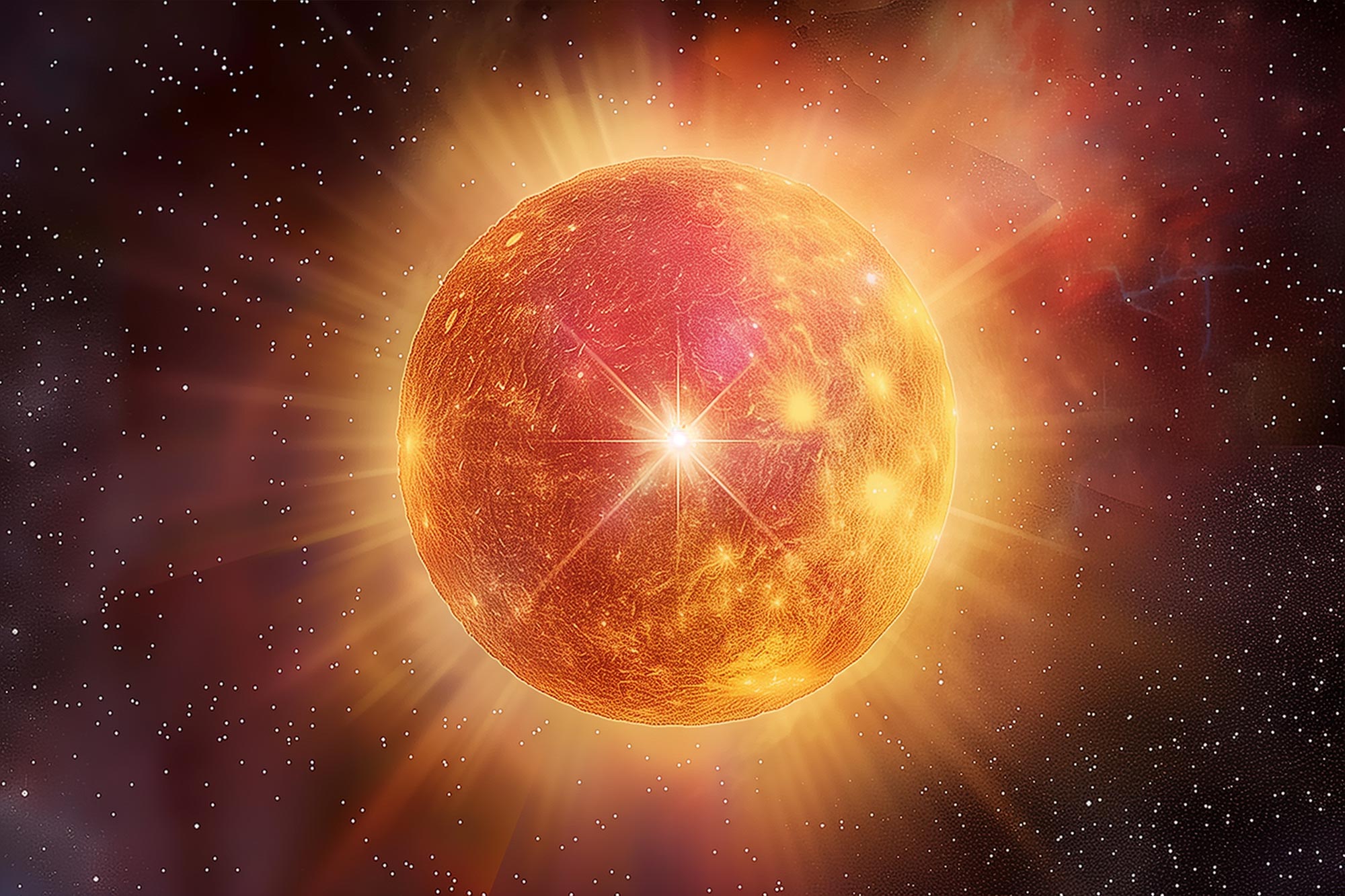
New findings indicate that Betelgeuse’s fluctuating brightness, previously thought to signal its imminent explosion, is caused by a companion star that affects its light visibility by clearing cosmic dust.
Betelgeuse, the 10th-brightest star in the night sky, might not be on the verge of exploding as a supernova, according to a new study of the star’s fluctuating brightness. Instead, recent research suggests that the pulsing of Betelgeuse’s starlight is likely due to the presence of an unseen companion star orbiting it.
This companion, informally dubbed “Betelbuddy” by astrophysicist Jared Goldberg, is officially known as Alpha Ori B. As it orbits Betelgeuse, it acts like a snowplow, clearing away dust that normally blocks some of the light, temporarily making Betelgeuse appear brighter. Goldberg and his team have detailed their simulations of this process in a paper soon to be published in The Astrophysical Journal.
“We ruled out every intrinsic source of variability that we could think of as to why the brightening and dimming was happening in this way,” says Goldberg, the study’s lead author and a Flatiron research fellow at the Flatiron Institute’s Center for Computational Astrophysics. “The only hypothesis that seemed to fit is that Betelgeuse has a companion.”
Goldberg co-authored the study with Meridith Joyce of the University of Wyoming and László Molnár of Konkoly Observatory at the HUN-REN Research Centre for Astronomy and Earth Sciences in Hungary.

Uncovering the ‘Betelbuddy’
Betelgeuse is a red giant star around 100,000 times the brightness of our sun and more than 400 million times the volume. The star is nearing the end of its life span, and when it dies, the resulting explosion will be bright enough to see during the day for weeks.
Astronomers can predict when Betelgeuse will die by effectively ‘checking its pulse.’ It’s a variable star, meaning it gets brighter and dimmer, pulsing like a heartbeat. In Betelgeuse’s case, there are two heartbeats: one that pulses on a timescale a little longer than a year, and one that pulses on a timescale of about six years.
One of these heartbeats is Betelgeuse’s fundamental mode, a pattern of brightening and dimming that’s intrinsic to the star itself. If the star’s fundamental mode is its long-scale heartbeat, then Betelgeuse could be ready to blow sooner than expected. However, if its fundamental mode is its short-scale heartbeat, as several studies suggest, then its longer heartbeat is a phenomenon called a long secondary period. In that case, this longer brightening and dimming would be caused by something external to the star.

Solving a Stellar Mystery
Scientists still don’t know for sure what causes long secondary periods, but one leading theory is that they arise when a star has a companion that circles it and barrels through the cosmic dust that is produced and expelled by the star. The displaced dust alters how much starlight reaches Earth, changing the star’s apparent brightness.
The researchers explored whether other processes may have caused the long secondary period, such as the churning of the star’s interior or periodic changes in the star’s powerful magnetic field. After combining data from direct observations of Betelgeuse with advanced computer models that simulate the star’s activity, the team concluded that the Betelbuddy is by far the most likely explanation.
“Nothing else added up,” Goldberg says. “Basically, if there’s no Betelbuddy, then that means there’s something way weirder going on — something impossible to explain with current physics.”
The team has yet to determine exactly what the Betelbuddy is, but they assume it’s a star of up to twice the sun’s mass.
“It is difficult to say what the companion actually is beyond providing mass and orbital constraints,” says Joyce. “A sunlike star is the most probable type of companion, but that is by no means conclusive.”
“A more exotic hypothesis I personally like, though the opinions of my co-authors may differ, is that the companion is a neutron star — the core of a star that has already gone supernova,” she says. “However, in that case, we would expect to see evidence of this with X-ray observations, and we haven’t. I think we should look again.”

Future Endeavors in Star Research
Next, the team will play paparazzi, trying to snap images of the Betelbuddy with telescopes, as there will be a potential window of visibility around December 6.
“We need to confirm that Betelbuddy actually exists, since our result is based on inference, not on direct detection,” says Molnár. “So we’re working on observation proposals now.”
The researchers note that this study was only possible through team science.
“Without each of us considering this problem from very different angles — László as an expert in space-based observations and data analysis, Jared as someone who studies and simulates massive stars, and myself as a 1D modeler — the work wouldn’t have been possible,” says Joyce. “I want to thank the Flatiron Center for Computational Astrophysics in particular for creating an environment in which pulling together such a diverse range of scientists is possible.”
The team is also excited to have new information about a long-studied celestial body.
Betelgeuse “has been the target of countless studies since the dawn of modern astrophysics,” says Molnár. “And yet there’s still room to make significant new discoveries: in this case, a sunlike star hiding in plain sight, in the immense glare of a red supergiant. That is what excites me the most.”
Reference: “A Buddy for Betelgeuse: Binarity as the Origin of the Long Secondary Period in α Orionis” by Jared A. Goldberg, Meridith Joyce and László Molnár, Accepted, The Astrophysical Journal.
DOI: 10.48550/arXiv.2408.09089
Never miss a breakthrough: Join the SciTechDaily newsletter.
Follow us on Google and Google News.
3 Comments
Can you focus on finding the aliens, please?
What a twist, eh?
Now picture this:
They’re not even sure what’s going on with Betelgeuse, a star mere 700 light years away from us, and why it’s been dimming…
…but they’re *sure* that the stars that are billions of light years further away have red hue because of the red shift, and they inferred the whole cosmological model, the “Big Bang”, out of that.
Our twin planet was exploded into the dust and a new star became .. as on earth as it is in heaven , Dust to dust .