
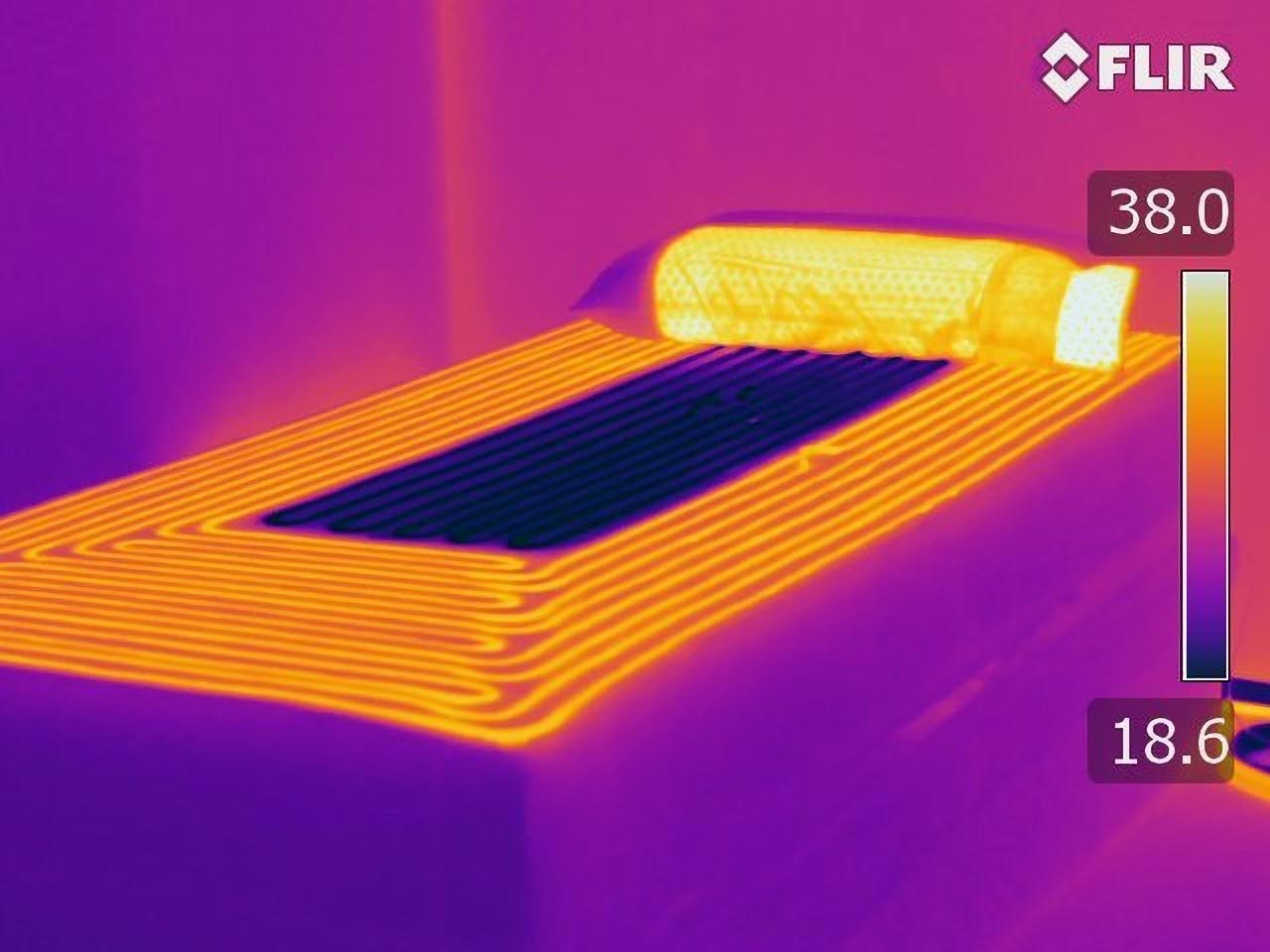
Bioengineers developed a cooling-warming mattress that speeds up sleep onset and enhances sleep quality by regulating body temperature.
Throughout the course of a day, people alternate between feeling alert and sleepy. This sensation is actually controlled in part by the ebb and flow of a 24-hour rhythm of their body temperature. A unique mattress and pillow system that uses heating and cooling to tell the body it is time to go to sleep has now been developed by bioengineers at The University of Texas at Austin.
When the body temperature drops at night as part of the 24-hour cycle, sleep is provoked. With the new mattress, individuals may fall asleep more quickly and have better-quality sleep since it stimulates the body to make them feel drowsy.
Leveraging Skin Sensors for Sleep
“We facilitate the readiness to fall asleep by manipulating internal body temperature-sensitive sensors to briefly adjust the thermostat of the body so it thinks the temperature is higher than it actually is,” said Shahab Haghayegh, a research fellow at Harvard Medical School’s Division of Sleep Medicine and Brigham and Women’s Hospital, who helped lead the development of the mattress at UT Austin while earning a Ph.D. in biomedical engineering. Haghayegh graduated in 2020.
An important bodily thermostat for humans is the skin of the neck. Therefore, it is the primary sensor the mattress targets, by means of a warming pillow. To increase blood flow to dissipate body heat, the engineered mattress is designed to simultaneously cool the central areas of the body while heating up the neck, hands, and feet.
When people feel sleepy or alert, that sensation is controlled in part by the ebb and flow of a 24-hour rhythm of their body temperature. At The University of Texas at Austin, bioengineers have developed a unique mattress and pillow system that uses heating and cooling to tell the body it is time to go to sleep.
In the Journal of Sleep Research, the scientists published a proof-of-concept study about the unique combination warming pillow plus cooling-warming, dual-zone mattress system. It looked at two versions of the mattress: one that uses water and another that uses air to manipulate the core body temperature. They tested the mattresses with 11 subjects. They were asked to go to bed two hours earlier than usual, some nights using the cooling-warming functions of the mattresses and other nights not.
Improved Sleep Quality Through Temperature Control
According to the results, the warming and the cooling-warming mattress helped them fall asleep faster – approximately 58% faster compared with nights when they did not use the cooling-warming function, even in the challenging setting of an earlier bedtime. In addition to drastically reducing the time needed to fall asleep, decreasing internal body temperature also produced significantly improved quality of sleep.
The project arose out of a larger goal in the lab of Kenneth Diller, a professor in the Cockrell School of Engineering and an expert in heat and temperature regulation for therapeutic devices, to find new ways to use thermal stimulation to help people sleep. The researchers published a study in 2019 that found taking a warm bath an hour or two before bed helped people fall asleep quickly and sleep better.
This project is similar but more targeted. Lowering the internal body temperature at the right circadian time sends the signal that it is time to go to sleep. Targeting the important bodily sensors in just a few areas that control heat dissipation, and thus body temperature level, made more sense than focusing on the entire body.
“It is remarkable how effective gentle warming along the cervical spine is in sending a signal to the body to increase blood flow to the hands and feet to lower the core temperature and precipitate sleep onset,” Diller said. “This same effect also enables the blood pressure to fall slightly overnight, with the benefit of allowing the cardiovascular system to recover from the stress of maintaining blood flow during daily activities, which is highly important for long-term health.”
The team of researchers has a patent for the cooling-warming mattress and pillow technology and is seeking partnerships with mattress companies to commercialize it.
Reference: “Novel temperature-controlled sleep system to improve sleep: a proof-of-concept study” by Shahab Haghayegh, Sepideh Khoshnevis, Michael H. Smolensky, Ramon C. Hermida, Richard J. Castriotta, Eva Schernhammer and Kenneth R. Diller, 19 July 2022, Journal of Sleep Research.
DOI: 10.1111/jsr.13662
Other members of the team are Sepideh Khoshnevis and Michael Smolensky of UT Austin, Ramón Hermida of the University of Vigo in Spain, Richard Castriotta of the University of Southern California and Eva Schernhammer of Harvard University.
Never miss a breakthrough: Join the SciTechDaily newsletter.
Follow us on Google and Google News.